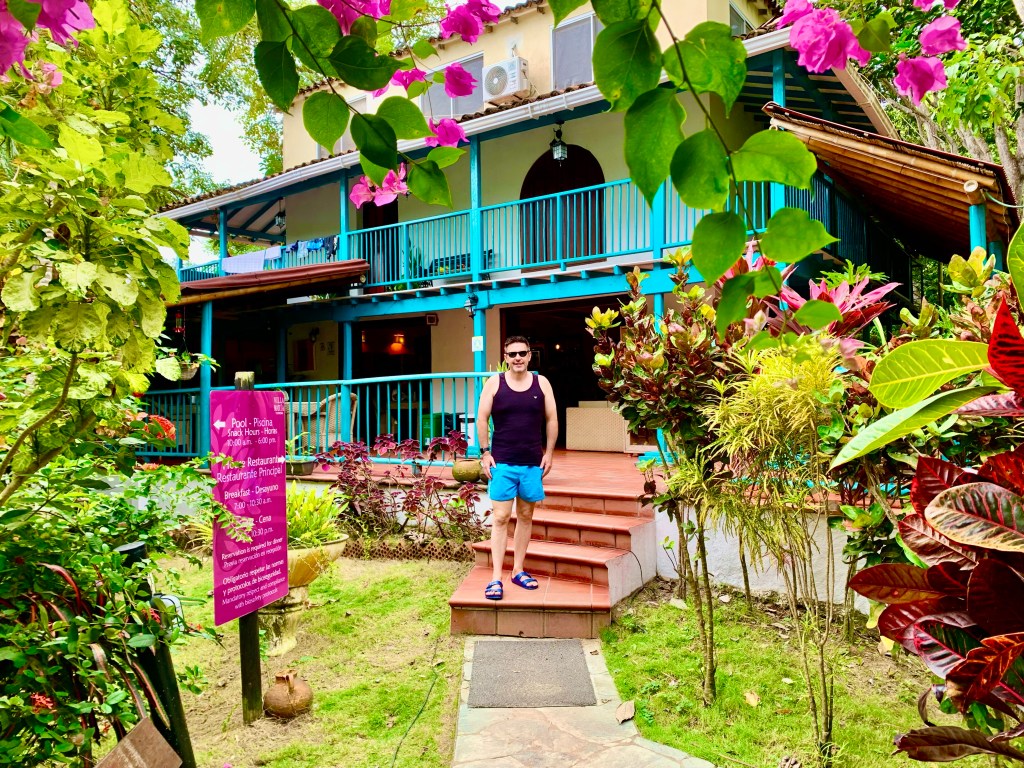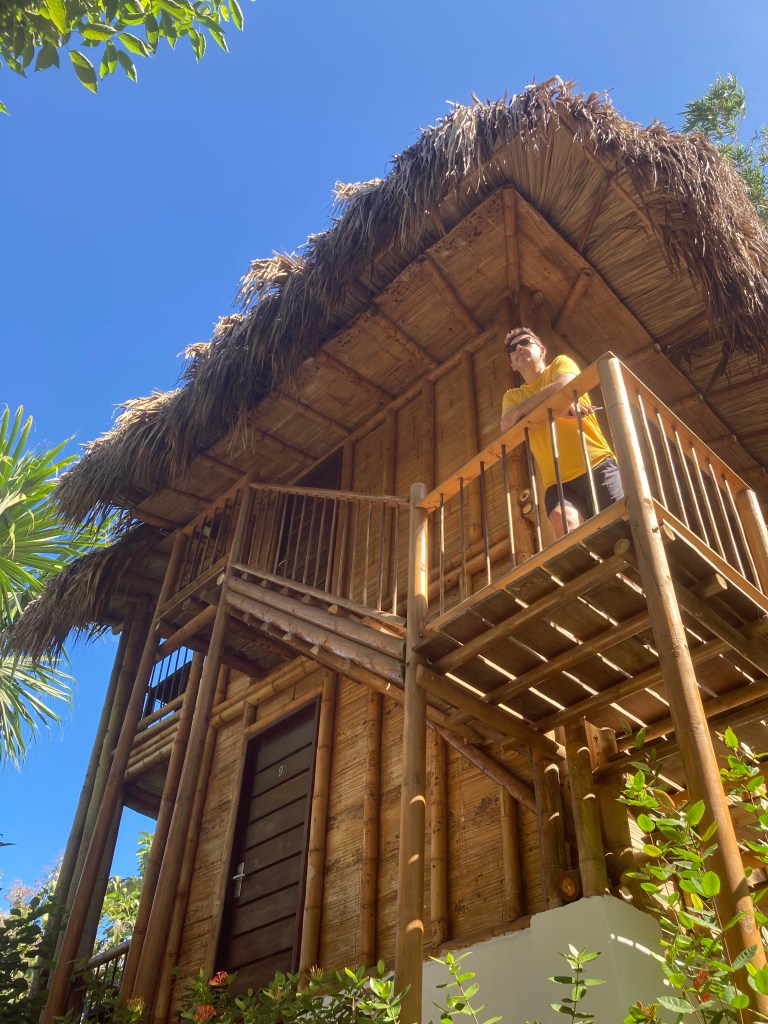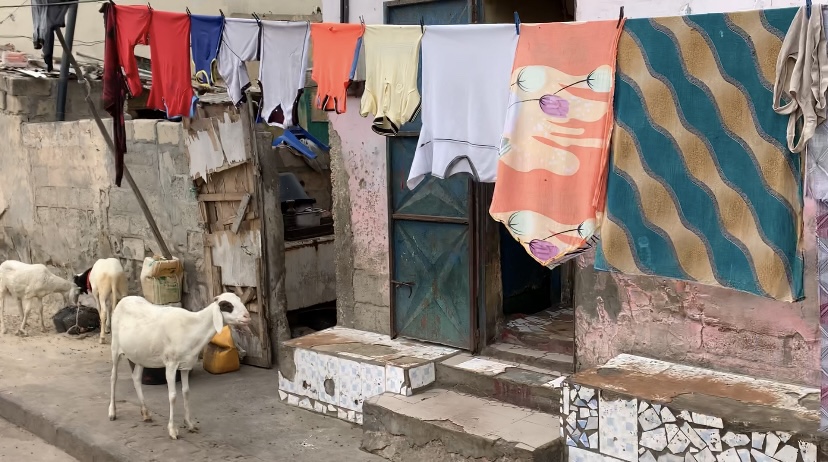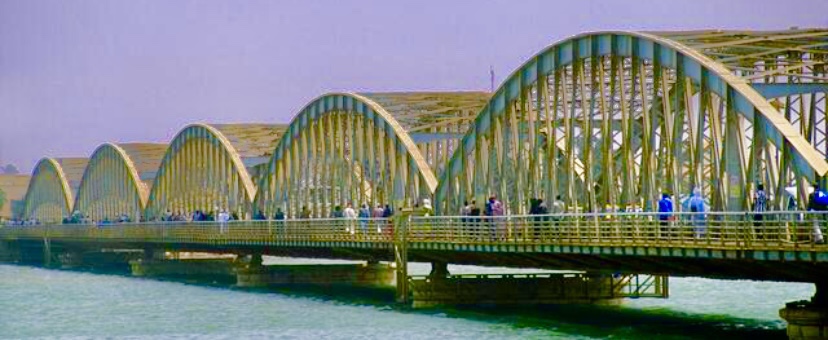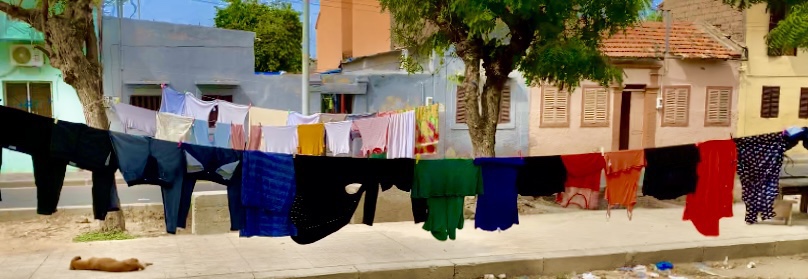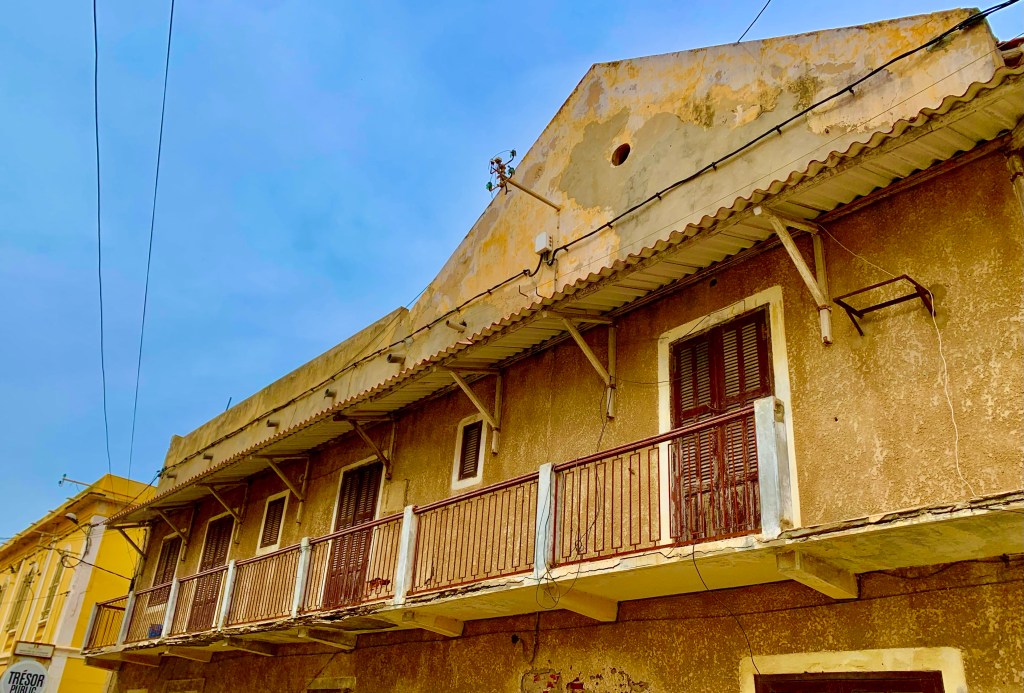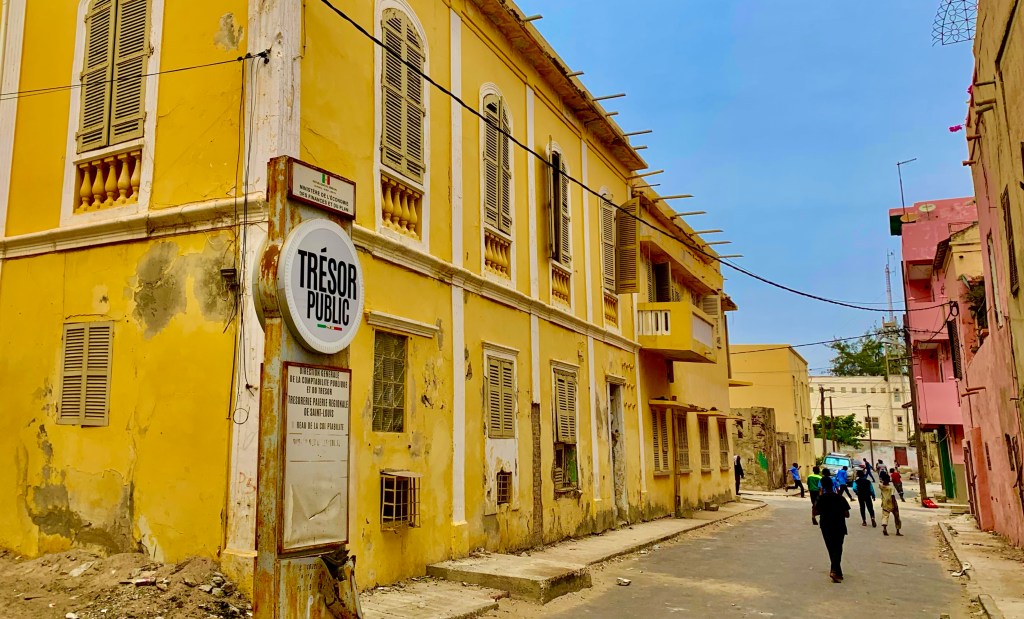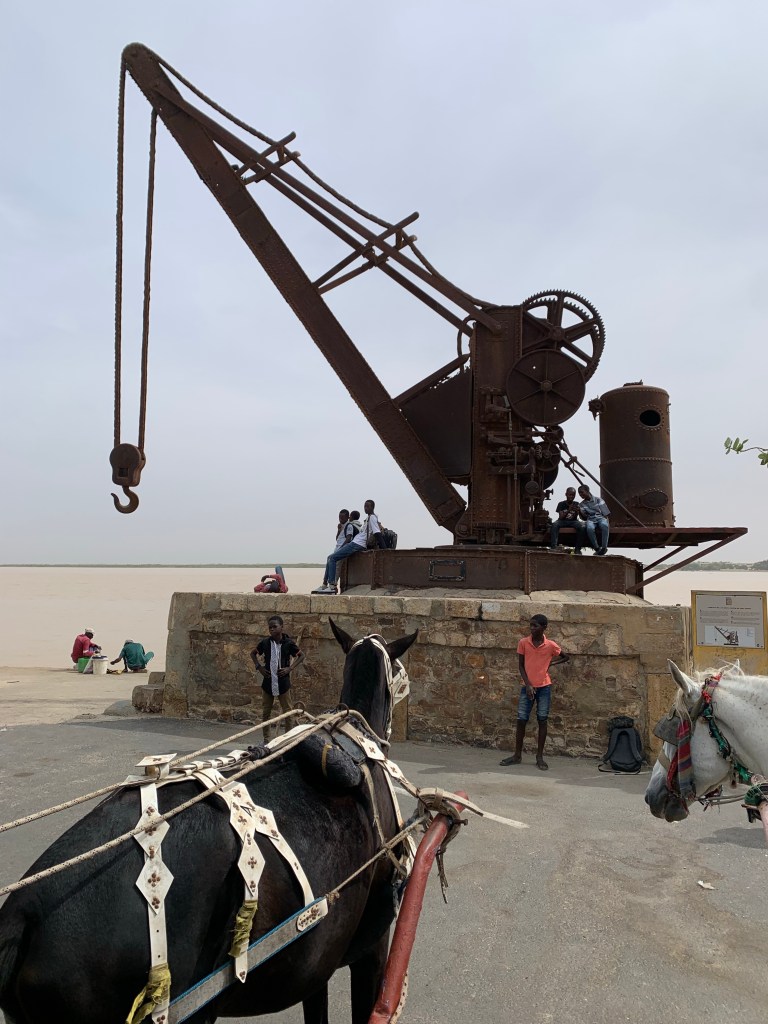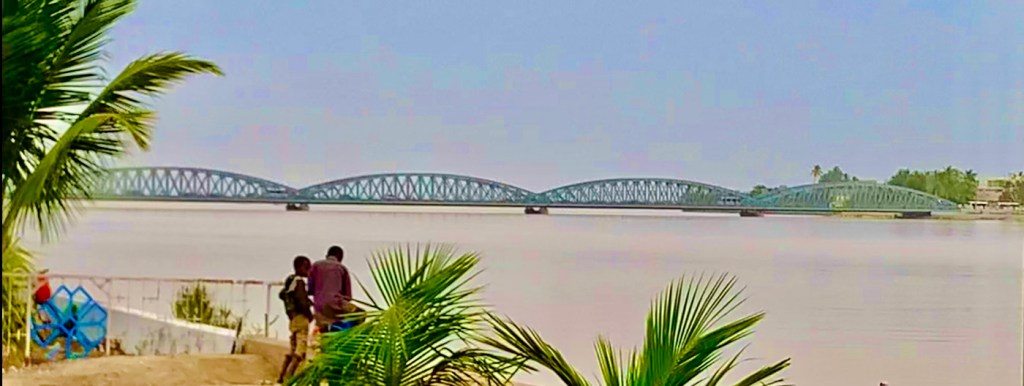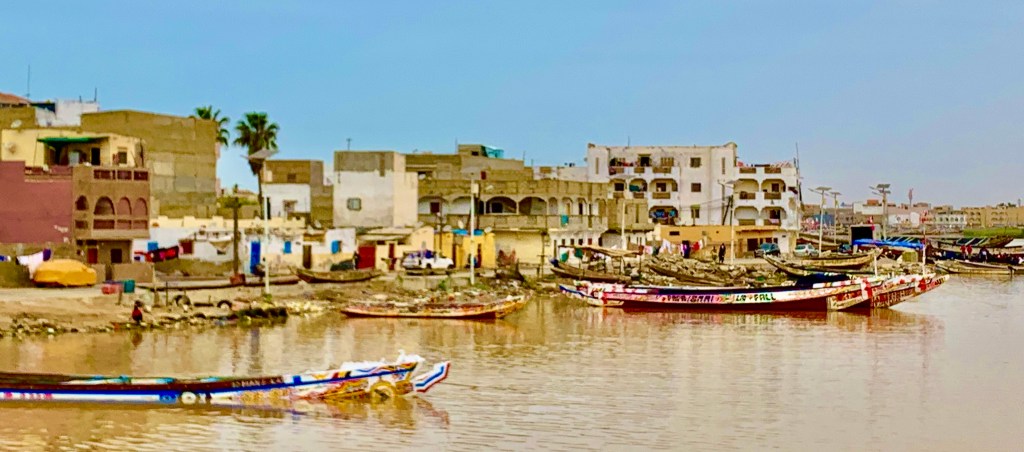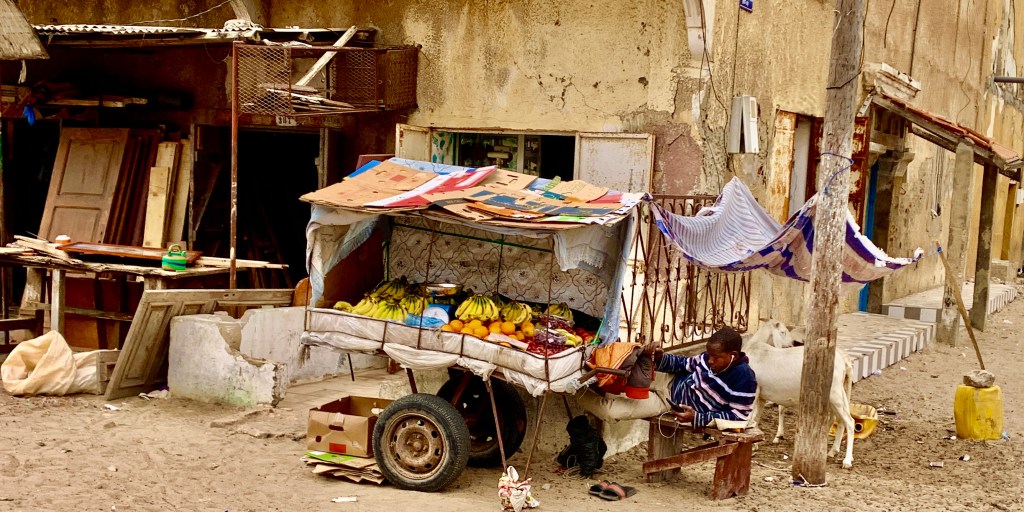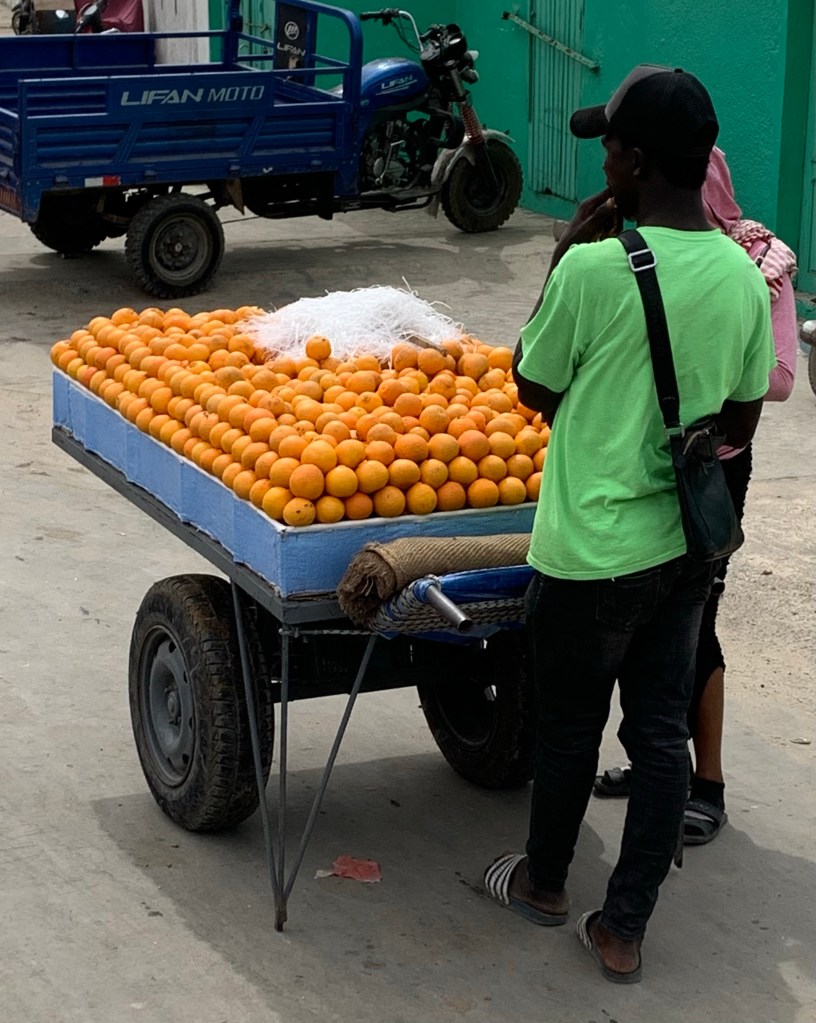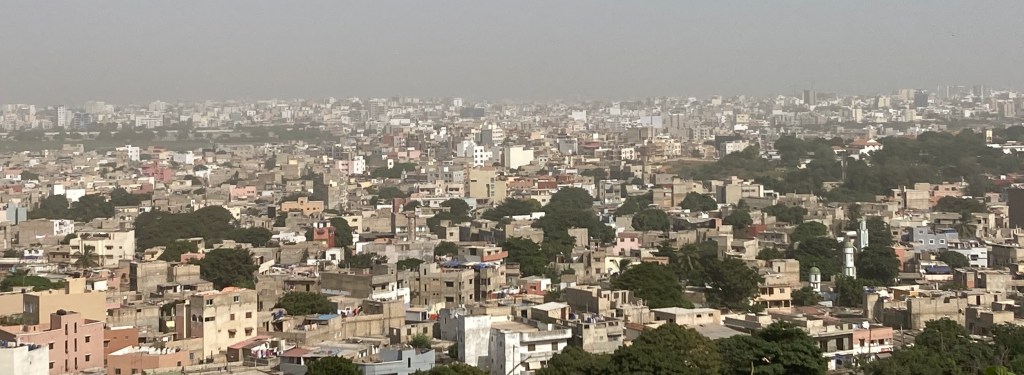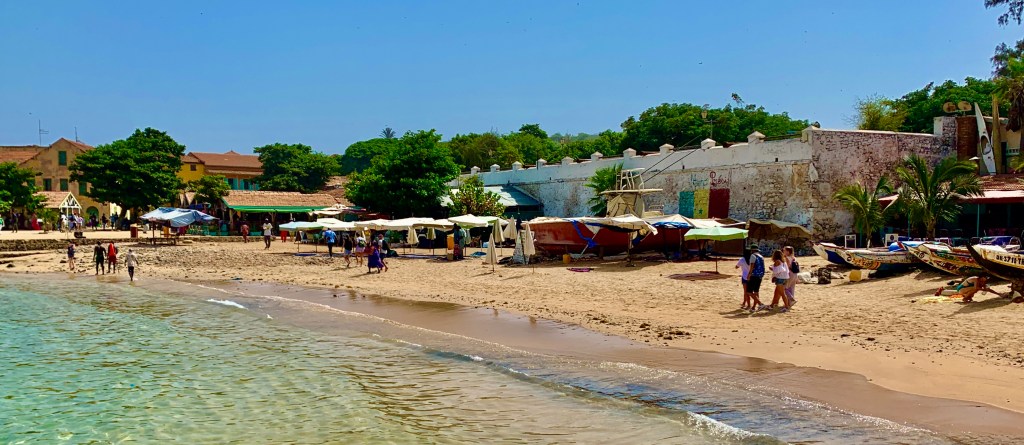
Perched on Africa’s most westerly point and surrounded by water on three sides. Dakar is home to 4 million people. It can seem like a city of extremes where horses and carts share the road with shiny new SUVs, French Colonial architecture is interspersed with African buildings
Although due to its independently mined people, colonisation didn’t come to the area till the middle of the 19th century, more than 400 years after the Portuguese set up their first trading post just across the water in Goree Island.
Dakar ferry terminal to Goree Island
Such was Dakar’s strategic location and importance, little after 50 years of the city’s foundation it became the capital city of all French West Africa and one of its most important cities within the French Empire.
Experiencing rush hour in Dakar😲
Dakar is a city that wears its heritage with pride and takes comfort in its diverse history and identity, very much the exception to the rule in this part of the world. Senegal being one of the few African states not to experience a coup d etat or exceptionally harsh authoritarianism.
Today Dakar is a major financial centre home to over a dozen International banks, including the Central Bank of West Africa which manages the unified West African Franc.
The French have not severed ties completely, with over 20,000 French expatriates living in Dakar. The French still operate an air force base near the city and the French fleet is still serviced in Dakar’s port and the French language is used.
The Plateau District
The city of Dakar is certainly full of surprises. It is a member of the Organization of World Heritage Cities and contains several landmarks. Unfortunately for us, time was in short supply with a ferry to Goree to catch, so it was just a visit to some of Dakar’s prominent sights.
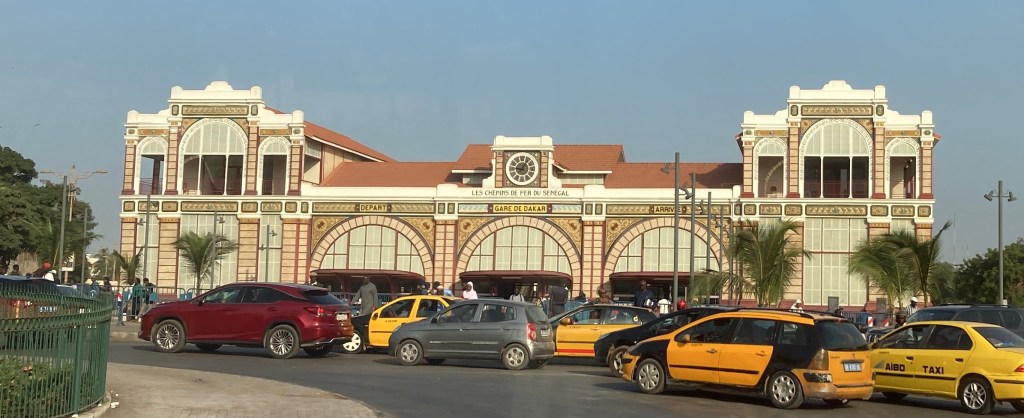
This compact area next to the ferry terminal is full of French Colonial relics, like the beautiful railway station and though Senegal currently has no operating train service, this and other buildings have been well maintained. They are considered proud parts of Senegalese heritage.
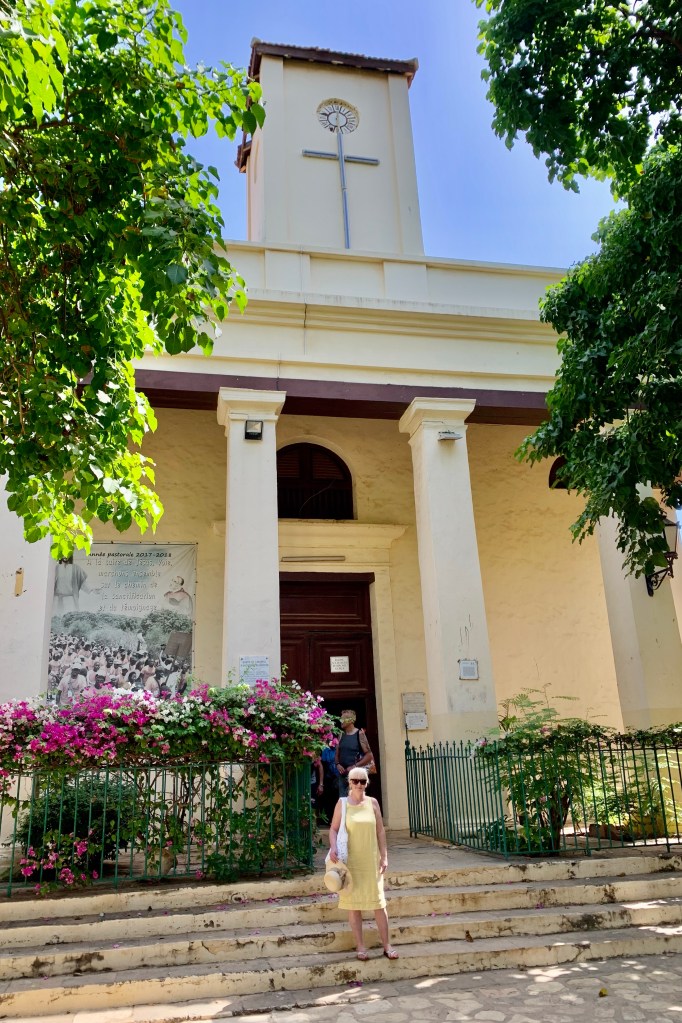
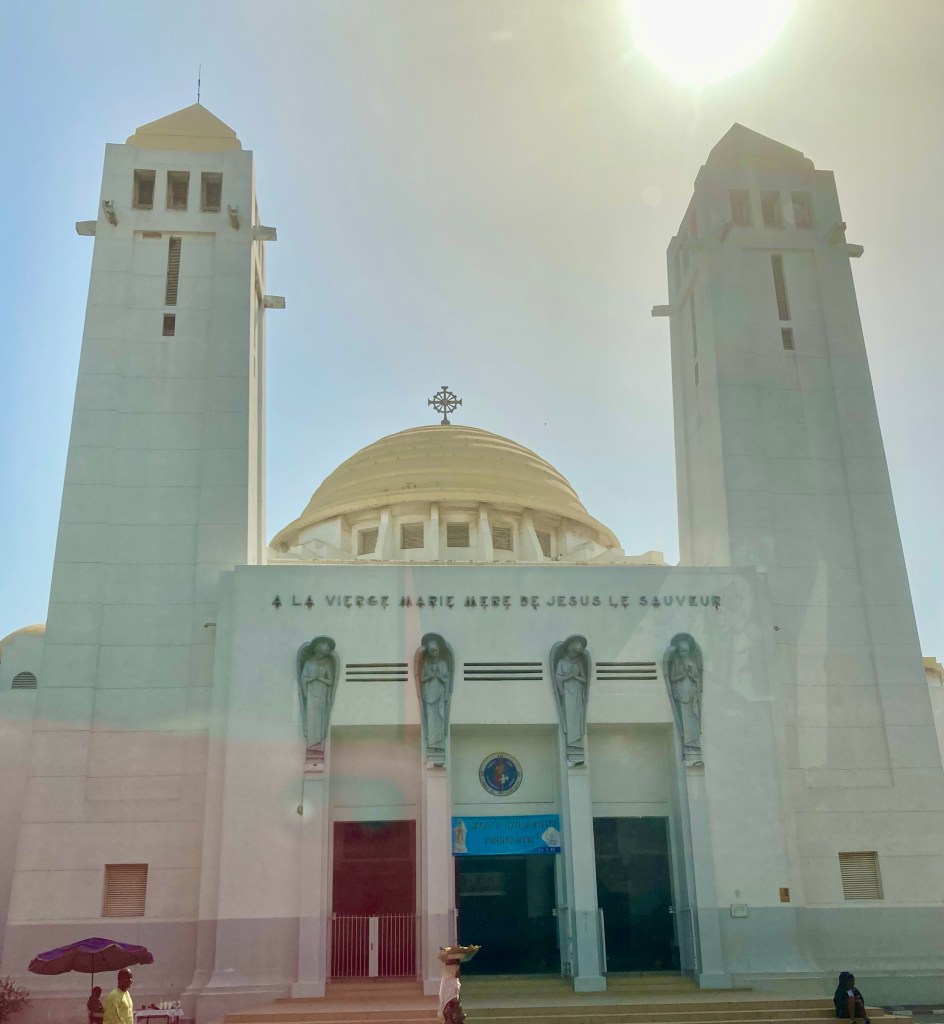
The Catholic Cathedral of Dakar built in 1936 can also be found in The Plateau district. Catholicism was brought by the French although today less than 5% of the population are Catholics, it stands as a symbol of Senegal’s multicultural society where all religious tolerance is respected.
Ouakam
The beachside suburb is famous for surfing, The Mosque of Divinity and The African Renaissance Monument.
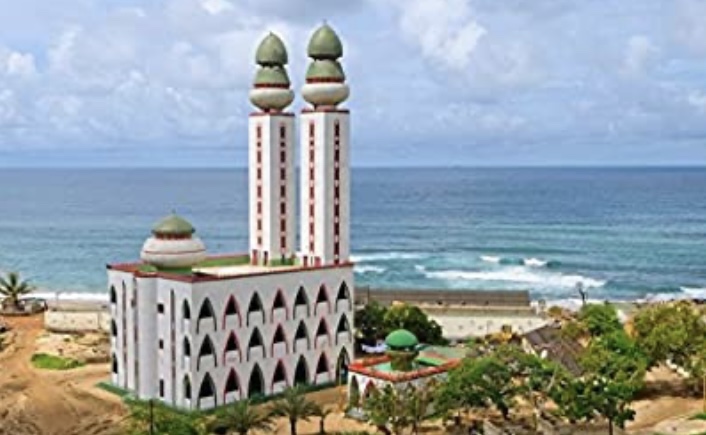
The Mosque of Divinity
The mosque is a relatively new building which was completed in 1997. Its structure has two minarets and is located in an impressive beachfront location with unobstructed views of the Atlantic Ocean.
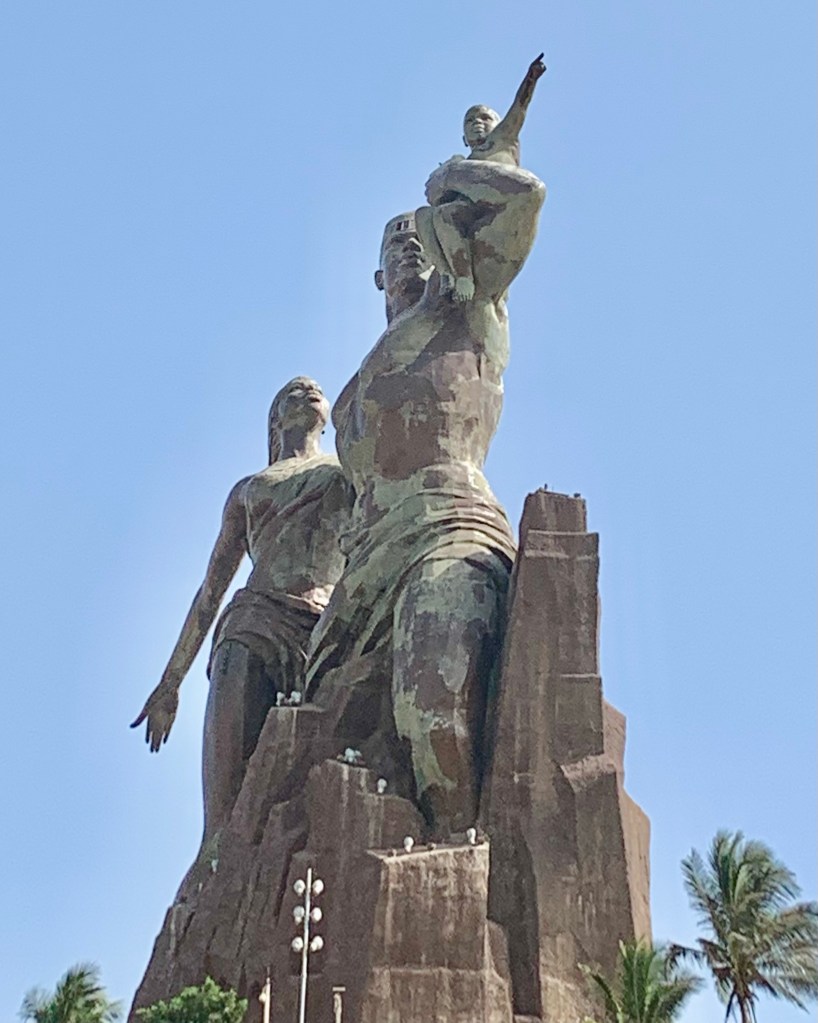
The African Resistance Monument
A statue which symbolises African liberation from centuries of oppression? or an expensive vanity project? Officially unveiled on April 4th 2010 National Day in Senegal.
The 160-foot statue is impossible to miss. Perched high on a hill, the mighty Soviet Esque bronze statue of a man, woman and child overlooks the Atlantic Ocean and dominates the horizon of the capital Dakar.
The project was launched by then Senegalese president Abdoulaye Wade, as a prestige project to provide monuments to celebrate African Renaissance. Designed by a Senegalese architect Pierre Goudiaby Atepa and built by a North Korean sculpting company.
The construction cost of £17 million deeply divided opinions at the time, even leading to public demonstrations a rare occurrence in Senegal, when many ordinary people were struggling to put food on the table. The rather austere design was poorly received by art aficionados. The former president owns intellectual property rights to the sculpture, which entitled him to profits raised by the sculpture, which further adds to the controversy.
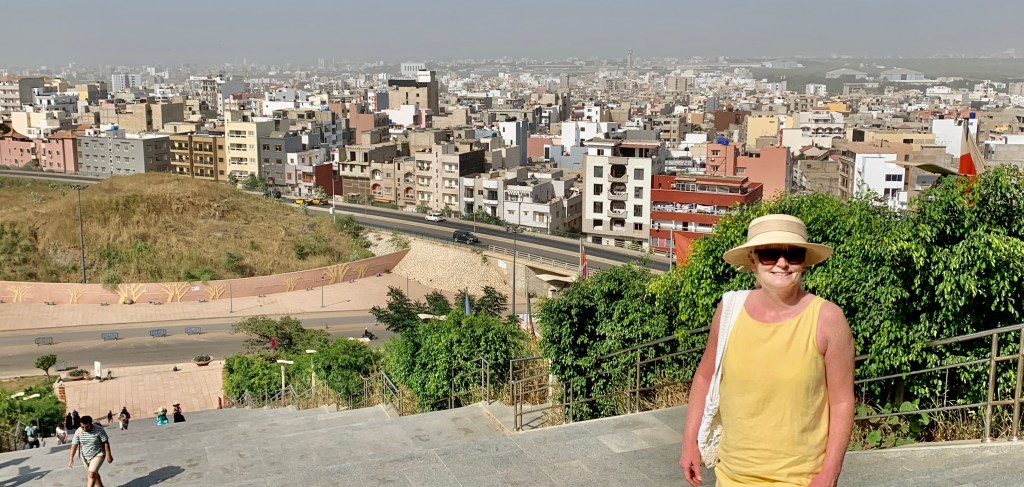
The statue is certainly in a fantastic location on top of one of the twin hills known as Collines des Mamelles, giving fabulous panoramic views of Dakar and the Atlantic Ocean.
Goree Island
The primary reason for my visit to Dakar was to visit Goree Island which lies just off the coast of Dakar. This beautiful colourful island has a dark disturbing history.
Goree Island was declared a World Heritage Site in 1978.
The island is a UNESCO World Heritage Site. From the 15th to 19th Century it was the largest slave trading centre on the coast of Africa. Ruled in succession by Portuguese, Dutch, British and finally French colonial rulers.
The only way to reach Goree Island is by boat. Ferries depart regularly from the port at Dakar, the trip takes 25 minutes and boats depart every 1-2 hours and run from 7 am up until just past midnight.
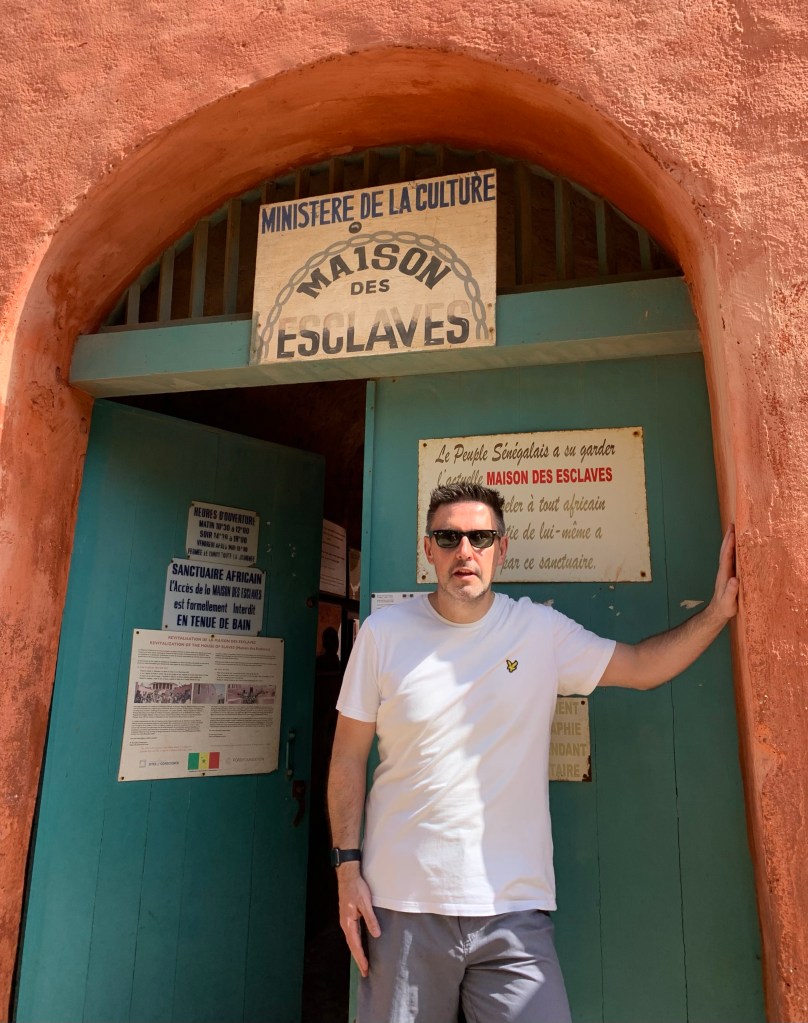
Maison Des Esclaves
The island of Goree was first discovered by the Portuguese in 1444 and used primarily as a transportation hub for slaves.
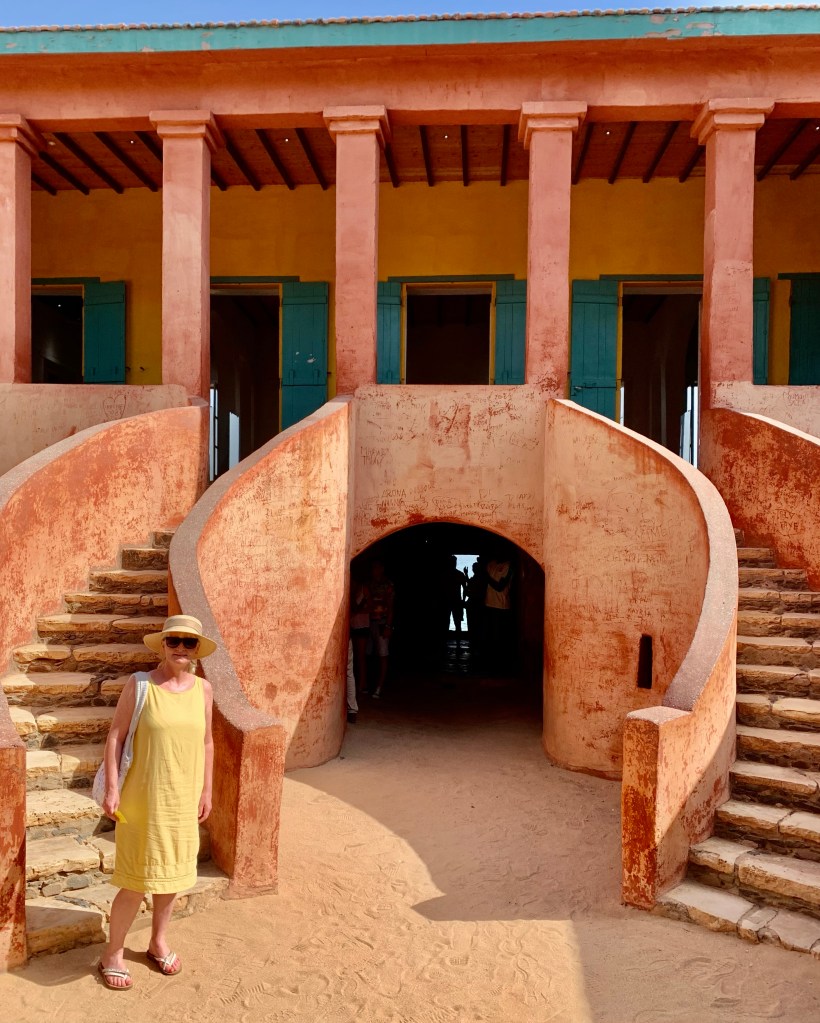
In 1780 the famous House of Slaves “for all the wrong reasons” was built. It was one of the first stone buildings on the island
The House of Slaves had now been turned into a living history museum. For me, this is an unmissable and profound part of my travels to Senegal.
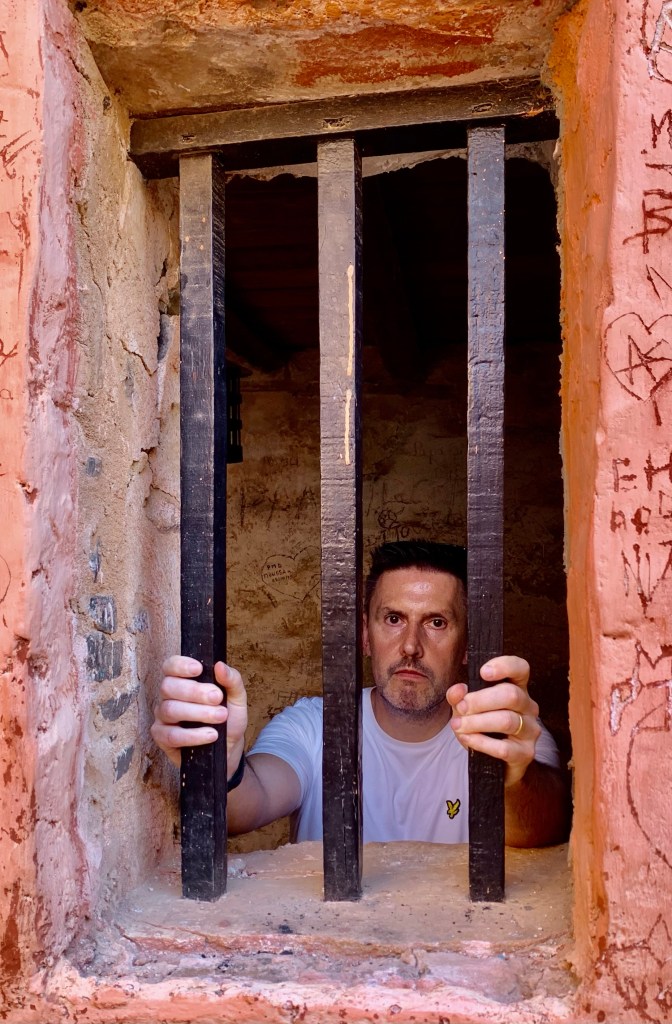
It is estimated that thousands if not millions of enslaved peoples passed through the chambers of Goree before they met their fate across the ocean in the Americas. An African Ellis Island if you like, with one major difference, none of these African people had a choice of seeking their new world and certainly wasn’t for a better future.
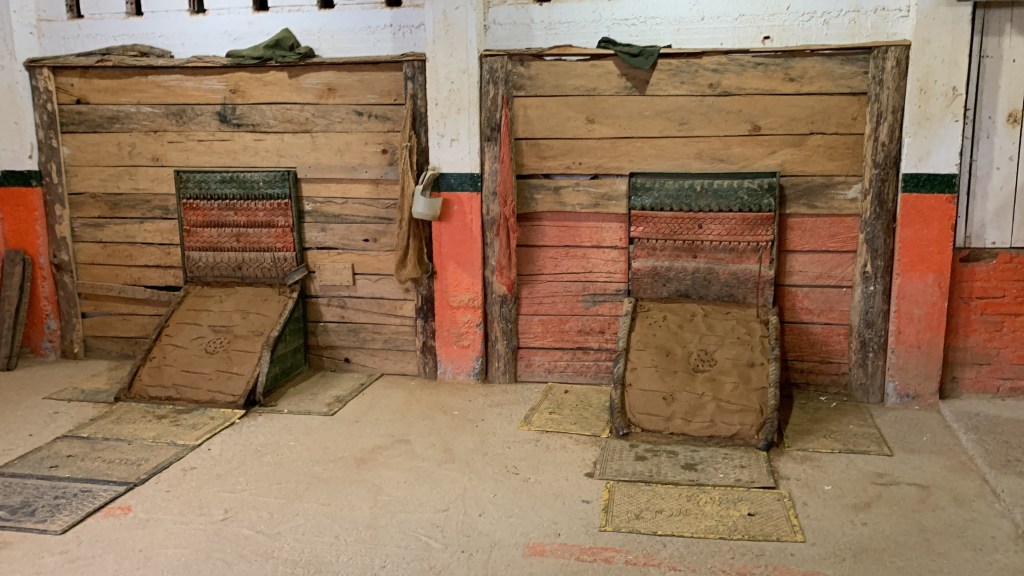
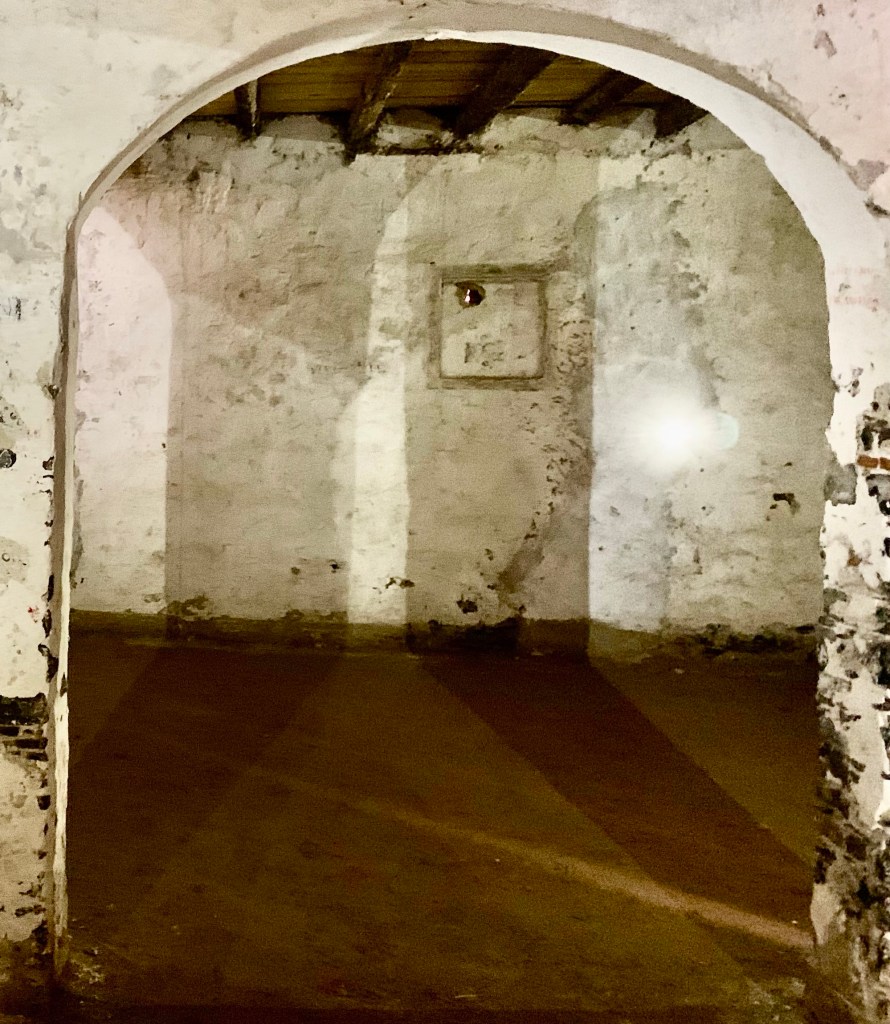
One of the holding pens used for the “storage of slaves” hundreds could be kept in these cramped conditions
Today it has been left more or less untouched, a permanent and important reminder of the human toll of the suffering and misery of the African people and the devastation of several centuries of European colonisation. Although judging by the rise of modern slavery have we learned anything at all?
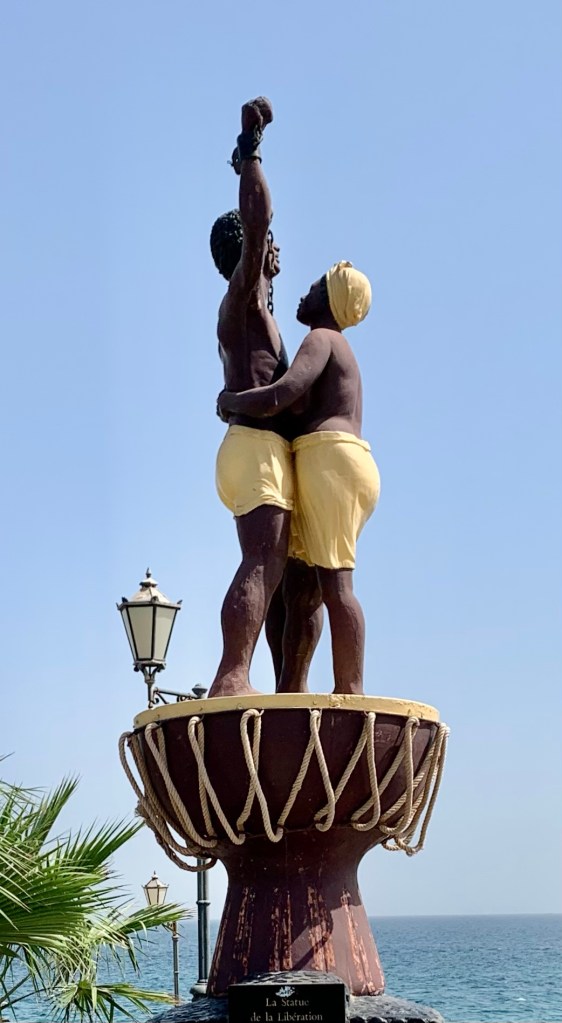
The sculpture was a gift from France unveiled in 2006.
On Goree Island, you will find the Statue Of Liberation, which is a very poignant sculpture of two free slaves one male and one female which is located overlooking the Atlantic Ocean. The statue was a gift from France, a symbol of the abolition of the slave trade and the reconciliation between the two nations.
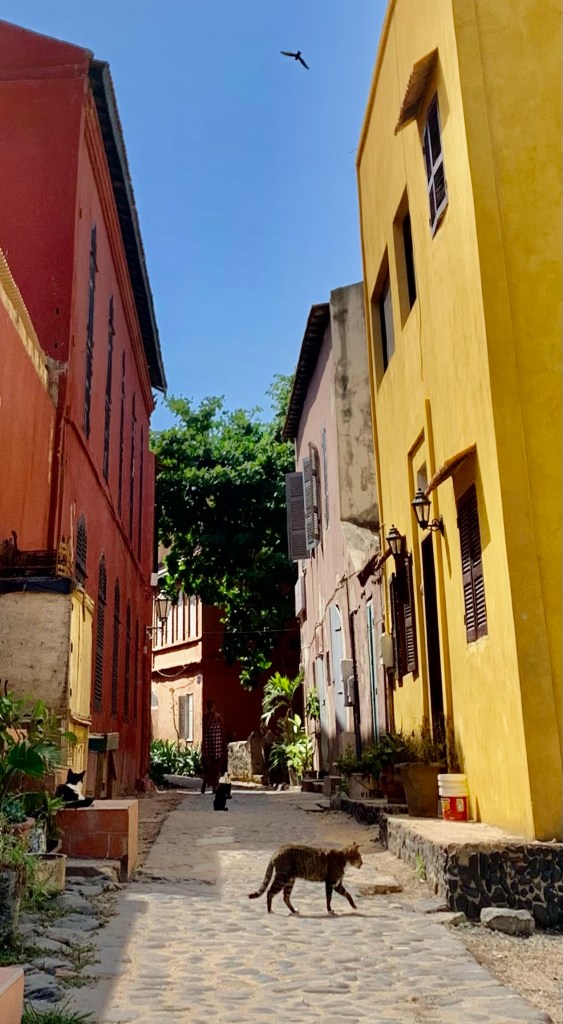
The rest of the island is in stark contrast to the House of Slaves, where you will find no cars, little crime and lots of cobblestone streets with prettily painted pastel-coloured houses.
Slavery ended in 1848 (it was previously abolished by the French in 1794 and 1815) but was never enforced in its colonies. Goree then became the first western-style municipality in French West Africa, complete with an elected mayor and council, finally gaining independence on the island from the French in 1929.
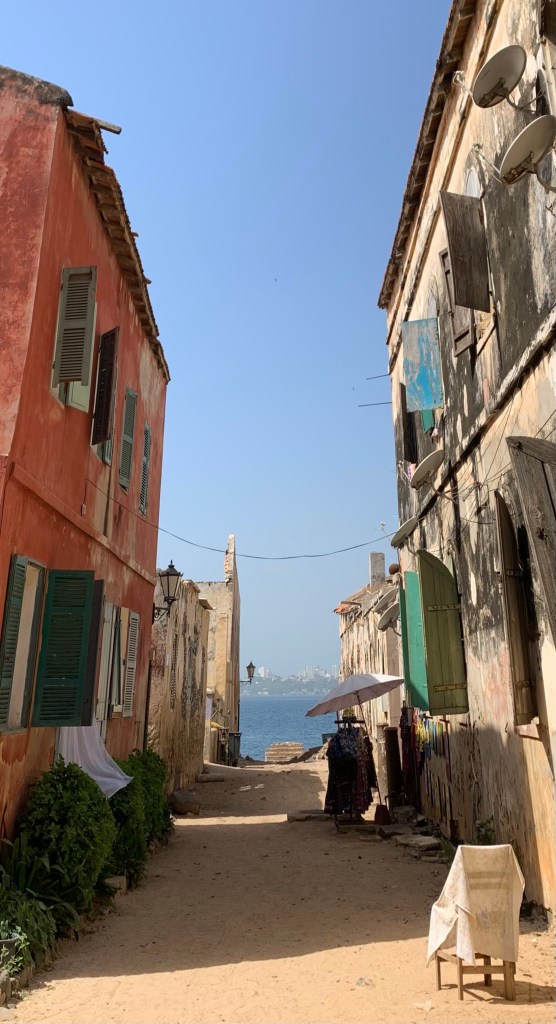
Today Goree feels like a million miles from the constant hustle and bustle of Dakar. Where I found colonial era houses with wooden shutters, painted in pastel colours weather beaten over time giving the houses a faded grandeur, where time slowly passes by.
Although Goree is not an island without life. The island is home to 1700 people, you will see many children playing in the public squares on the island, artists lining the main boulevard and many craft shops.
Too late to change your mind this item is already sold even if you don’t realise it yet 😂
Situated not from the ferry terminal you will find many vendors selling their goods to the many visitors who come to Goree for the day. Although they can be persistent they are generally good natured and prices were reasonable.
With my wife’s purchase safely packed away, it was time to take a walk along the beach back to the ferry terminal. The 3-kilometre ferry journey back to Dakar. Goree is a place with a very sad history, a place of pilgrimage for some, but it’s also vibrant and colourful, with a feeling of calmness.
Goree can look forward to the future but at the same time serves as a reminder of the human atrocities carried out on this idyllic island. We can move forward only if we remember the mistakes of the past.
A country which is known for its unassuming beauty and gorgeous tropical climate. My first instalment takes me to M’Bour on the Petite Coast to fully understand Senegalese life.
A first-time visitor to Senegal. Due to its French colonial history, the country for many English speakers has been very much under the radar. Although Senegal has been known as the Gateway to Africa and has been welcoming visitors for centuries.
This peaceful sub-Saharan country is one of the continent’s safest and most accessible, it’s also blessed with a rich culture, seven UNESCO world heritage sites no less, not to mention the dreamy beaches, wildlife, musical heritage and delicious cuisine.
Senegal is a predominantly Muslim country, although you needn’t worry about some of the usual protocols. In most areas, women don’t wear the hijab and you won’t be showing disrespect by not covering up. This is not set in stone so just be aware of the surroundings in which you may find yourself.
Parlez-vous francais? Def dangay wax Wolof? Unfortunately, my wife only speaks English
Another thing to consider is the language. There are 39 spoken languages in Senegal, Wolof is the predominant tribal language and French is spoken by some locals and is an official language. English is not widely understood, so it may be a good idea to brush up on some simple French and Wolof phrases.
M’Bour Petite Coast
M’Bour is the major town in the area, about 90 kilometres from Dakar, it lies on the Petite Coast. The Petite Coast is the main tourist hub in Senegal where you will find lots of hotels, restaurants and miles of beaches. Nicknamed the Senegalese Riveria it has been a popular destination for French visitors for many years.
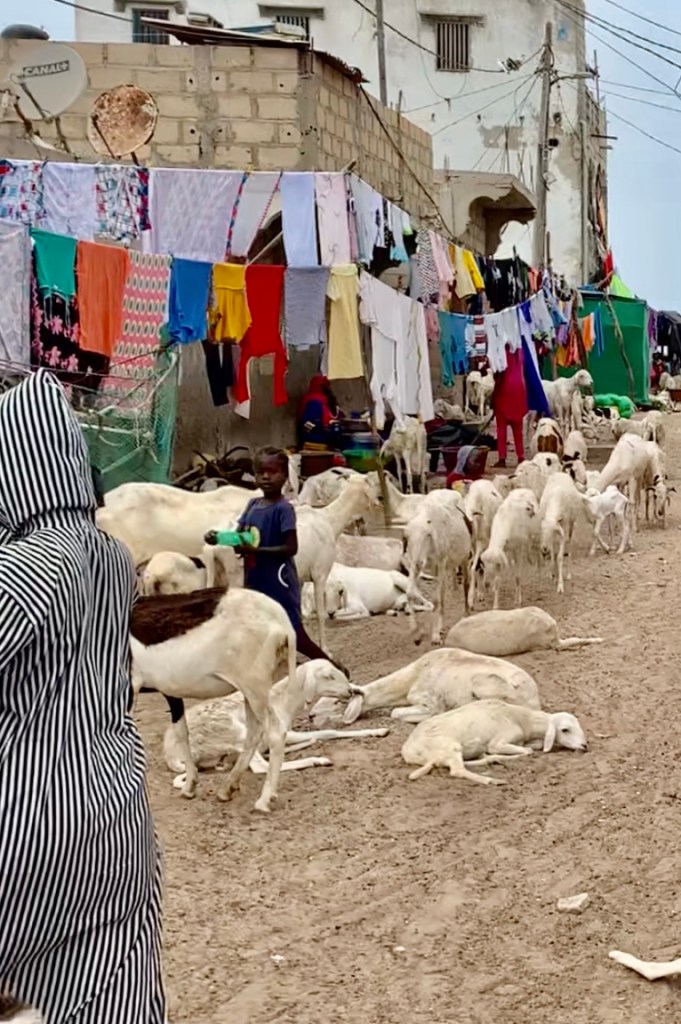
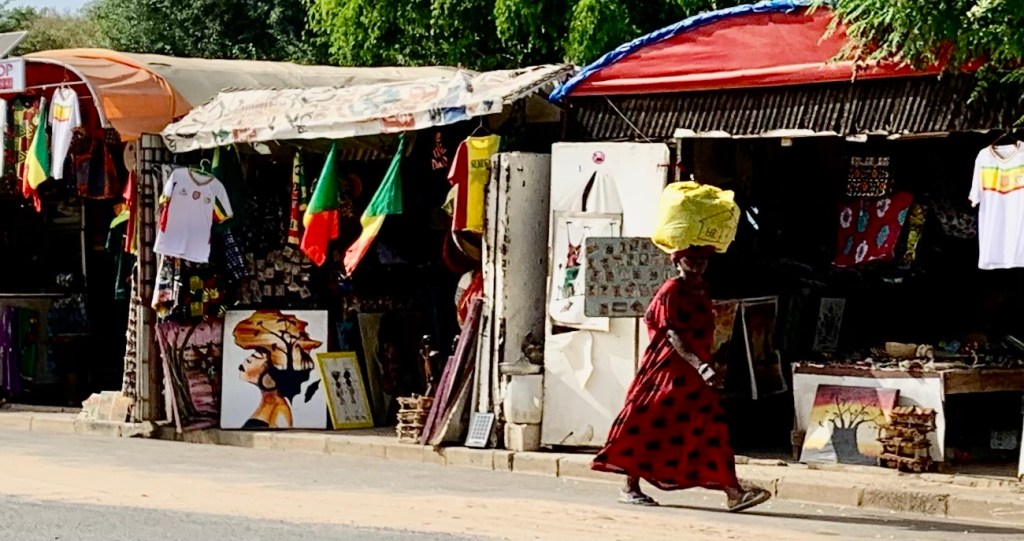
A typical scene in a Senegalese town.
Travelling to an underdeveloped country can be somewhat of a culture shock for the uninitiated. Nevertheless, the positives of this for the traveller can include fresh cultural insights, friendly locals and affordable prices that can outweigh any possible difficulties.
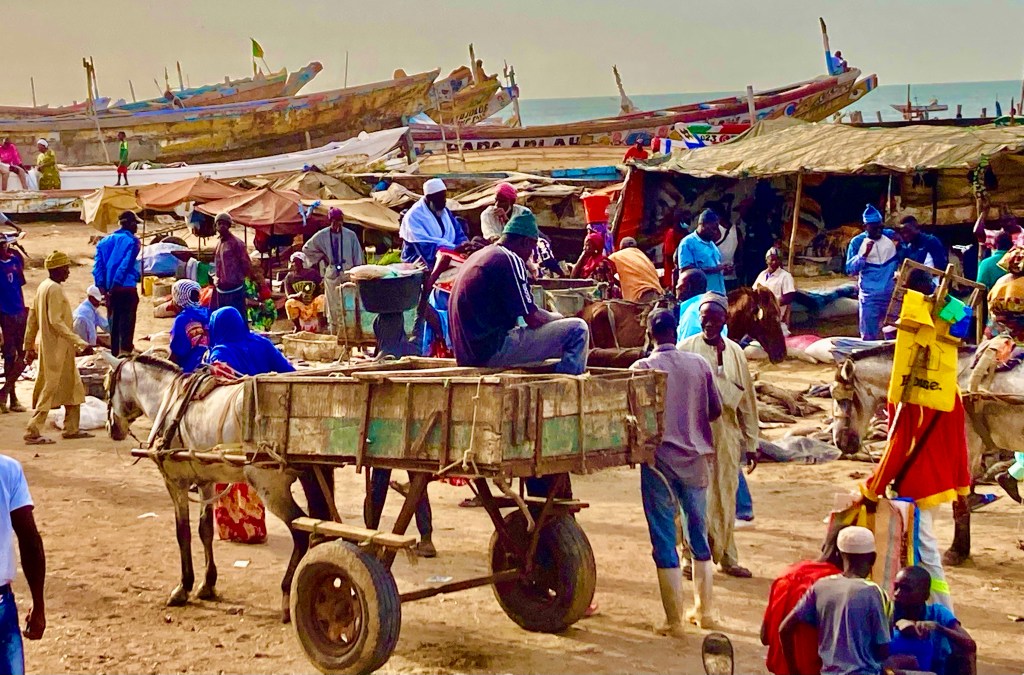
Don’t be surprised when you get there to find roaming goats, cows, chickens and horses and carts as well as buses crammed with locals all sharing the same roads with cars and pedestrians.
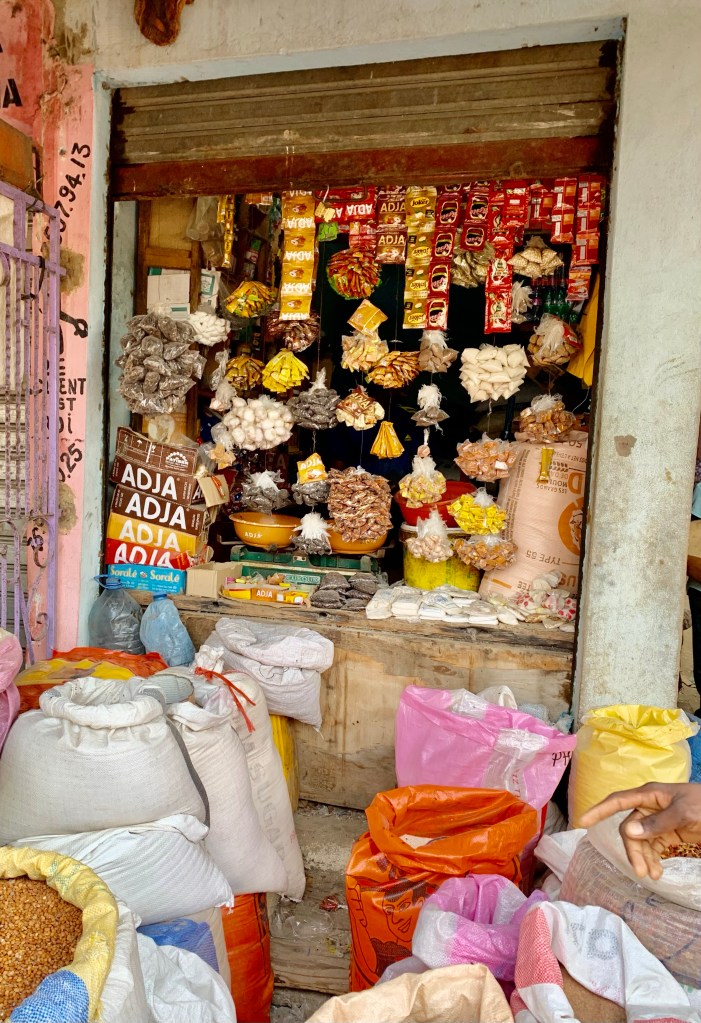
M’Bour market
I wasn’t quite sure where to start my Senegalese adventure. but what better place to start than a colourful Senegalese market where your able to buy a myriad of products.
You will find almost anything for sale at the market.
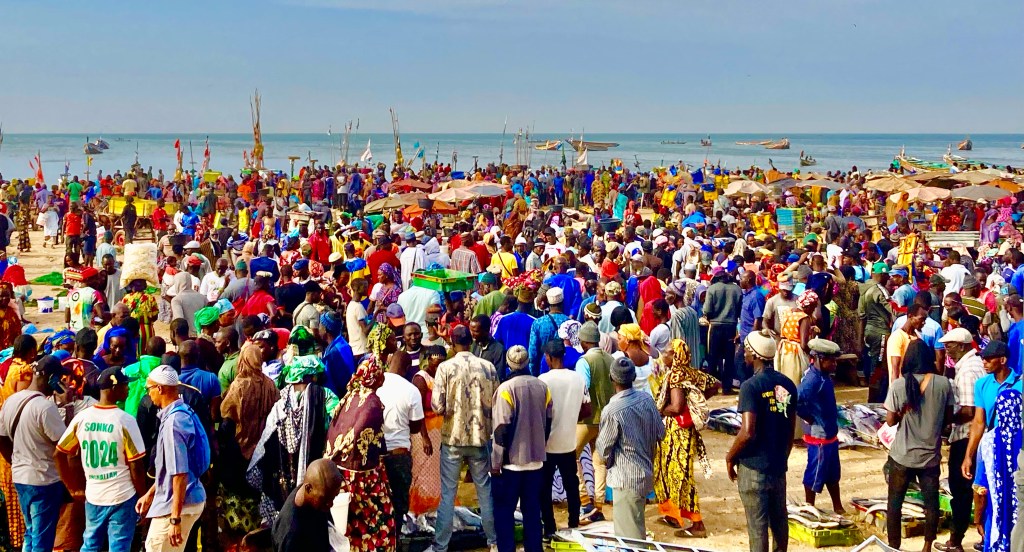
Discover the authentic Senegalese way of life by visiting a market at M’Bour. The colourful fishing and craft market was just a short distance from where we were staying at our hotel in Saly.
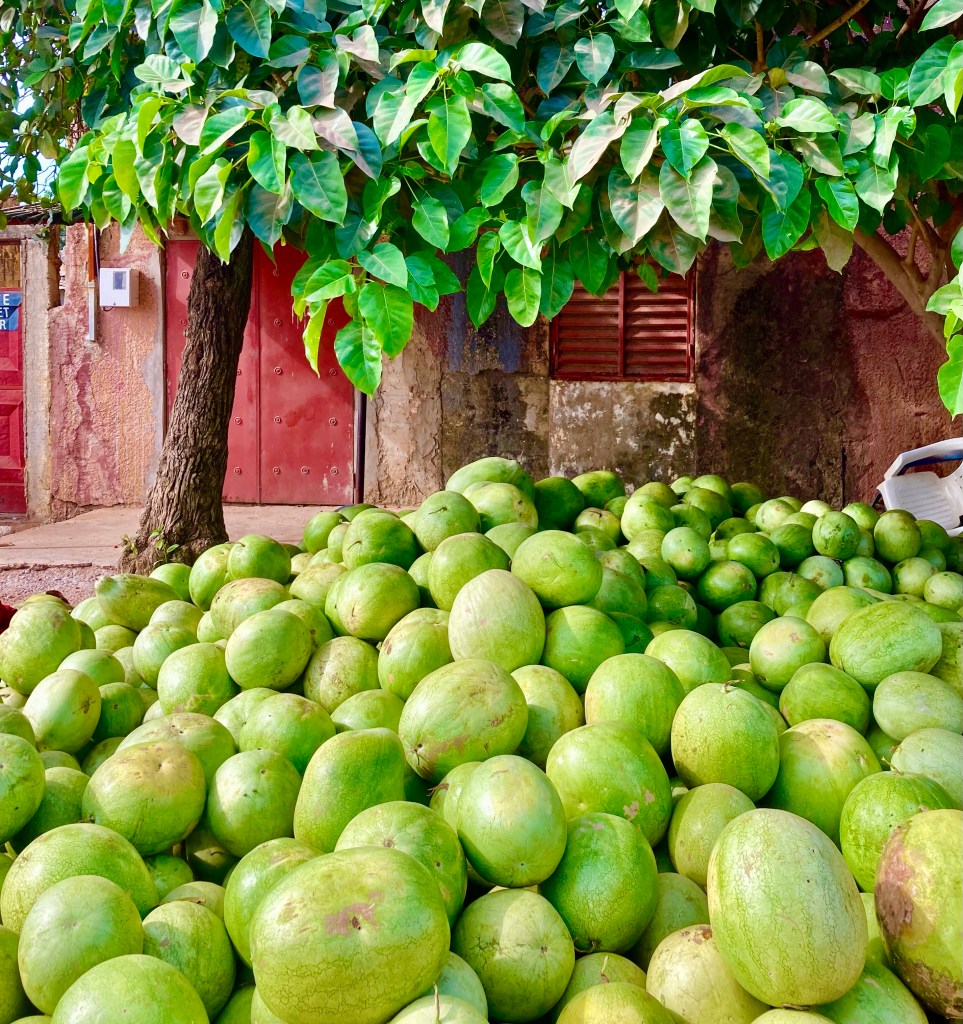
Watermelons everywhere
I have never seen so many watermelons. It is an ancient fruit native to Africa. Senegal has the perfect growing conditions for the fruit and is available in abundance, it’s fresh, deliciously sweet and very cheap, the perfect healthy snack on the go, and most vendors will prepare the watermelon 🍉 for you.
Fish being transported at the market
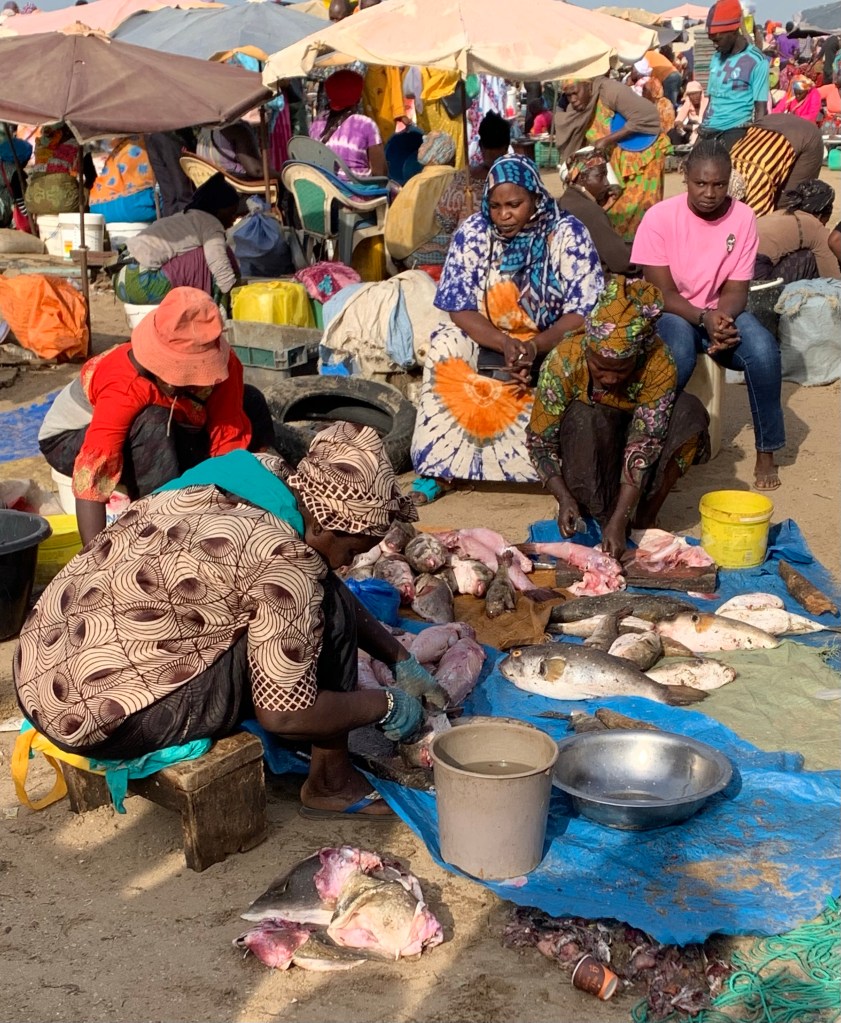
At the market, you will certainly find plenty of fish stalls. A staple food for many on the Senegalese coast. Where it can be purchased straight from the fishermen and sold fresh at the market.
Fish being prepared for sale.
One particular dish you will commonly find is thieboudienne which is rice and fish it doesn’t sound very exciting however you will find hundreds of variations around the country.
The market at M’Bour
Peanut and chicken dishes are also very popular. Senegal is a significant producer of peanuts and poultry is widely available so the food is relatively cheap to get.
M’Bour fishing harbour
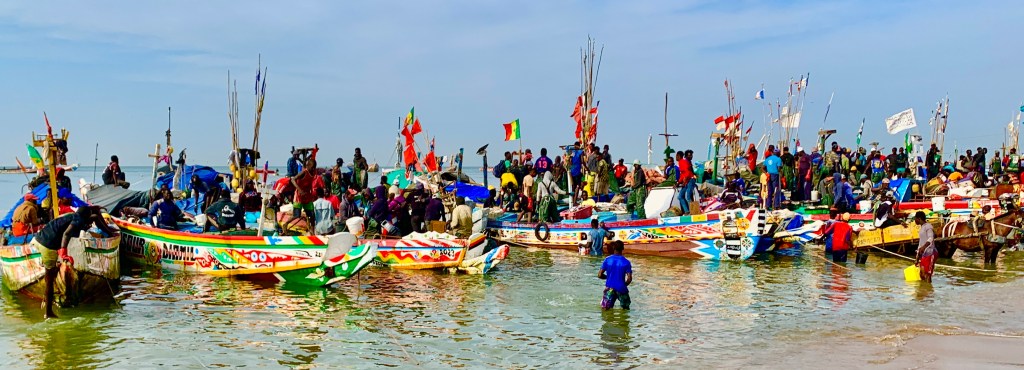
M’ Bour has one of the largest fishing fleets in Senegal.
We were staying on the Petite Cote the centre of tourism in Senegal. M’Bour is the major town in the region and the centre of the fishing industry with its busy harbour.
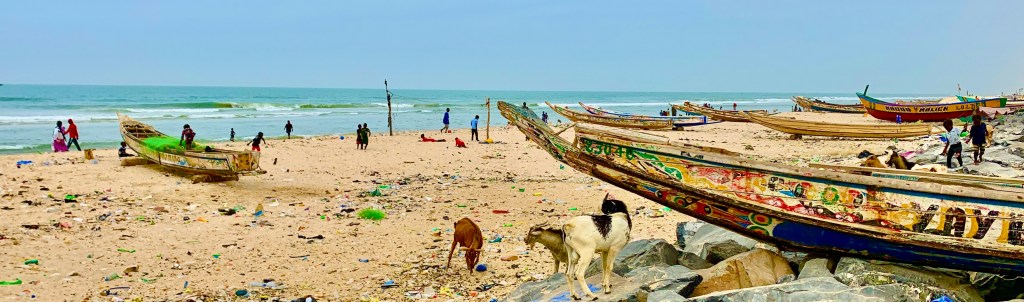
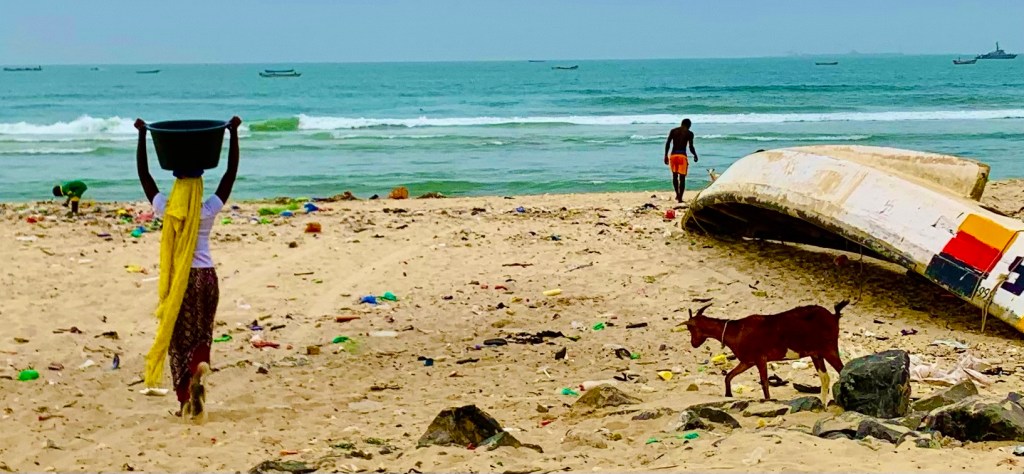
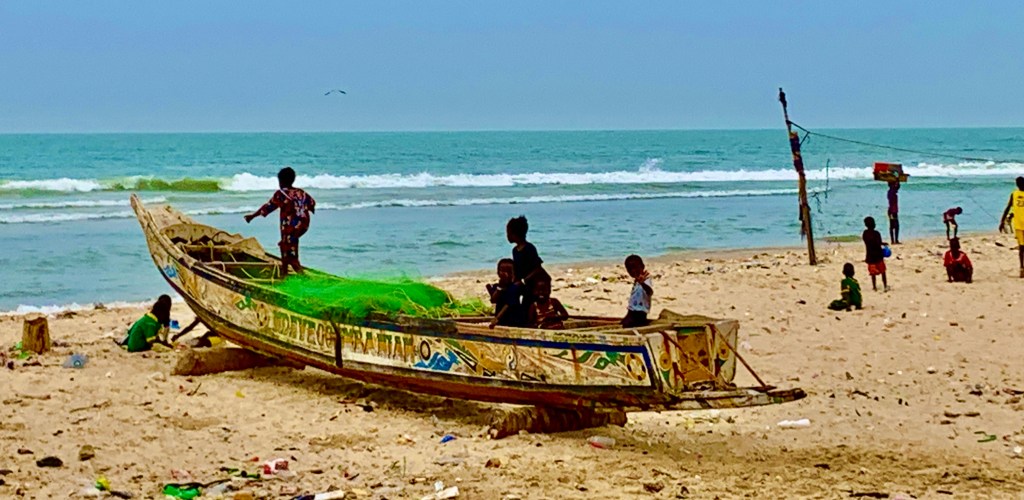
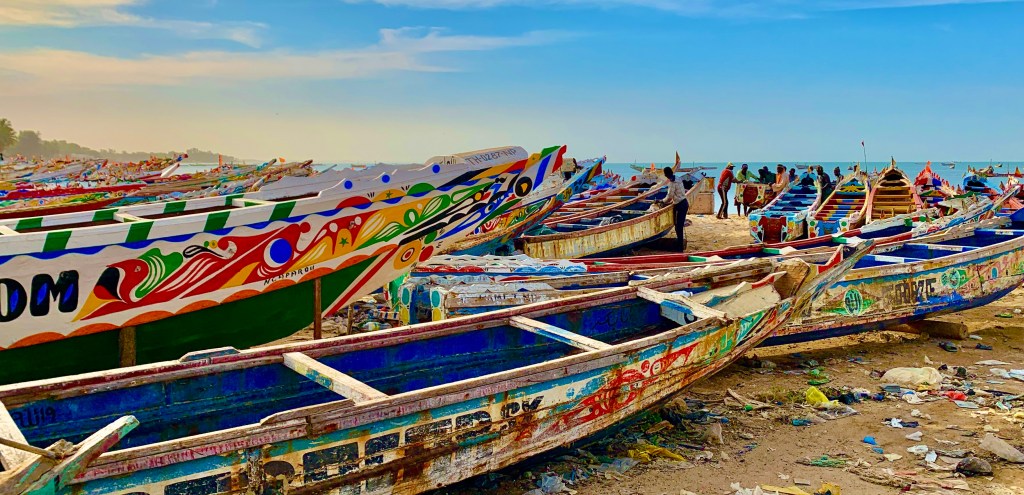
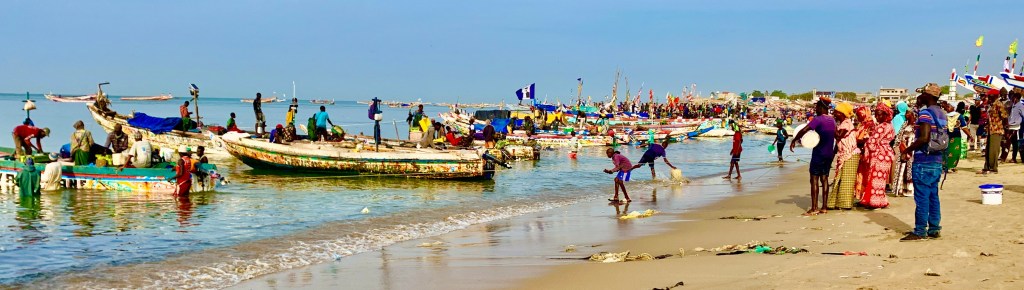
Colourful boats can be found at the fishing harbour, these are typical of the area.
The first thing we noticed was the beautifully painted fishing boats. It’s impossible not to be impressed when you see the boats lined up on the beach all painted in their striking designs.
The days catch coming into the harbour.
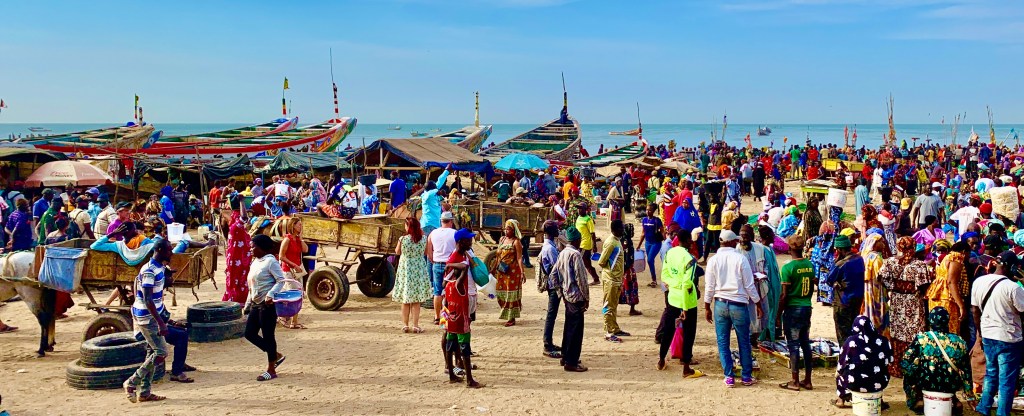
M’Bour’s bustling fishing harbour and its geographical location on Senegal’s central west coast, make the town one of the country’s busiest fishing ports. This is a working beach and not a place for pleasure. Whoever comes here comes with the intention of fishing or purchasing fish.
From when the sun rises in the morning till well past sunset the fishing harbour of M’Bour is a hive of activities. It is especially busy when the morning catch is coming to the port. Where the boats will hopefully be full of grouper, snapper, swordfish, mackerel, tilapia and many more varieties of fish.
Fishermen, wholesalers and buyers will meet at this chaotic location where deals are continually being made, where fish are sorted by size and variety, before being transported to the market and beyond. A heaving mass of humanity tries to make a living amongst the chaos that ensues.
You can visit independently, but to get the best experience of the market and fishing harbour, it’s probably best to get a local guide. They will know the best times and locations to visit, will be able to speak to you in English and translate to locals, and keep away street traders although not aggressive can be very persistent with their sales patter.
Senegalese rural village
If all the hustle and bustle of the market and fishing harbour is getting too much. An all together different pace of life to experience
Agriculture methods are still very traditional.
I sometimes feel a little bit uncomfortable with these sorts of excursions. As if I am some sort of voyeur peering into someone else’s life.
Villagers working the land.
Nonetheless these tours are done very professionally, the company we used works closely with local communities and employs local people. I felt by visiting that we were providing a supplementary income besides farming, giving the community an opportunity that they can show visitors what a vibrant culture these rural villages have.
Workers taking a break in the field.
The guides giving us an insight about all the unique characteristics of the community. Being able to experience first-hand the tribe’s customs and how the community is organised, gave us a better understanding.
Helping out?
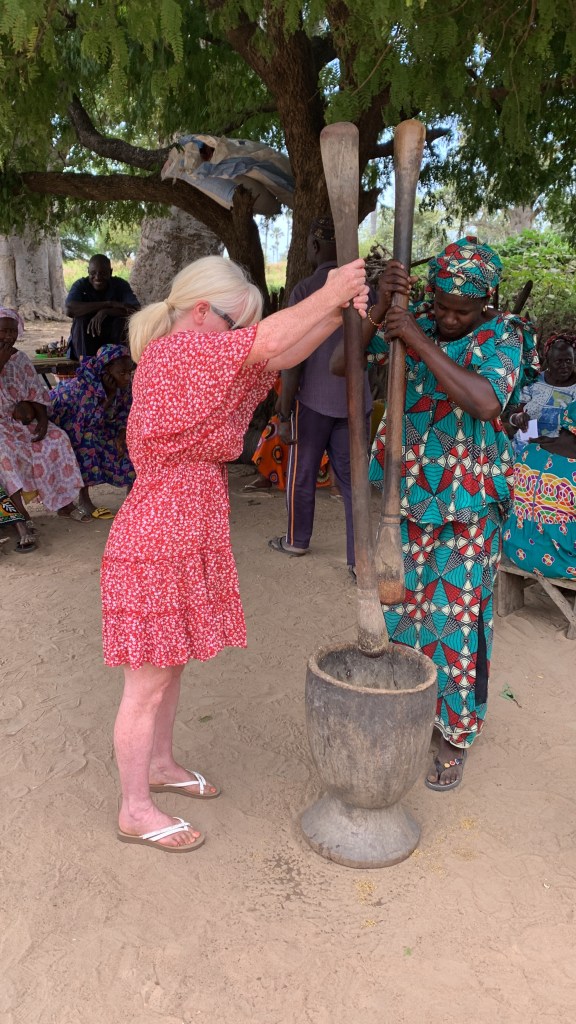
We were also very privileged and humbled to be able to share some moments with the people in these communities getting on with their daily lives. As they allowed us to experience some of the techniques they use when working the land.
Villagers in the country are very fit due to their hard-working nature, and my wife attempting to keep up with the local’s work ethic.
We were able to experience first-hand, villagers using traditional methods and techniques of farming and shepherding, which they have been employing for centuries, which to this day provide them with food and an income.
The Senegalese are very welcoming people.
Senegal is known as a country of hospitality and as a visitor, you will get to experience the concept of “terenga” a Wolof word, it is a term that defies strict translation but loosely translates to “the way you treat the guest.
Music and dancing start from a young age in Senegal.
This philosophy of sharing and giving and inclusion extends to strangers as well. We visited a local village with a tour company that works closely with local rural communities. As guests, it is only right that we should offer something to our hosts as a token of our appreciation, although not necessary we brought food and some things for the children which was accepted by the villagers.
Our small party of guests were warmly received at the village. Using local organizations that value their communities, our trip felt more meaningful, visiting the village we were able to pay for a service they provided, but in a more personal and meaningful manner than superficial tourism provided by multi-national travel companies interested in profits only.
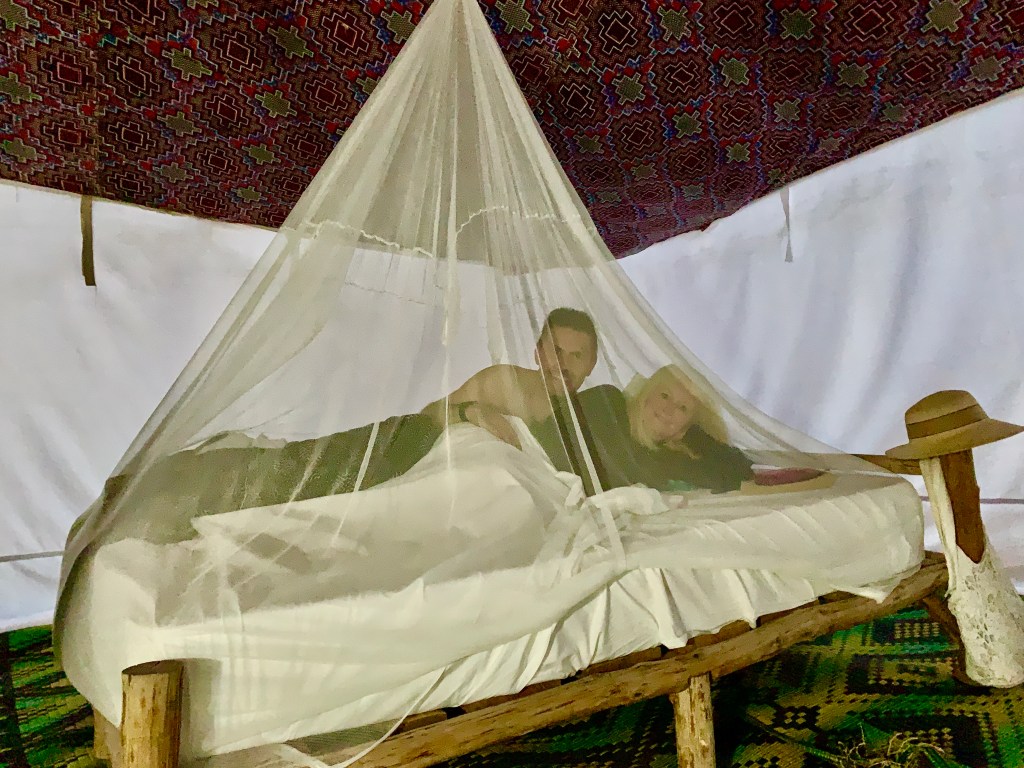
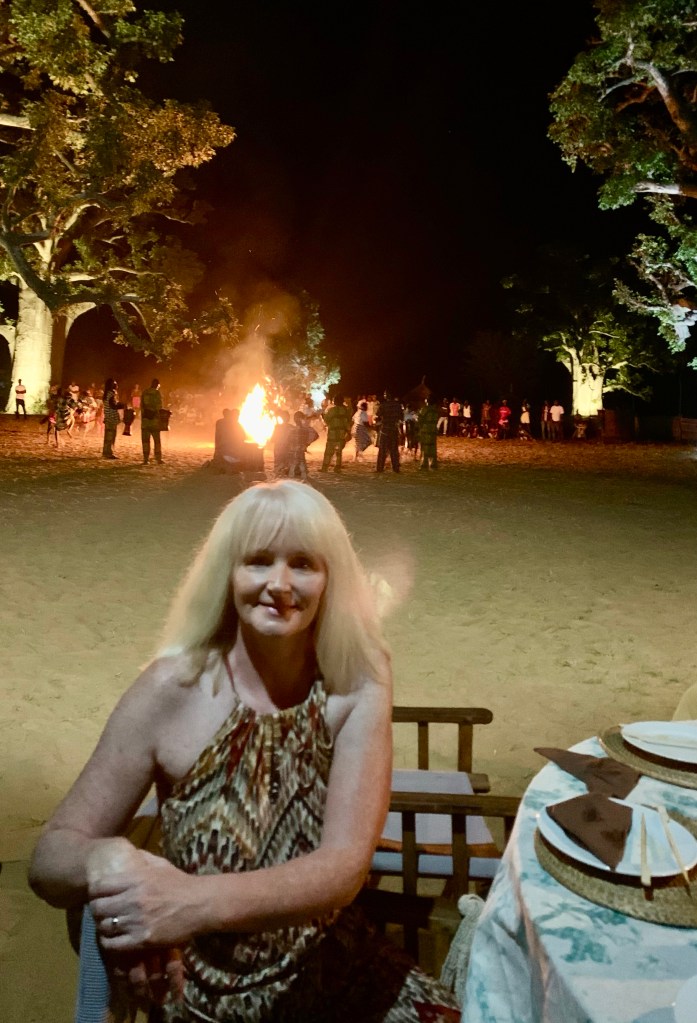
Moonlight, music and dining amongst the Baobab Trees
Senegal is known for its traditional music and cuisine. It has a rich musical culture, together with a delicious cuisine which combines local, Arab and French influences.
A very impressive Baobab tree
We combined both of these with a majestic setting of the star-lit sky and the brooding presence of the Baobab Trees, whose trees are native to Africa and Madagascar. The trees can grow up to a height of 30 meters and are one of Africa’s most ancient trees.
A very impressive welcoming party
When we arrived at the village we were welcomed by a local welcoming party. If you want great music, stimulating culture and delicious cuisine, then Senegal certainly has all three in abundance.
An atmospheric location to enjoy our meal.
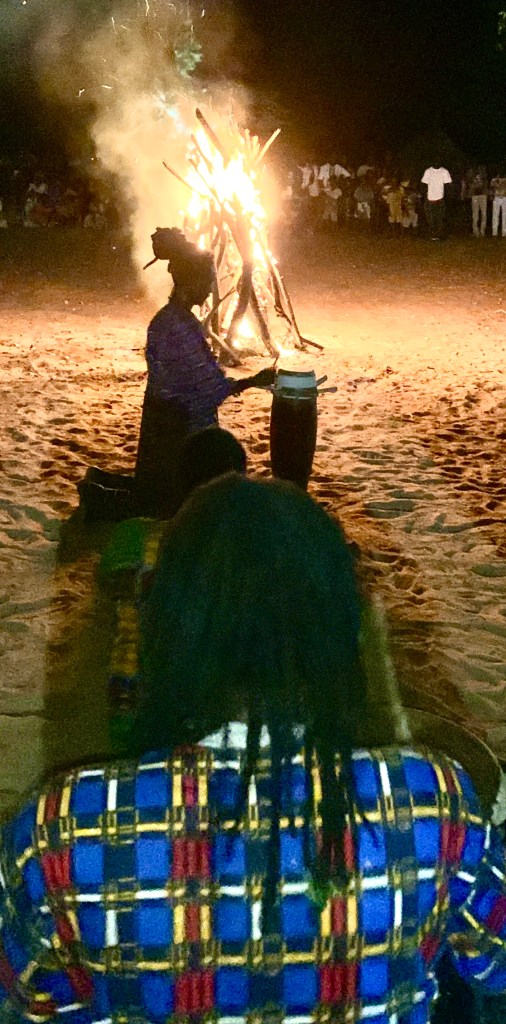
Classic African eats are accompanied by live African drumbeats and on this Senegalese evening, there was even some wrestling to watch which is the national sport, not football, in between much singing and dancing.
The drum beats provide the rhythm to Senegalese music, however, its close cultural connections to Arab, North Africa and Cape Verde can give the music a vibrant cosmopolitan sound.
Although during our evening musical entertainment we were in no doubt that the beating heart of this arrangement was the drums. These drums are unsurprisingly African drums, although their correct title is Djembe translated into English it means peace gather and its origins can be traced back to 1200 AD.
The performances were very entertaining a fantastic night of music and dance which exceeded my expectations. What could have been a very touristy Senegalese culture show which is usually little more than money earners for the tour operators, turned out to be very different giving us an insight into Senegalese culture, music and cuisine, who would have thought?
Belfast is an intriguing city and tends to be the main place to visit in Northern Ireland along with The Giant’s Causeway. The Antrim Coast which is situated between these two most popular destinations is well worth discovering.
I found lots of interesting things to do in the region. I had the opportunity to visit Cave Hill Country Park, Antrim Coast and Glens AONB, The Giant’s Causeway, Causeway Coast AONB, Bushmills Distillery and a few Game of Thrones locations, which meant nothing to me as I have never seen an episode but were still enjoyable nonetheless.
It’s a relatively small area and is close to Belfast so it’s very achievable in a day. Although Giant’s Causeway was the standout location, I enjoyed all stops on my trip of discovery to County Antrim.
Cave Hill County Park
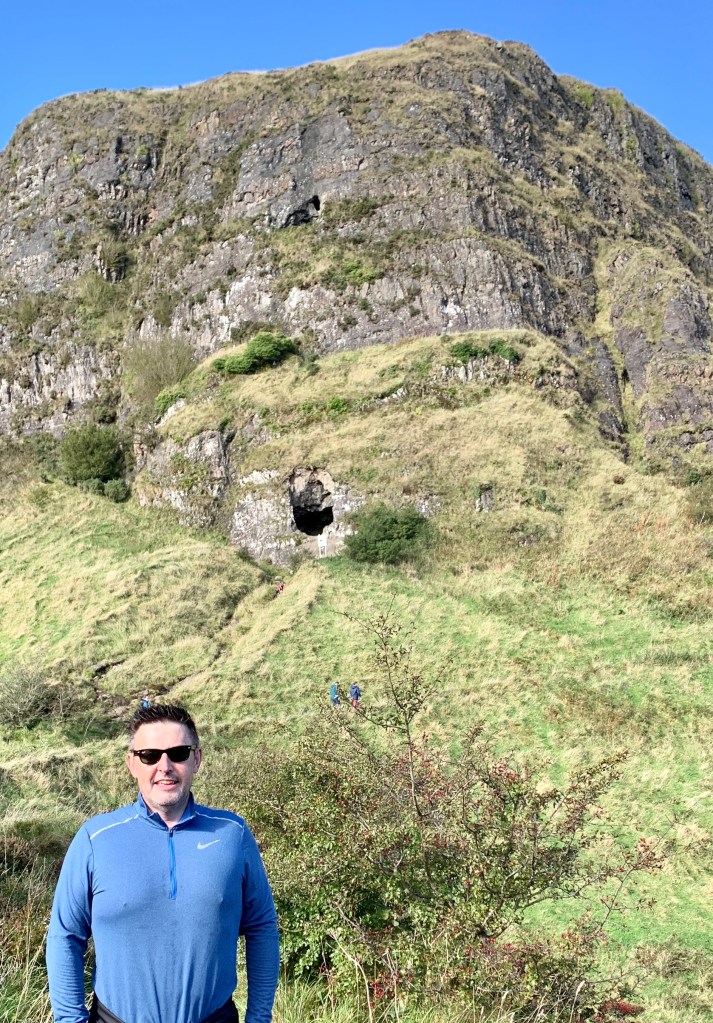
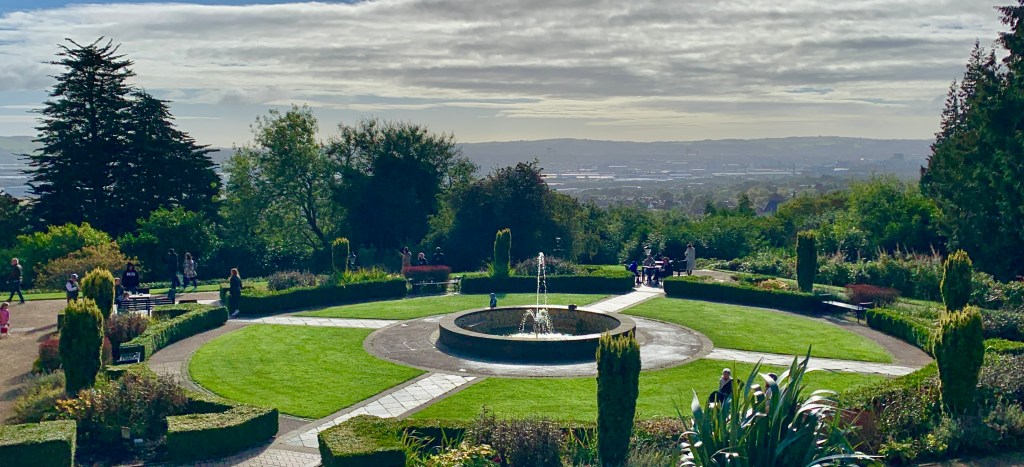
Although Cave Hill County Park is run by Belfast City Council. I have included it in this blog due to its very naturalistic feel, and very imposing presence, as it looms large over Belfast and the surrounding area which forms County Antrim.
The park is located on the northern fringes of the city, it covers an area of 300 hectares, the park was established in 1993, and is one of the most frequented areas of the Belfast Hills.
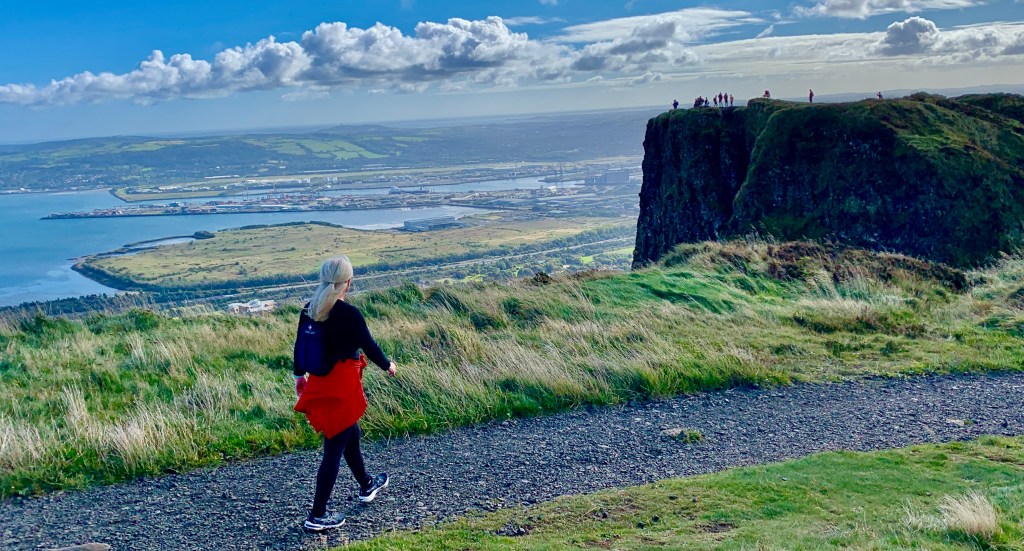
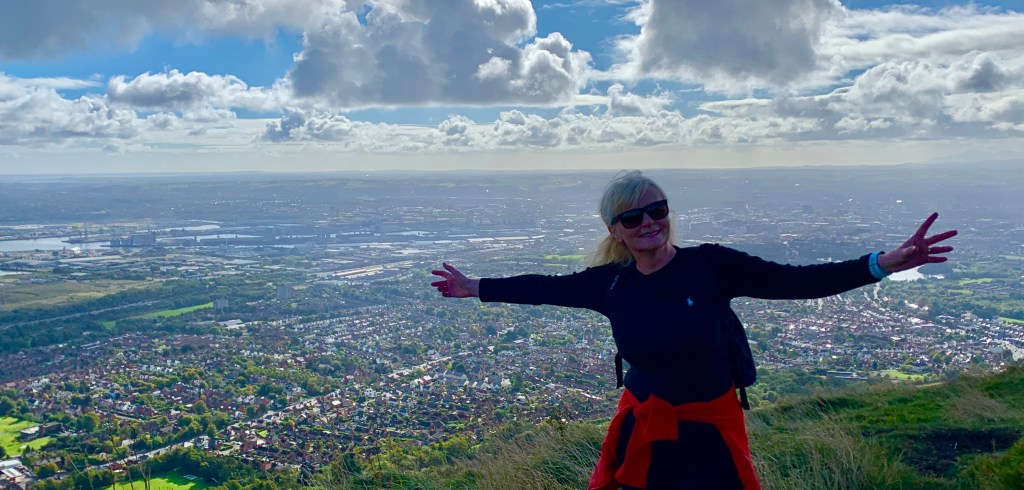
The main purpose of our visit was to walk the popular Cave Hill County Park circular trail route. This 4.5-mile trail starts and finishes at Belfast Castle. It gave us some fantastic vistas of the city and beyond, it took two hours to complete this walk. There are some less challenging routes to walk to enjoy this wonderful Country Park.
The first part of the walk can be physically challenging if you have little in the way of fitness, but for us it was ok. The steepest section is at the start of the walk as we ascended the mountain trail, this evens out, and the walk from there on is flat, you then begin a descent back down to Belfast Castle. It’s a much easier route if you walk it anti-clockwise rather than clockwise.
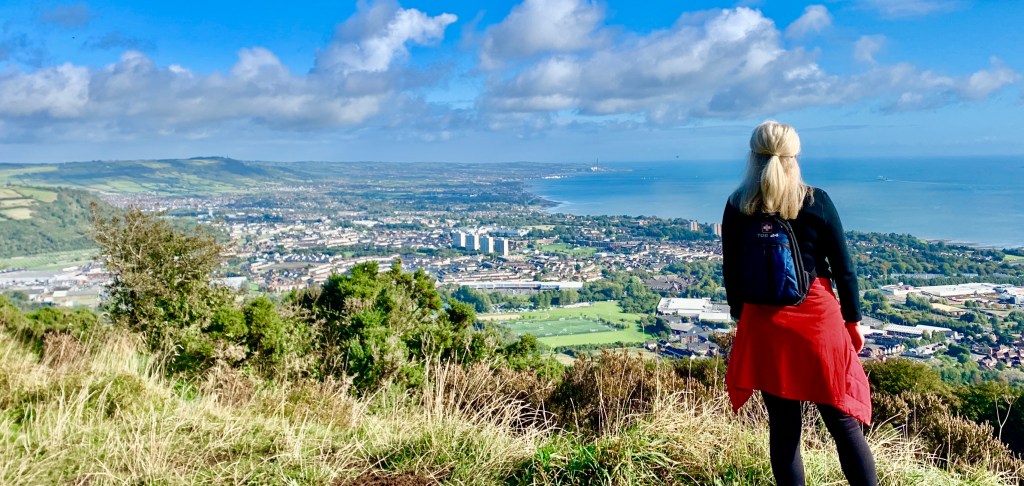
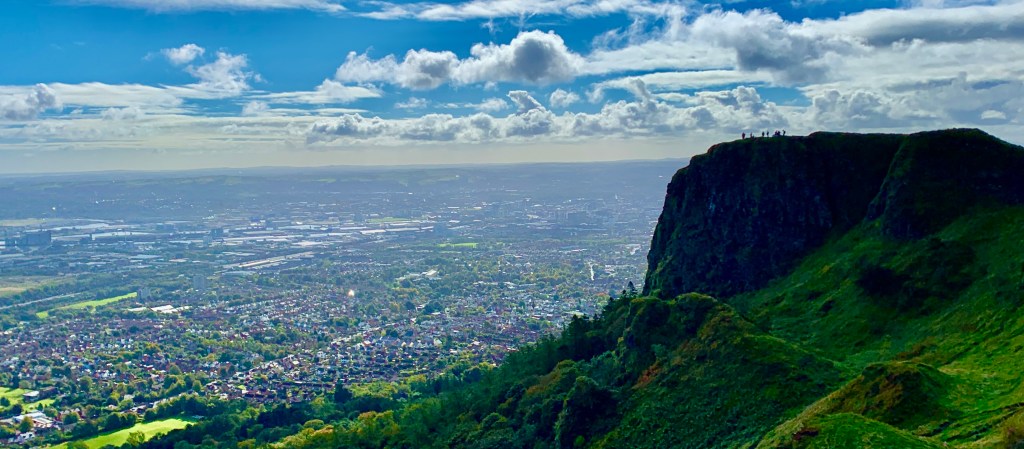
The highlight of the walk for me was the panoramic views of Belfast taking in the green hillside in which the ruins of McArt’s Fort can be found. The mountain itself is visible from most streets in Belfast and provides an imposing backdrop to the city.
At McArt’s Fort, we continued to get unobstructed views of Belfast, Belfast Lough, Mourne Mountains, the Irish Sea and Scotland from the 1207 feet (368) meters summit, with views like this, the effort was undoubtedly worth the reward.
Belfast Castle
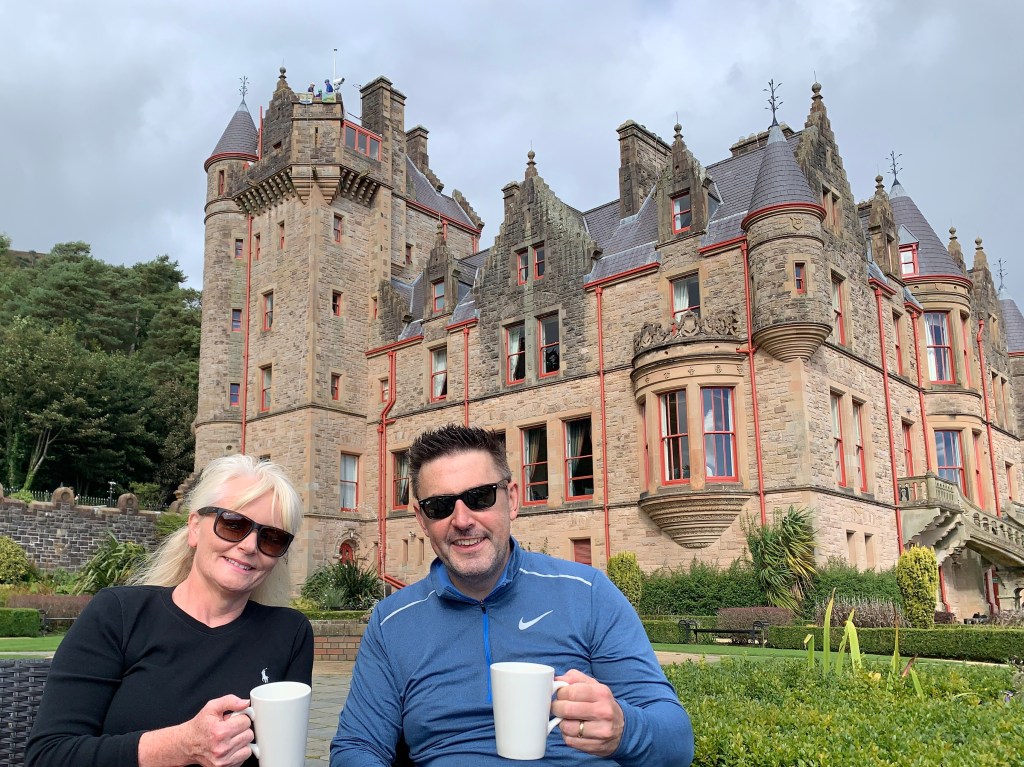
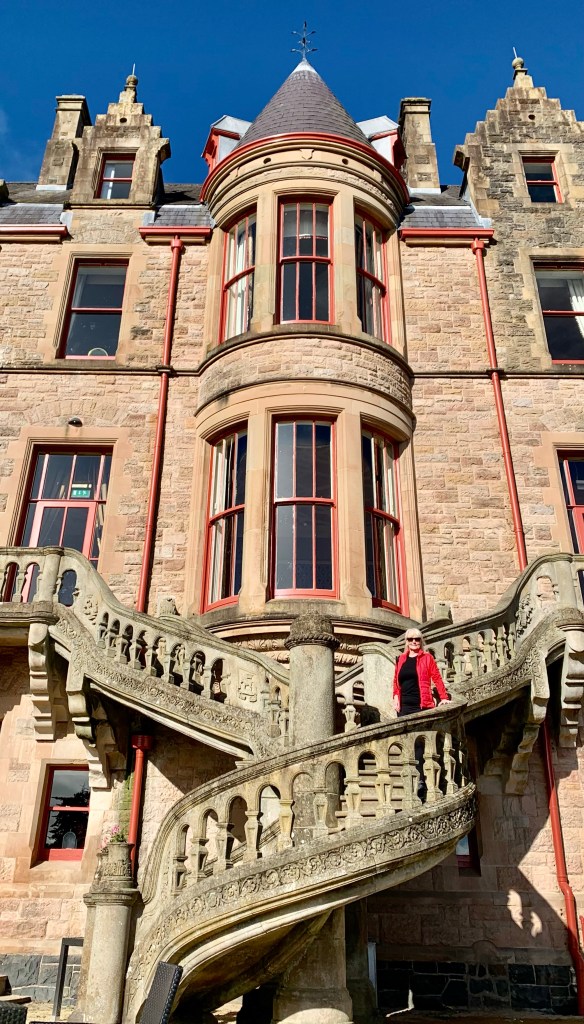
The castle sits in a prominent position in Cave Hill Country Park. As castles go it’s a little underwhelming, more stately home than a formidable castle. However, it was well worth a visit for the great trail walks and unobstructed views of Belfast.
Belfast Castle was the starting and finishing point of our walk to Cave Hill Country Park, we were able to enjoy a warm drink after we finished our trail walk, within the beautiful grounds, with the castle as a fabulous backdrop.
Although the castle looks relatively modern, built-in 1870 there has been a castle at this location since Norman times. The first castle was constructed in the late 12th century, and a second castle was built in 1611, which burnt down until the present castle was constructed.
The castle has extensive grounds and gave us spectacular views of Belfast and Belfast Lough. Unsurprisingly, because of its fantastic location, it is a very popular venue for weddings.
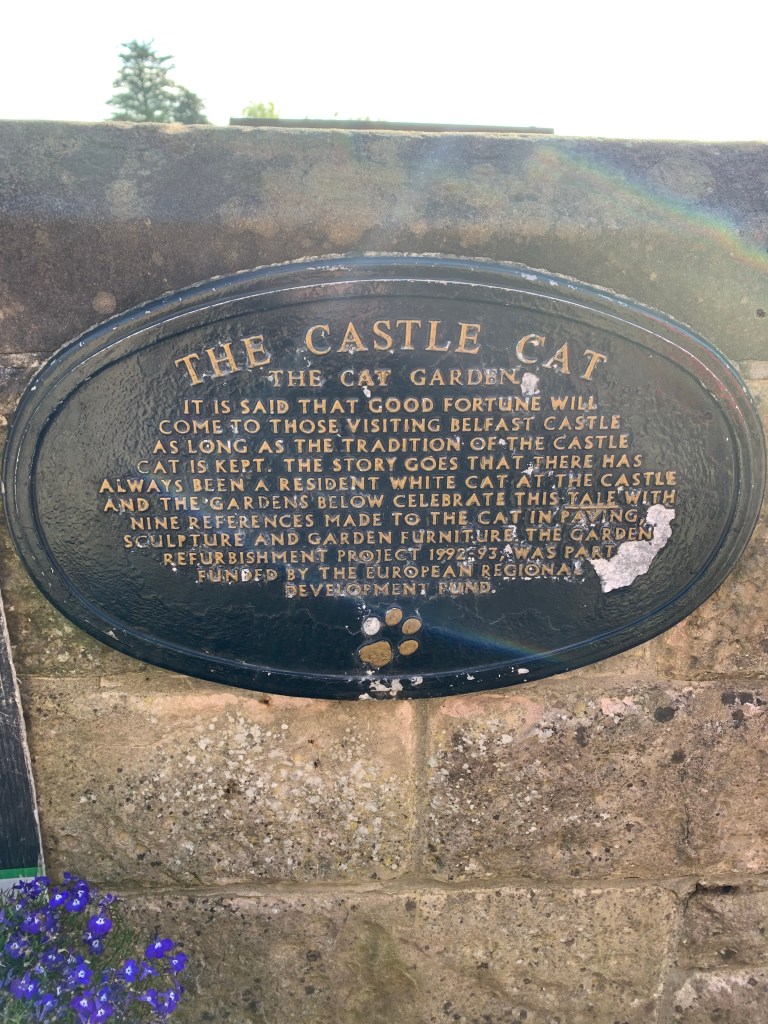
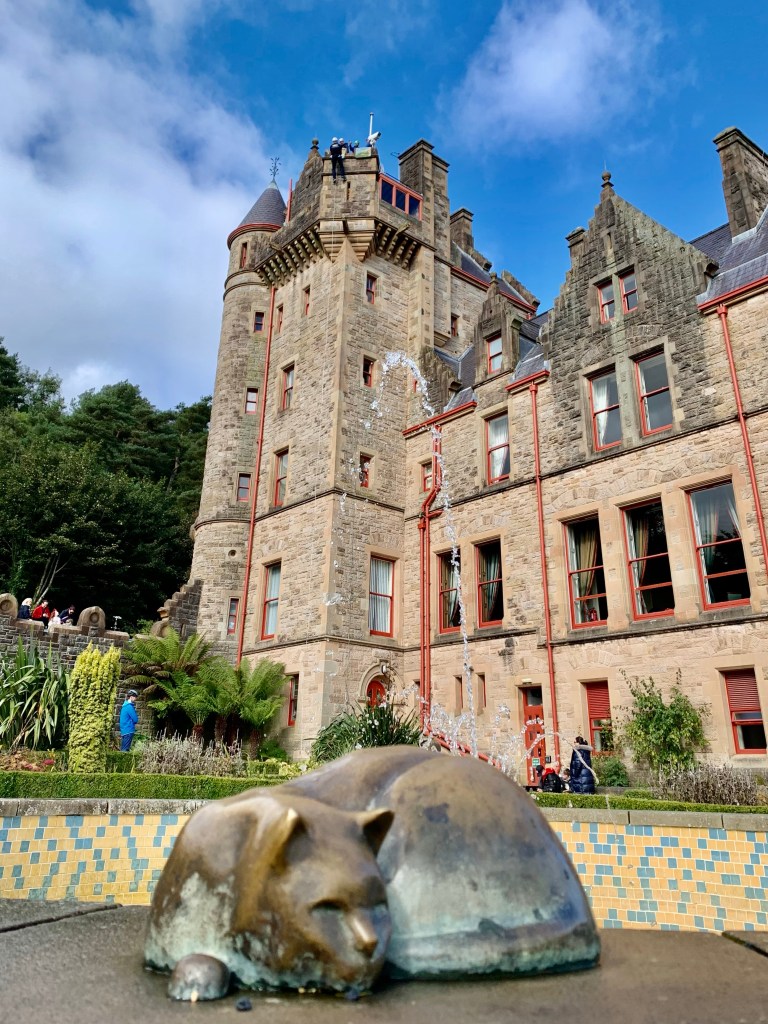
A rather unique aspect of Belfast Castle is the cat garden. As someone with four cats, this was always going to pique my interest. There has always been a cat at Belfast Castle, and it has been said that good fortune will come to those visiting the castle as long as this tradition is kept.
Within the immaculately kept castle grounds, nine cats have been added to the “cat garden” in the form of sculptures, topiaries and sculptures. It’s a bit like a cat treasure hunt, unsurprisingly there are no dogs allowed in the “cat garden” 🤣
Causeway Coast AONB
Established as an Area Of Outstanding Natural Beauty in 1989, it stretches from Larne to Ballycastle.
It may be small in area and less than thirty miles in length, nonetheless its rugged beauty soothes the eyes and soul, with an abundance of stunning views, historical sights and geological wonders to discover.
The Causeway Coast AONB is known the world over due to its Giant’s Causeway World Heritage Site, Northern Ireland’s first and to date only World Heritage Site. The Causeway Coast for me personally was certainly one of Northern Ireland’s highlights.
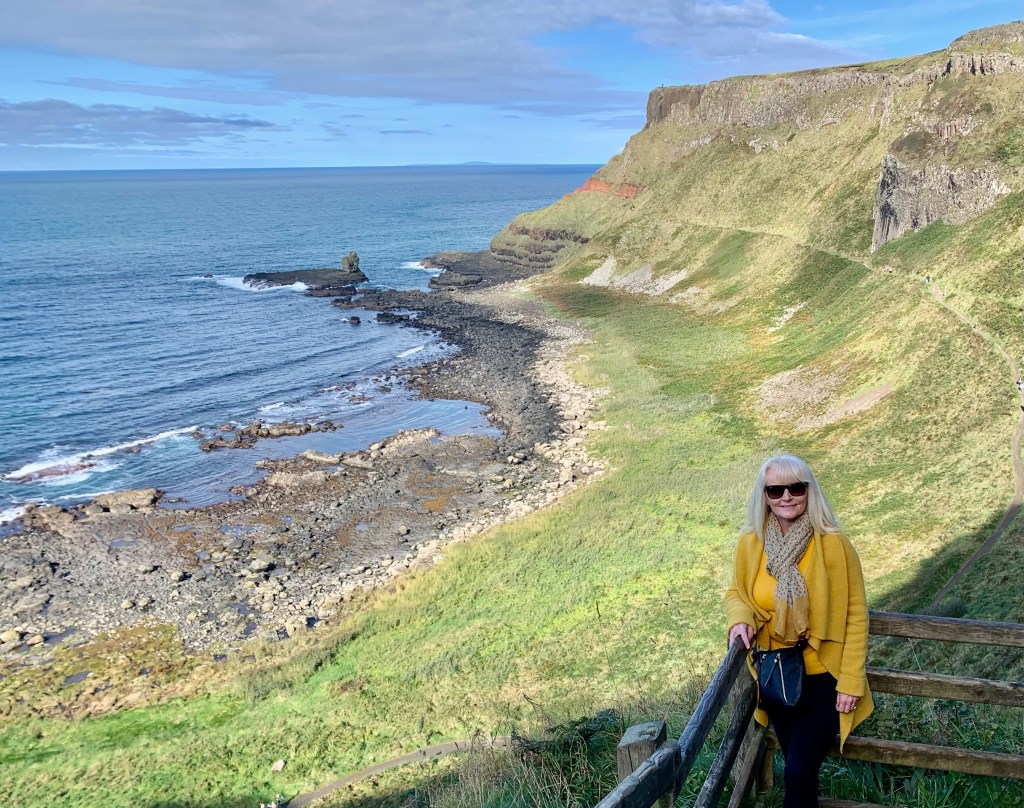
The unique geology of the area has formed this spectacular coastal scenery. Volcanic rocks have formed at this particular location which provides a dramatic backdrop as the cliffs plunge into the sea.
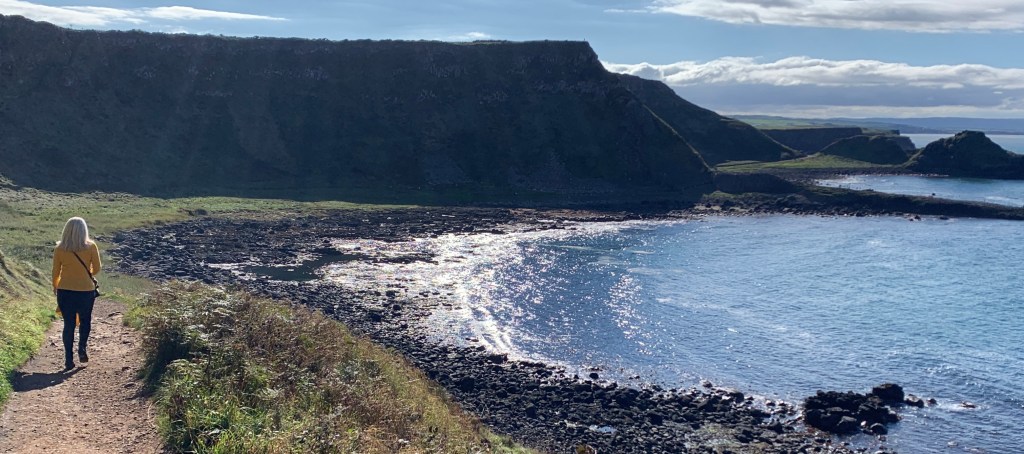
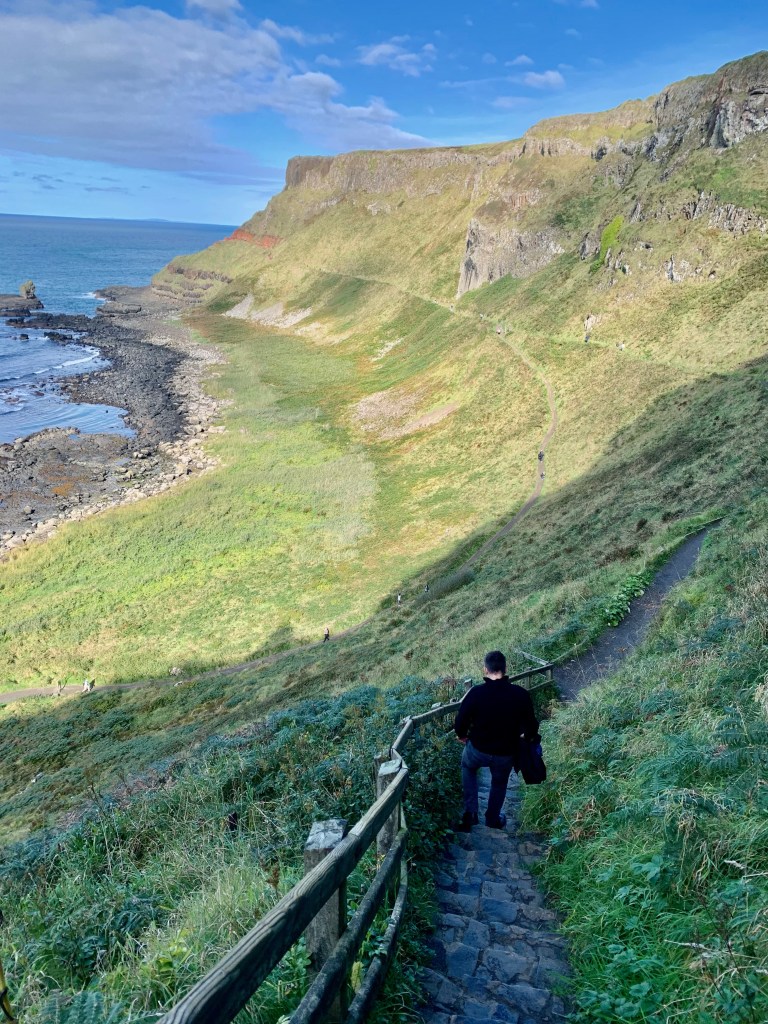
Due to time constraints, we were only able to discover a small section of the coast. We followed one of the trails from The Giant’s Causeway which hugged the cliff edge as we then descended to the seafront looping back to the Giant’s Causeway.
A walk that was just over 3 miles (5 kilometres) where the landscapes varied enormously. Contrasting with this wild coastal scenery are the gentler landscapes of woodland and farmland.
Giant’s Causeway World Heritage Site
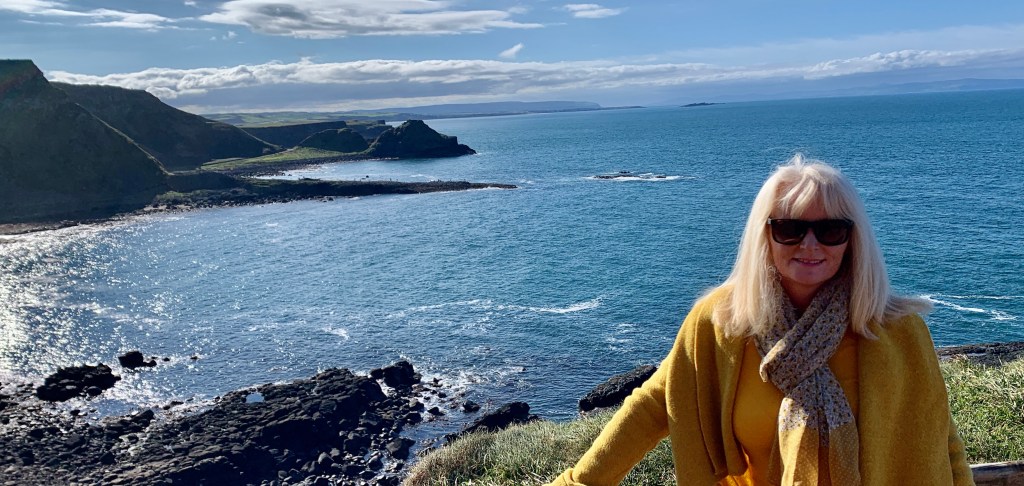
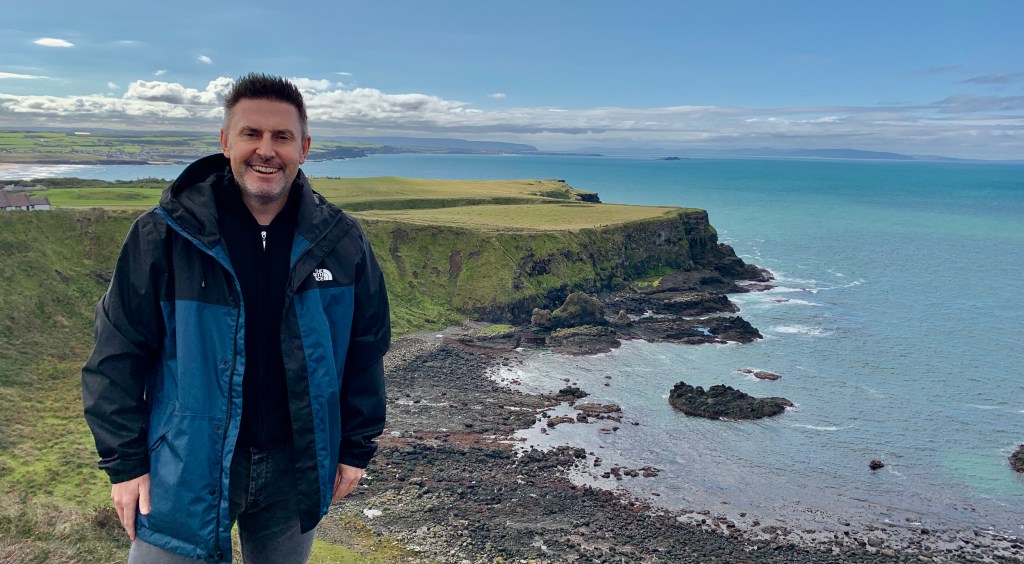
The Giant’s Causeway is located in County Antrim on the northeastern coast of Northern Ireland.
It was affirmed as a World Heritage Site by UNESCO in 1986, and a nature reserve in 1987 by the Northern Irish Government. It is one of the UK’s greatest natural wonders.
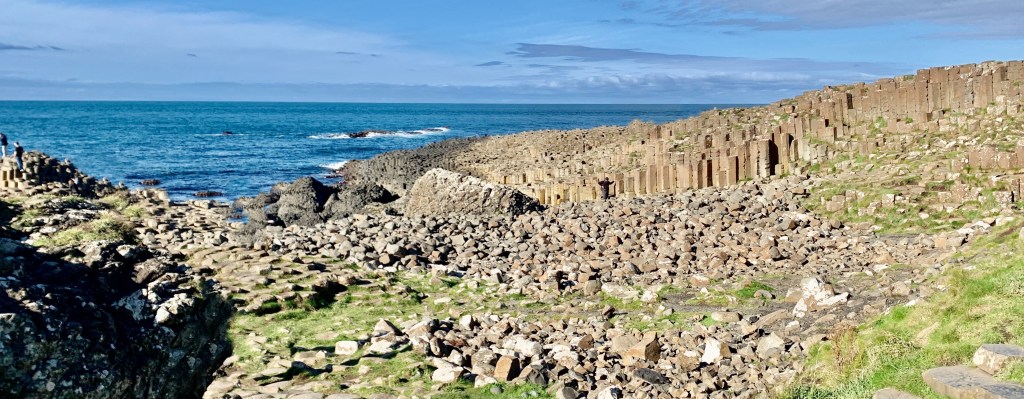
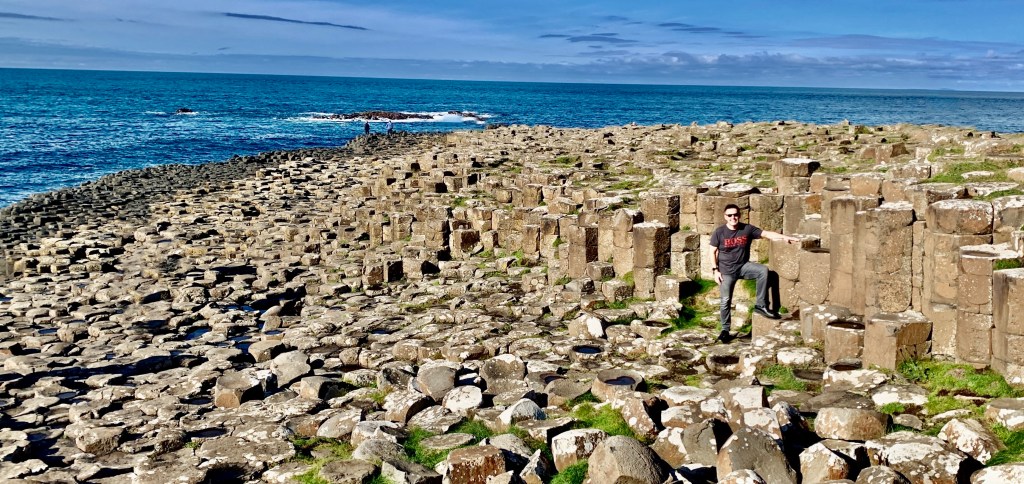
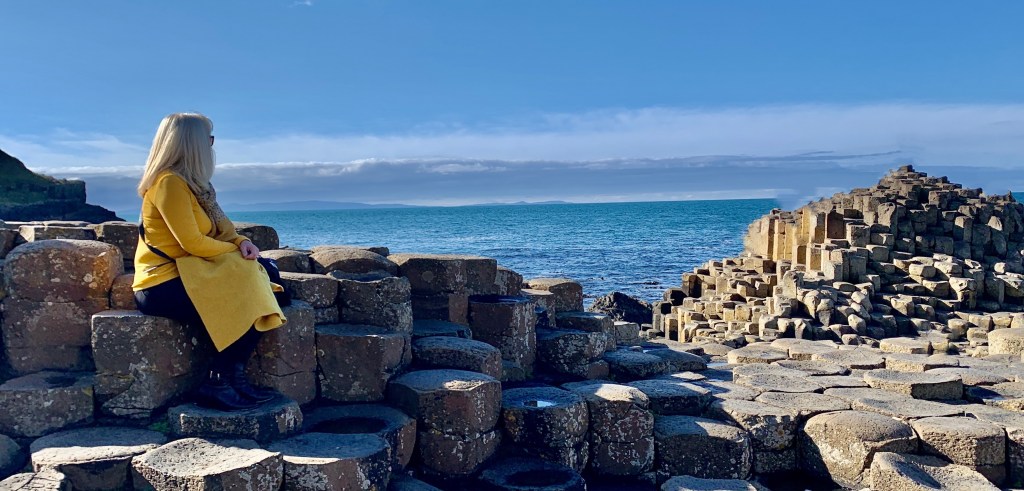
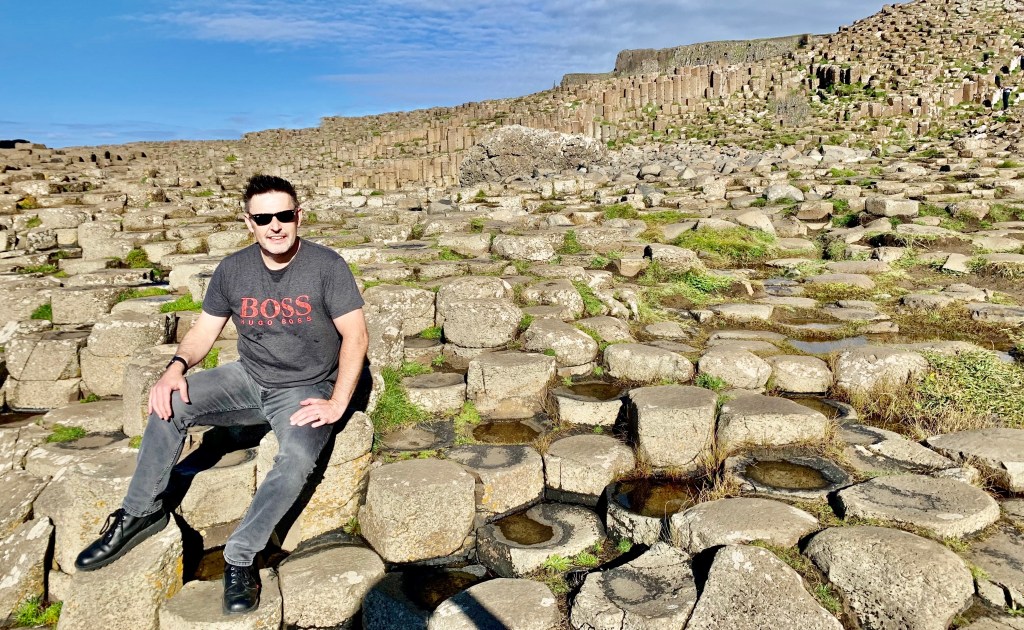
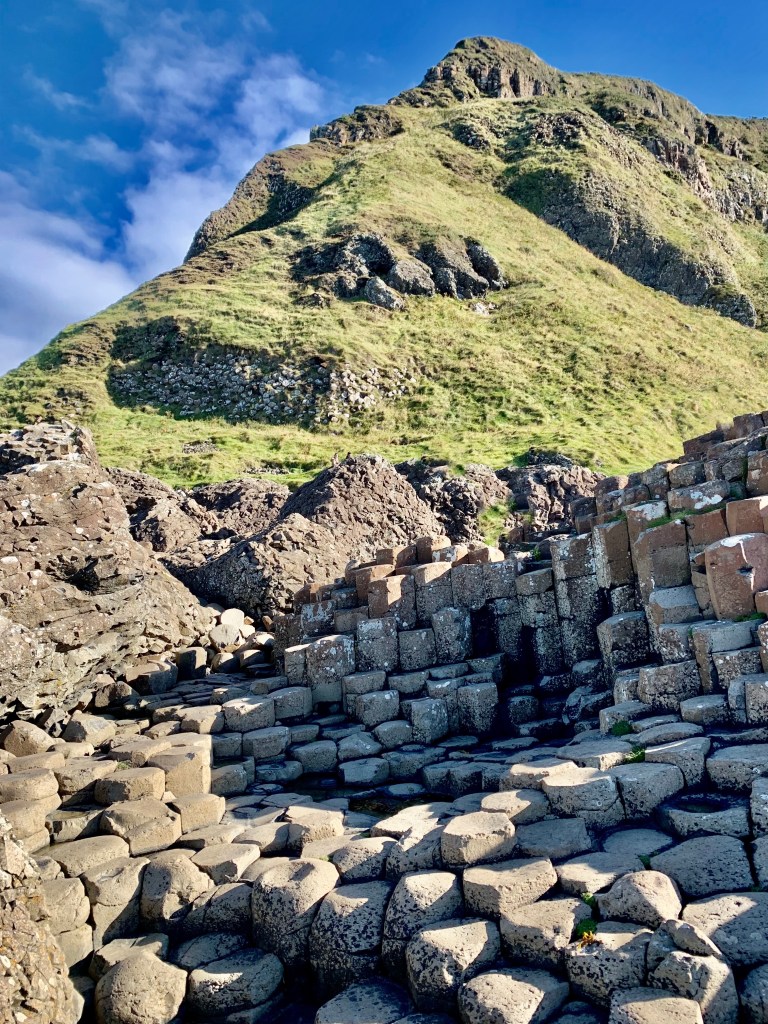
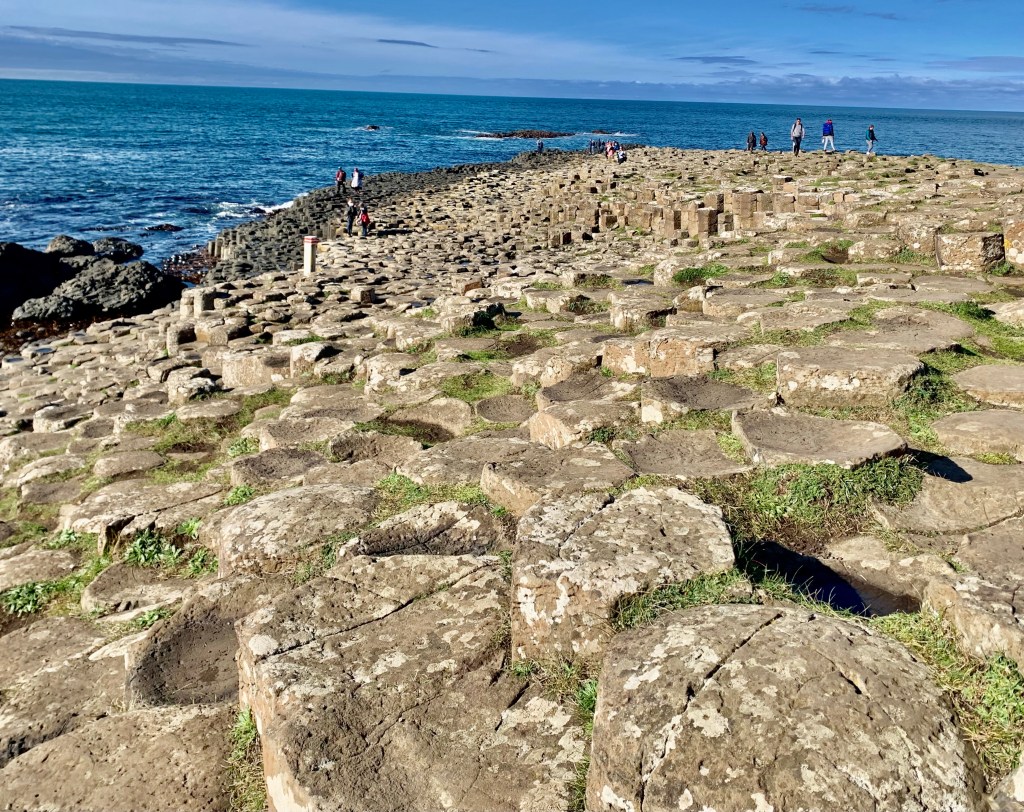
The Giant’s Causeway is an area of 40,000 interlocking basalt columns, the result of an ancient volcanic eruption.
The tops of the columns form stepping stones that lead from the cliff foot and disappear under the sea. Most of the columns are hexagonal, although there are some with four, five, seven and eight sides.
For centuries The Giant’s Causeway has been a place where myth and legends meet. Where the spectacular basalt columns formed through the rapid cooling of lava from an underwater volcano, or as some may say, created by the legendary mythical Irish Giant Finn MacCool??
Today The Giant’s Causeway is one of Northern Ireland’s most visited locations. Situated on one of the world’s most spectacular coastlines, its unique rock formations have, for nearly 60 million years stood as a natural barrier against the continual ferocity of the North Atlantic storms.
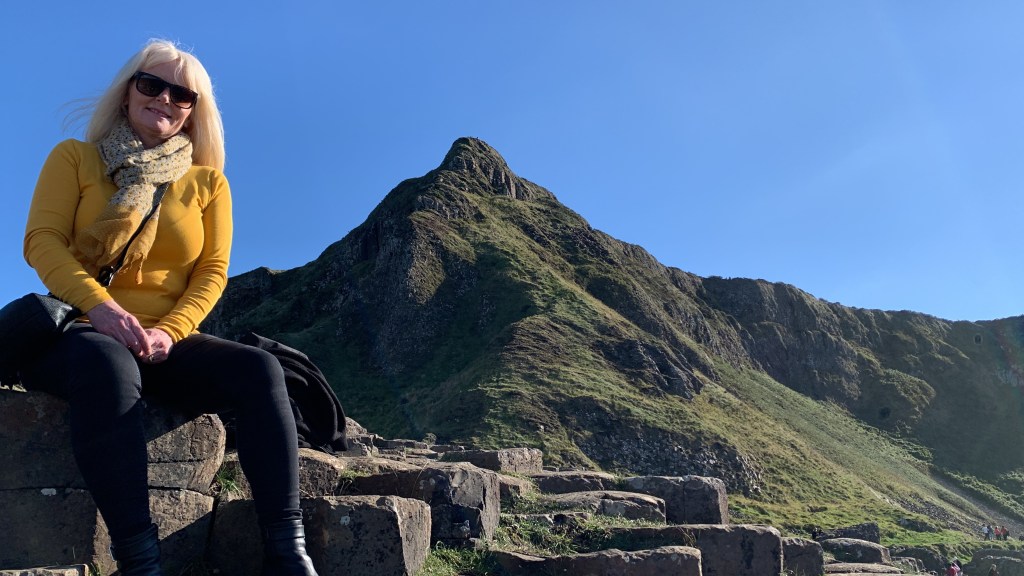
Although I have seen pictures of The Giant’s Causeway many times, nothing compares to viewing it for yourself. The rugged symmetry of the columns amazed and intrigued me. One of the natural wonders of the world.
Today much of the Giant’s Causeway is owned and managed by the National Trust. Access to the Giant’s Causeway is free. There is a visitor site which charges an entry fee, being the National Trust this will not be cheap, and in all honesty, it won’t add any value to your visit to the Giant’s Causeway. Just enjoy the beautiful natural surroundings and unique geology.
Bushmills Irish Whiskey distillery
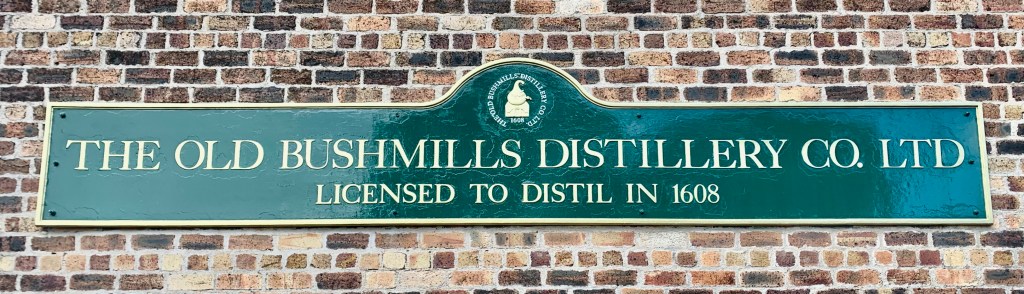
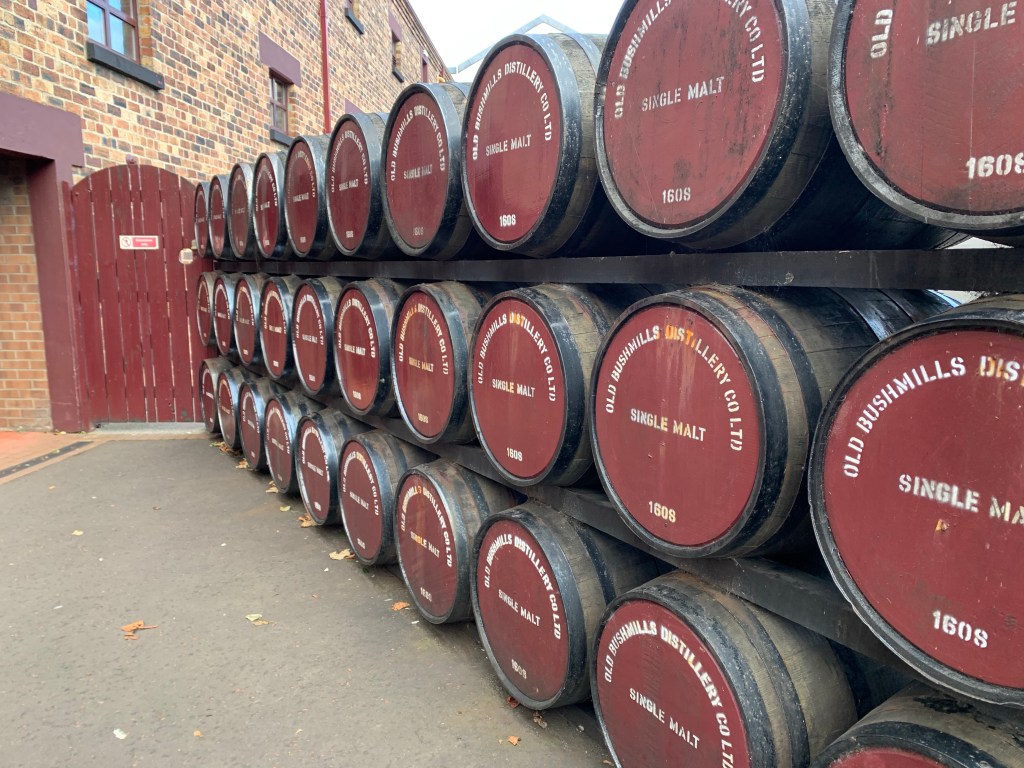
The old Bushmills Distillery is an Irish Whiskey Distillery. A popular visitor attraction, only a few miles from the Giant’s Causeway, well worth a short stop on your way back from The Giant’s Causeway.
Ireland has a long history of whiskey distillation and Bushmills is the oldest working distillery on the island of Ireland.
Tours are available which give a full guided tour of the distillery to see how this famous spirit is made and understand all about the distilling process.
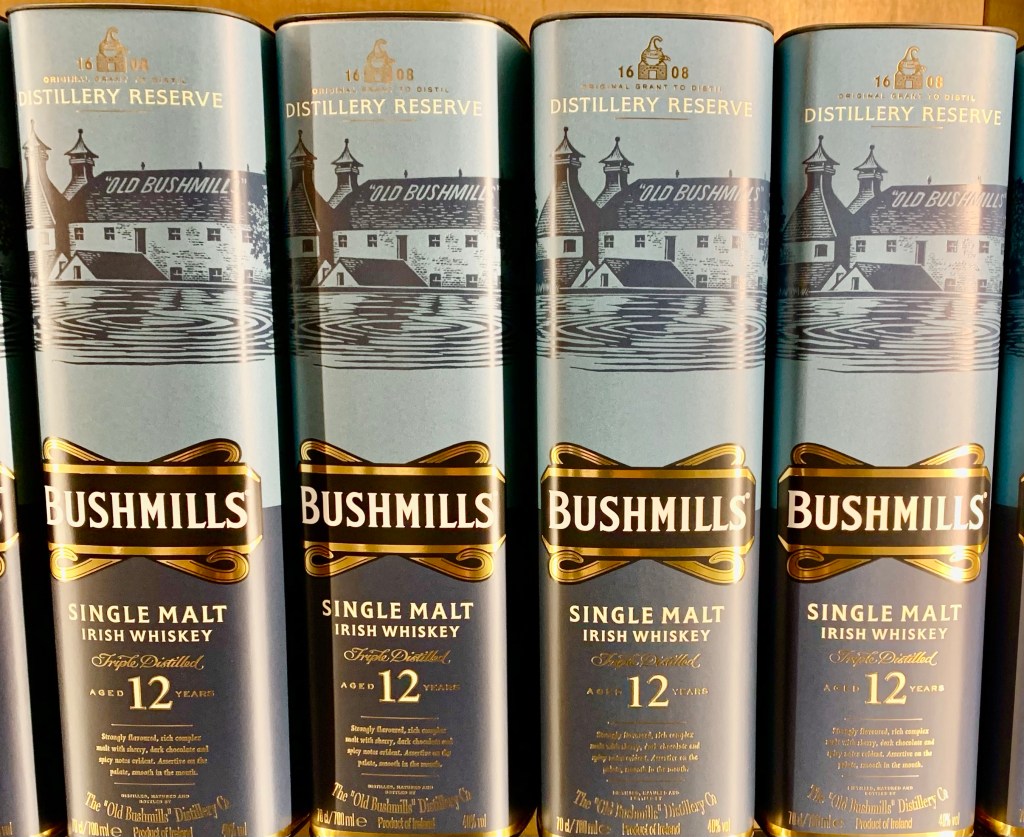
You don’t have to take a tour of the distillery, part of the distillery is open to the public. This inevitably includes the Bushmills shop where whiskey and other merchandise are available to purchase. Whatever you decide it’s an interesting stop and worth a short visit.
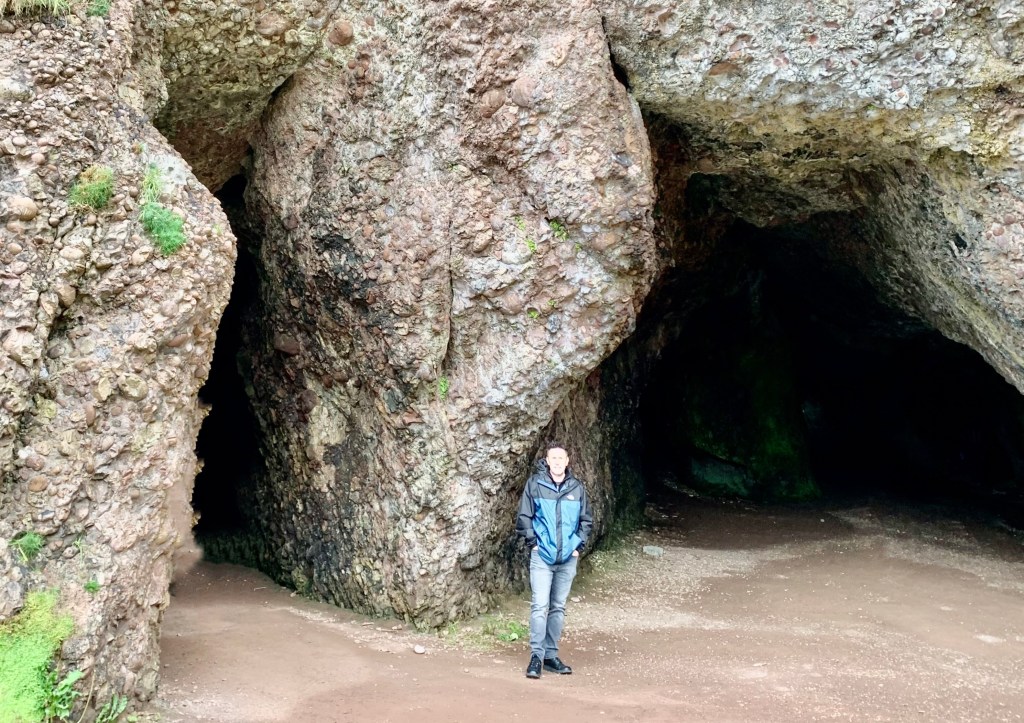
Cushendun Caves
One of the Locations where Games of Thrones was filmed. A lot of Games of Thrones was filmed on location in this part of the Antrim Coast.
The caves are very old and situated on the picturesque Antrim Coast. They have only recently come to prominence due to the caves being a filming location for Games of Thrones.
Easily accessiblee next to Cushendun Beach. The area has been formed by over 400 million years of natural erosion.
It was a stop on an organised tour to The Giant’s Causeway. If I’m being honest it was of little interest to me, but Game of Thrones fans seemed to be pretty enthralled with the location.
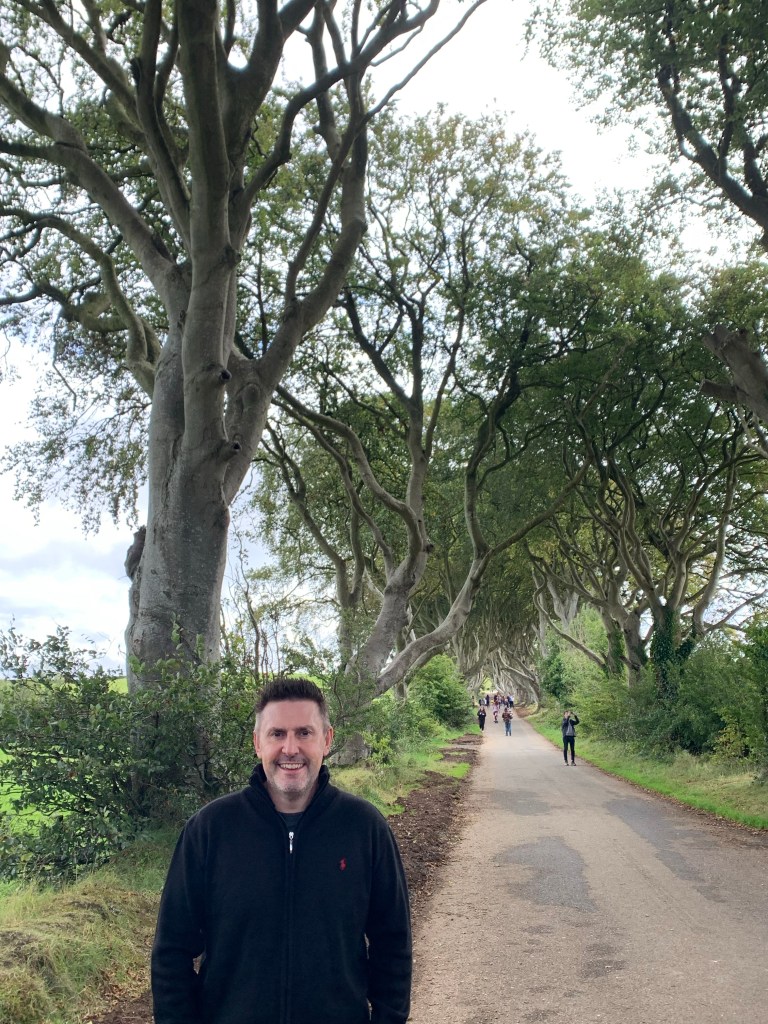
The Dark Hedges
The Dark Hedges is an avenue of beech trees, which forms an atmospheric tunnel, another location that has been used in Game of Thrones.
Having never seen an episode of Games of Thrones this location although very atmospheric and picturesque meant very little to me, although unlike Cushendun Caves I found this location much more photogenic.
It’s a very popular area and is probably Northern Ireland’s most photographed location. To have the eerie, silence and picture-perfect opportunity you will have to visit very early. It is in a rural location so you will have to visit by car or organise trips.
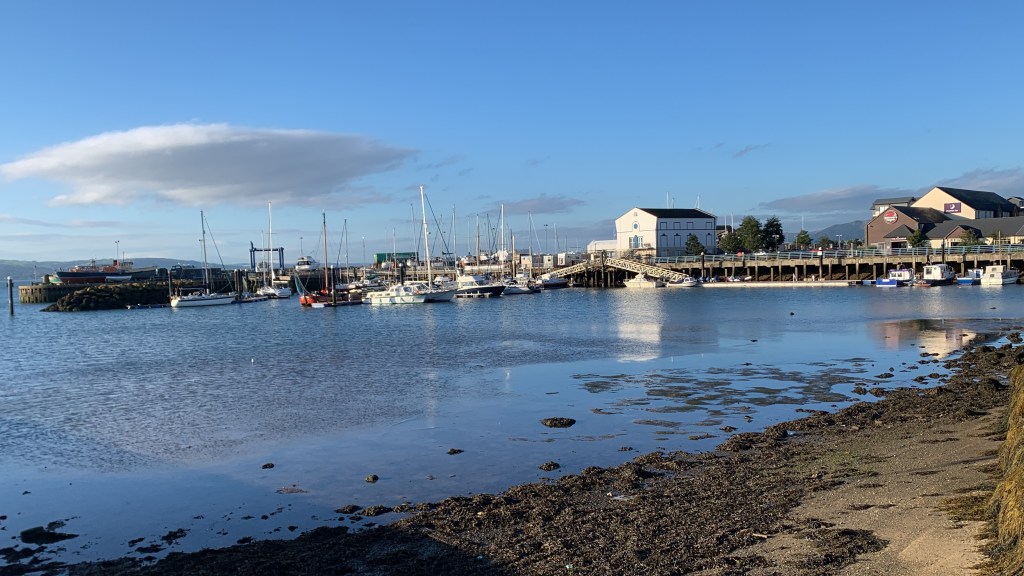
Carrickfergus
Carrickfergus sits on the north shore of Belfast Lough and is one of Northern Ireland’s oldest towns.
Carrickfergus is close to Belfast although as a town it considerably predates Belfast and the town has great historical significance. It is the start of the Antrim Causeway Coastal Route.
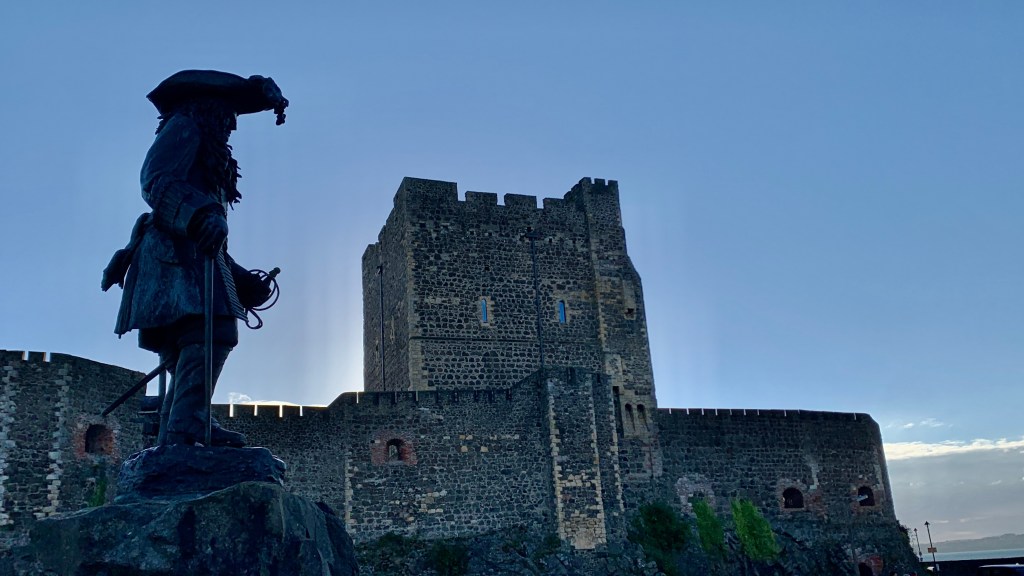
It has great historical significance as it is the place where King William III first set foot in Ireland, his victory against the Catholics at the Battle of the Boyne is still celebrated by Protestants to this day.
It had a small but significant role in the American War of Independence where a naval battle between American and British forces took the place off the coast of Carrickfergus.
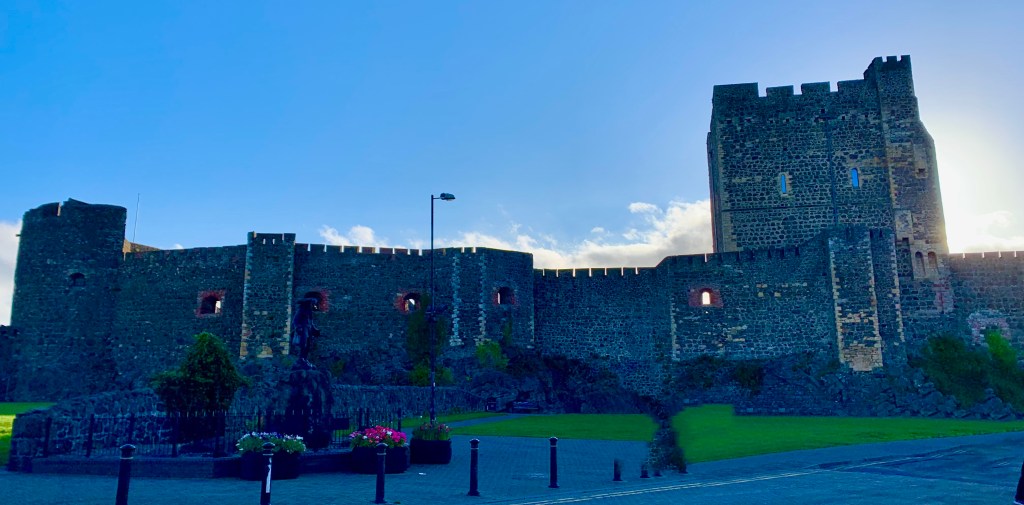
Although Carrickfergus is most famous for its castle, which dates back to the 12th century. During its long lifetime, it has survived multiple sieges from Scottish, Irish French and English, forces, despite this Carrickfergus Castle remains one of the best-preserved medieval structures in the country.
A historic yet modern city which has moved on. It’s a measure of what can be achieved by a community working together.
A first-time visit to Northern Ireland’s capital Belfast. Born in 1970 the Belfast I grew up with was a city which was seen in the media, as a city defined by violence, anger, danger and a deep social divide.
The Belfast I visited today was a remarkably different city, a vibrant place which welcomes visitors warmly. Numerous great old landmarks have been refurbished. This has come about partly through tourism and hospitality, which the city has developed and grown over the past 20 years.
The city has placed its problems to one side trying to rebuild itself. It hasn’t always been an easy journey, but by being patient, progressive and showing faith in its people the process has evolved.
Occasionally the troubles and tensions are seemingly not far away, which one can see from the current political landscape. Nevertheless, the people and communities, are looking towards a brighter future. The Belfast of today is incomprehensible to the one of just 30 years ago.
Belfast City Hall
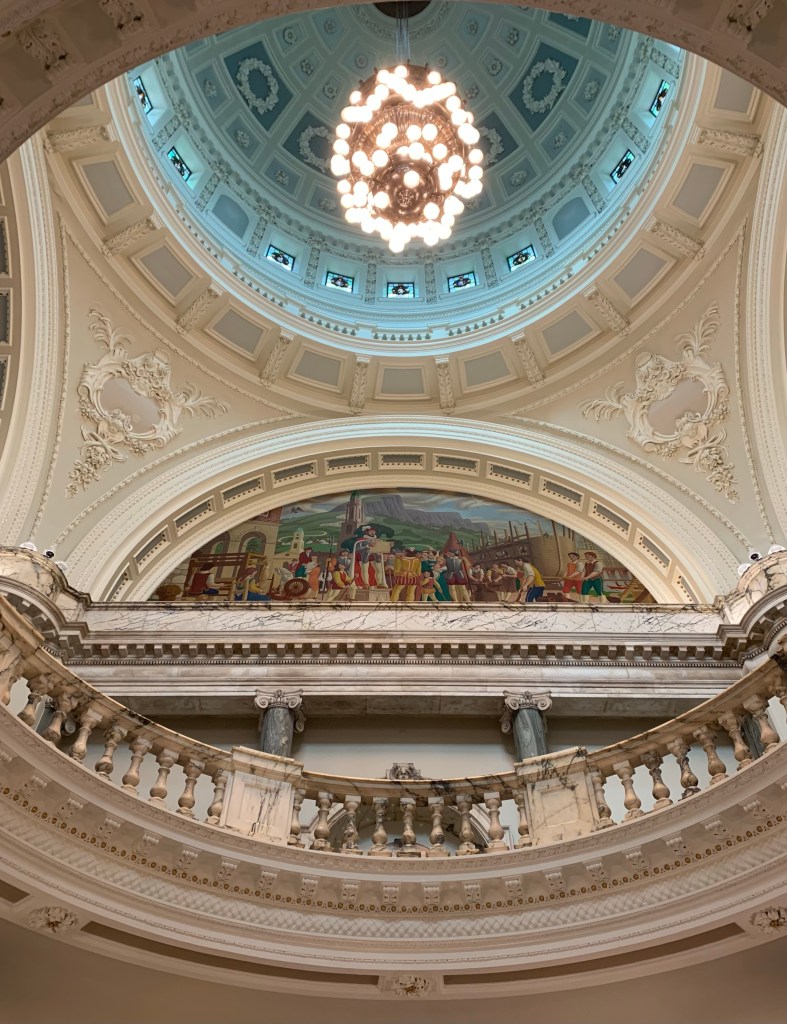
This a rather unique opportunity for us to take a guided tour of Belfast City Hall, one of Belfast’s most iconic buildings, to see first-hand where the democratic process takes place.
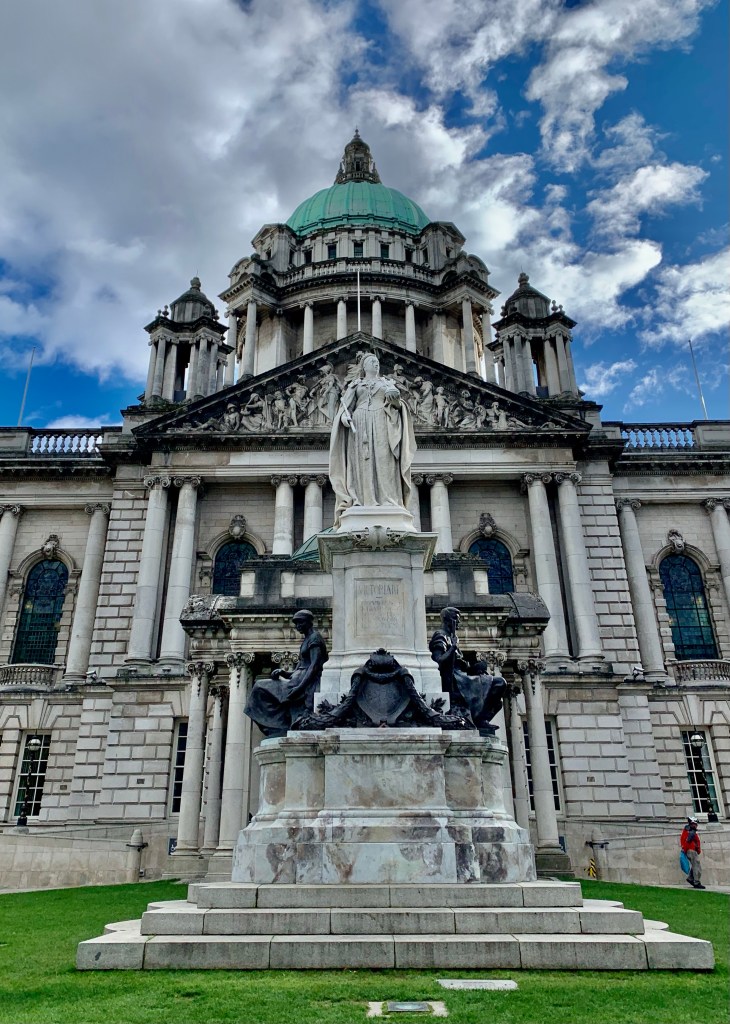
Belfast City Hall is a classic Renaissance-style city hall. It is situated in Donegal Square in the heart of Belfast city centre. It has beautiful architecture and incredible history to discover.
The industrial revolution greatly transformed Belfast in the 19th century. The city’s rapid rise to prosperity is reflected in this Grade I listed building. It was designed by Arthur Brumwell Thomas, in a Baroque Revival style. It officially opened in 1906.
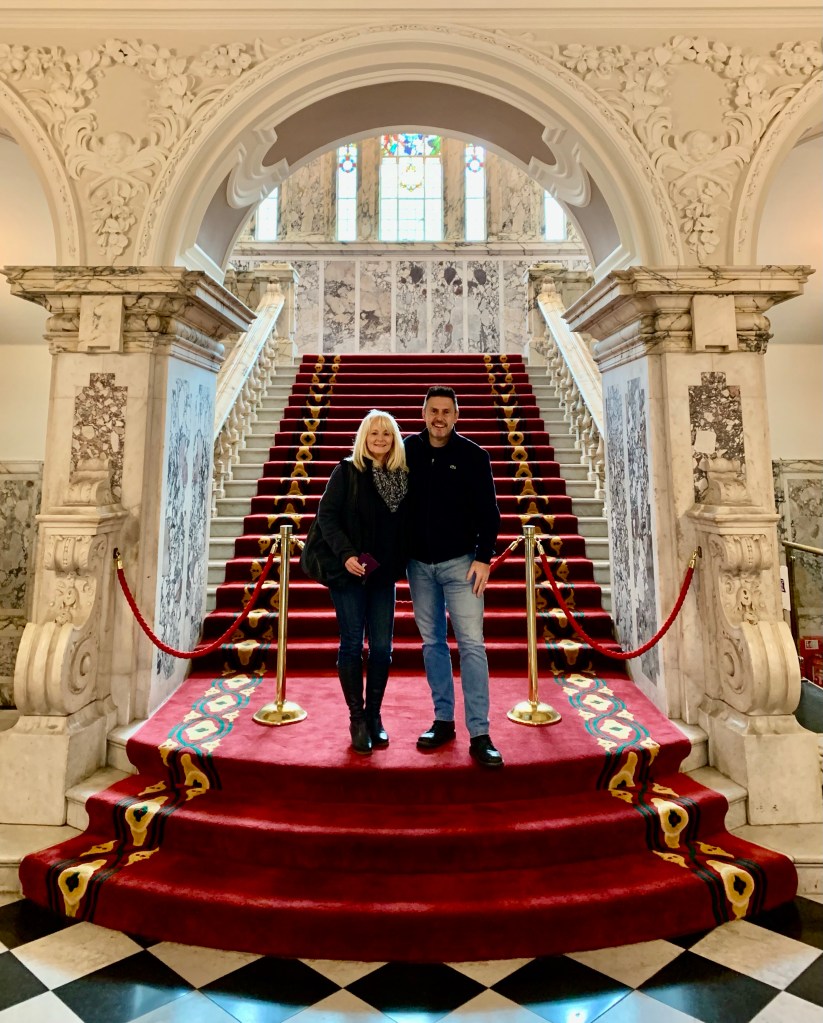
The Grand Staircase at Belfast City Hall
Tours can be taken at 11 pm, 2 pm and 3 pm Monday to Friday and 2 pm and 3 pm Saturday and Sunday. These tours are free of charge and pre-booking is not required, there are 25 places per tour which are on a first come first served basis.
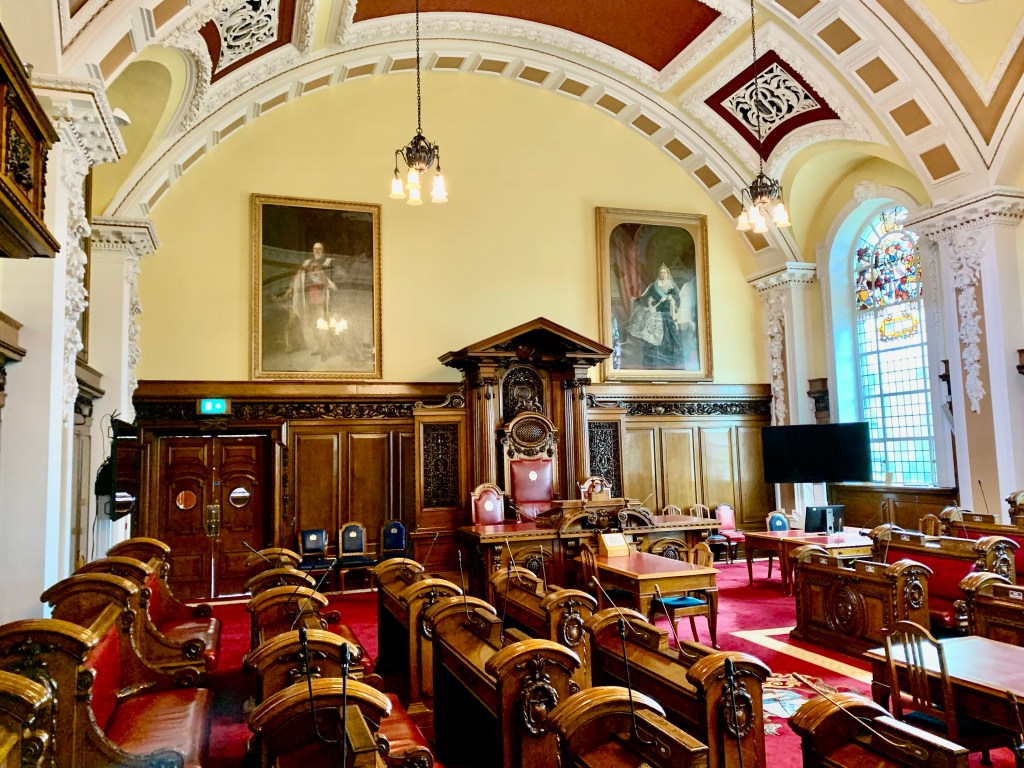
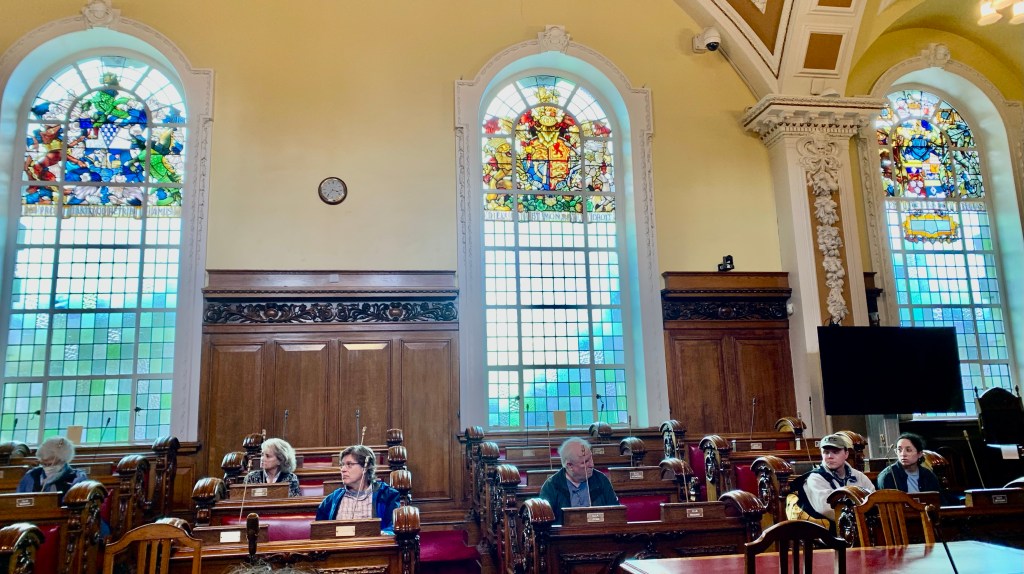
Council Chambers
It gave us a special opportunity to look at how local government works. We were given a tour around this grand old building. Taking in the many artefacts on display and viewing the grand rotunda and many of the official rooms including the City Rooms, Council Chambers and the main hall.
Sixty councillors represent the city of 342,000. Belfast is Northern Ireland’s smallest council in land area but the largest in population.
On the tour of Belfast City Hall, we were able to sit in the council’s chamber. Historically Belfast council used to be divided along religious lines, in more recent times non-religious political parties have gained in popularity, one of these the Alliance Party is the third largest party after traditional political parties, Sinn Fein which represents the national side and Democratic Unionist representing unionists.
Crumlin Goal (HMP Belfast)
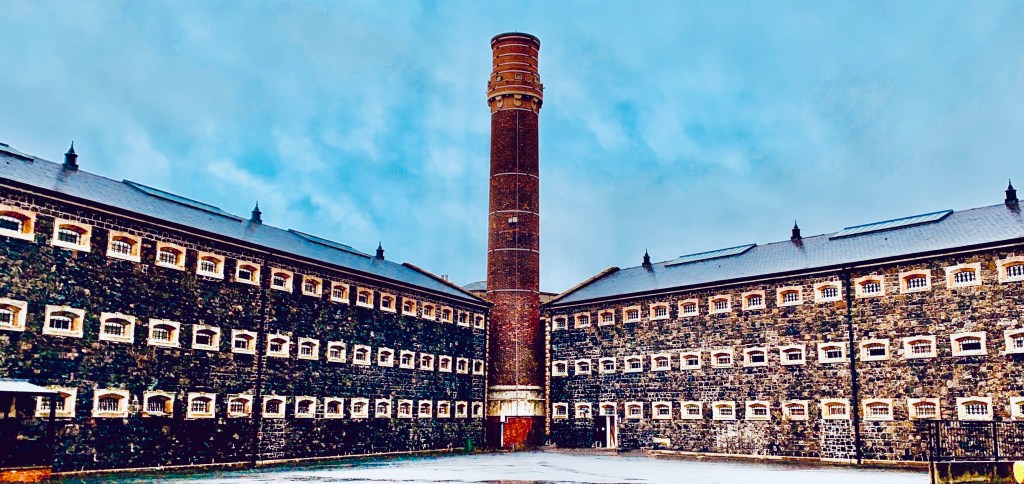
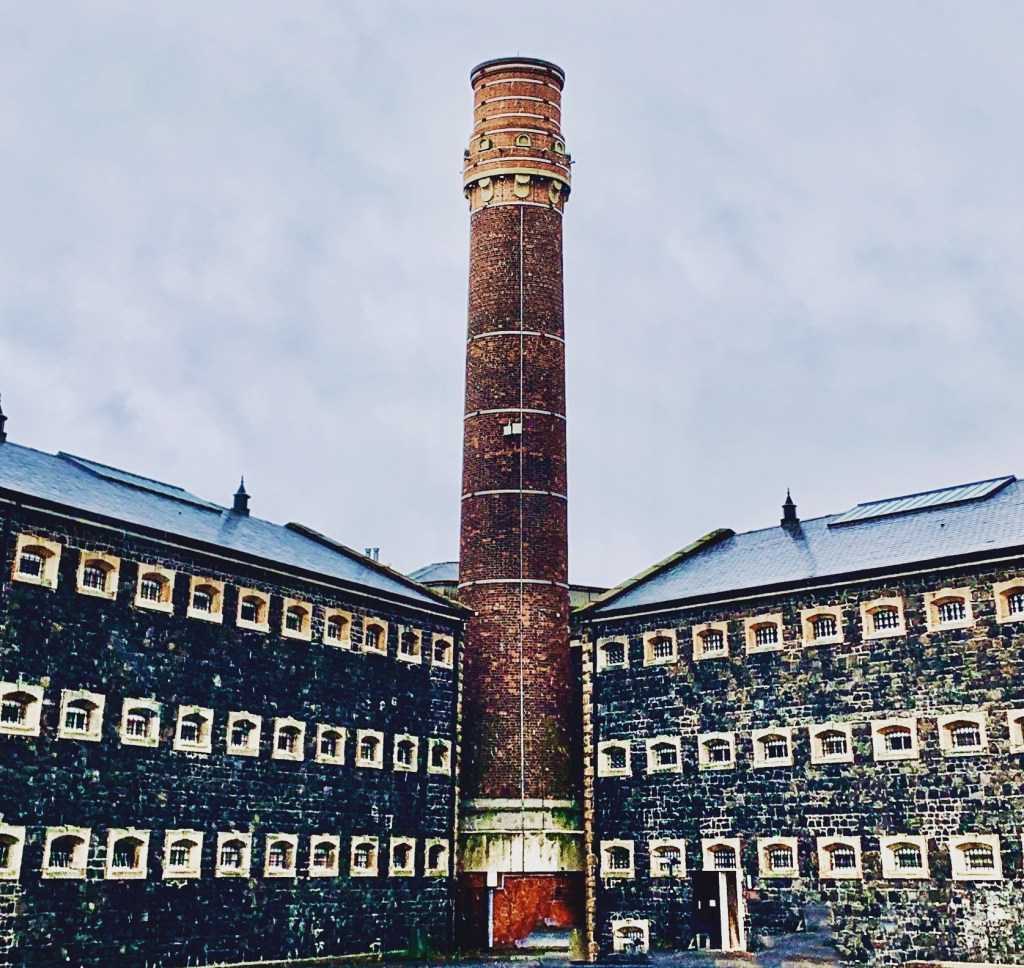
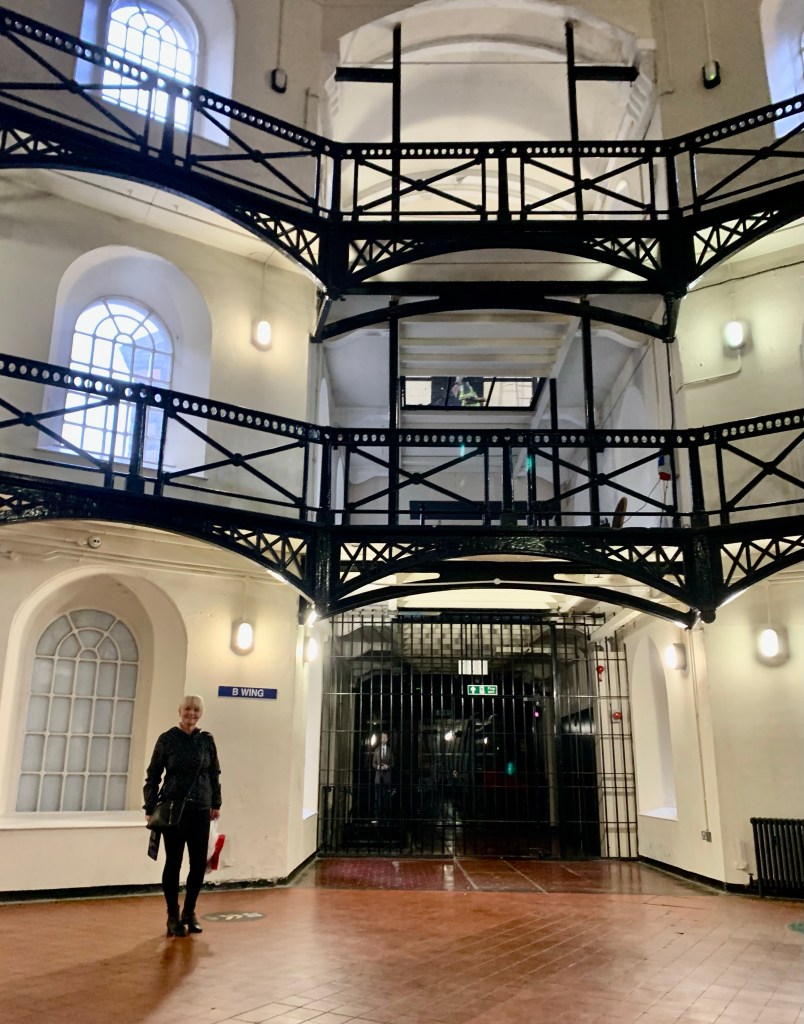
HMP Belfast or the Crum as it was colloquially known is a prison that closed in 1996 and is now a popular visitor attraction.
It remained empty, many thought it would remain closed for good. However, plans were put forward to convert the jail into a major visitor attraction and conference centre. The chains finally came off and it opened in 2012.
This Grade A listed 19th century is the only remaining Victorian-era prison in Northern Ireland. The first inmates arrived in 1846. During its 150 years as a prison, it has housed murderers, suffragettes, loyalists and republican prisoners.
In later years it became greatly associated with The Troubles due to it holding many prisoners with terrorist convictions and at times the jail could become three prisons, one section holding general prisoners and a section each for Republican prisoners and Loyalist prisoners.
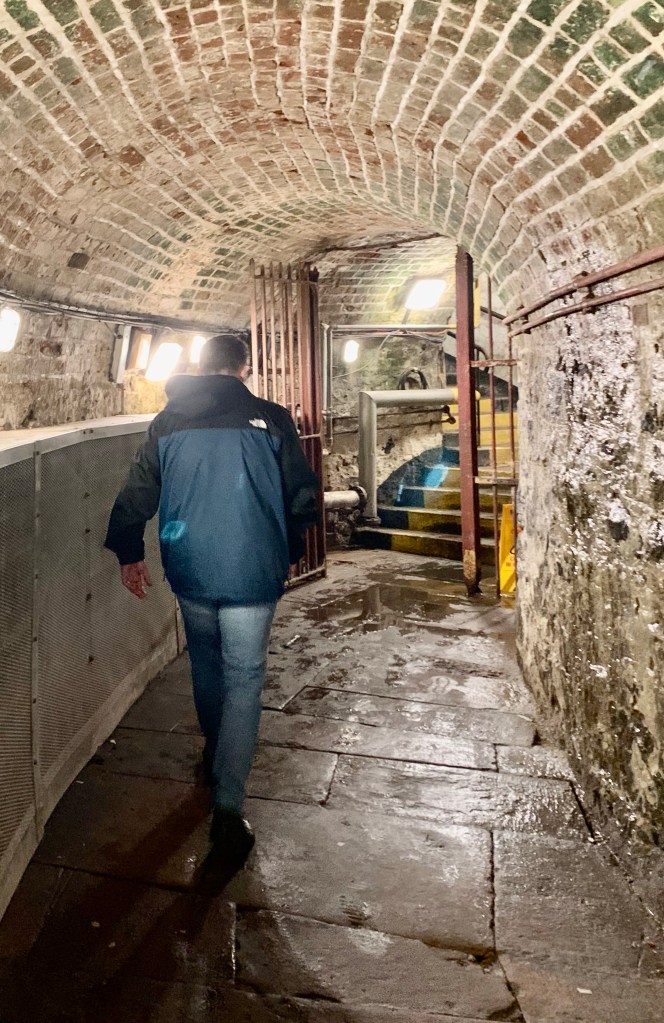
There is a tunnel which goes underneath the road and links the prison with the former courthouse opposite, which was used to transfer prisoners between the two locations.
Today it’s a popular visitor attraction. We took a tour around the jail and experienced for ourselves what life was like there. Through the testimony of former prisoners, multimedia displays and historical records and artefacts. The jail is much more than a museum more a part of Belfast’s political, social, religious and paramilitary history.
Black cab tours
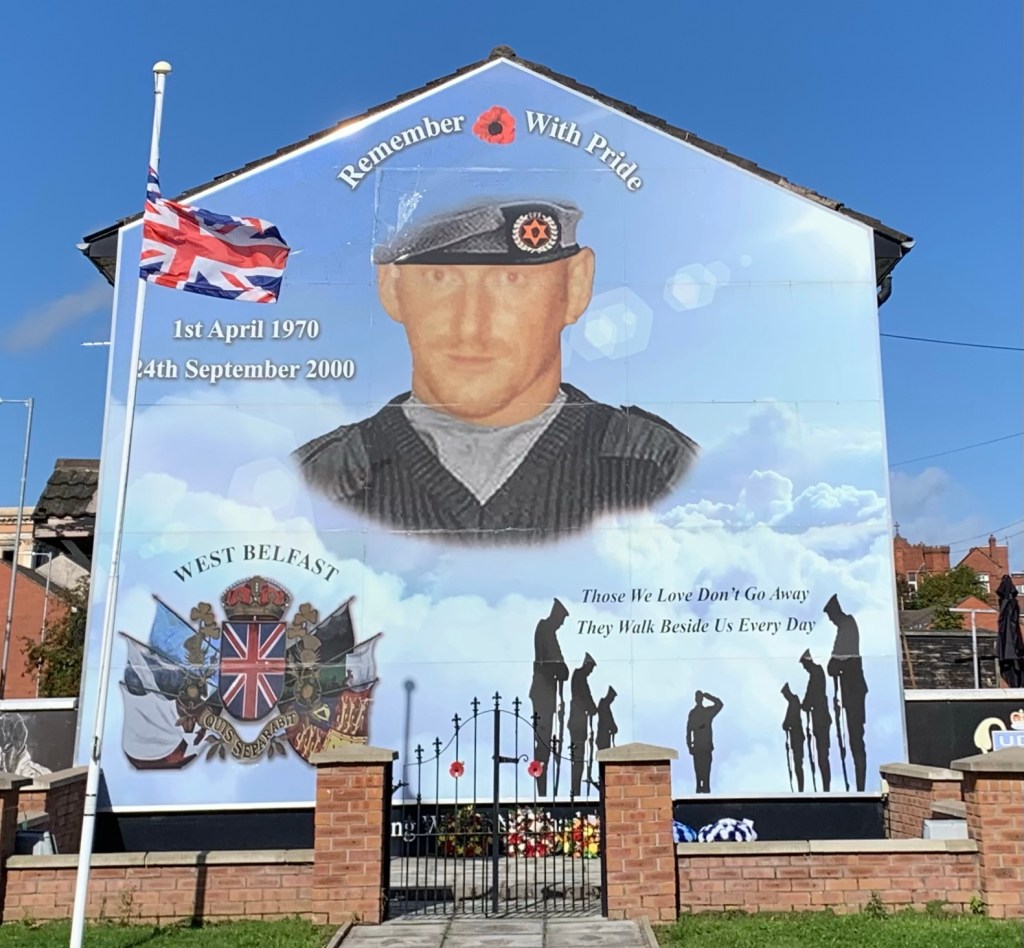
Northern Ireland has a complicated past. This can be seen in Belfast. We had a black cab tour of West Belfast, a flashpoint area where many atrocities occurred during The Troubles.
Although I could have easily spent a day looking at the numerous murals throughout the city, many of them are non-political.
Whether you think that this is sectarian voyeurism? or gives an insight into the political, religious, economic and social schisms that have blighted Belfast in the past. One certainty their significance, past, present or future can not be ignored.
Paramilitary mural on the Shankhill Road.
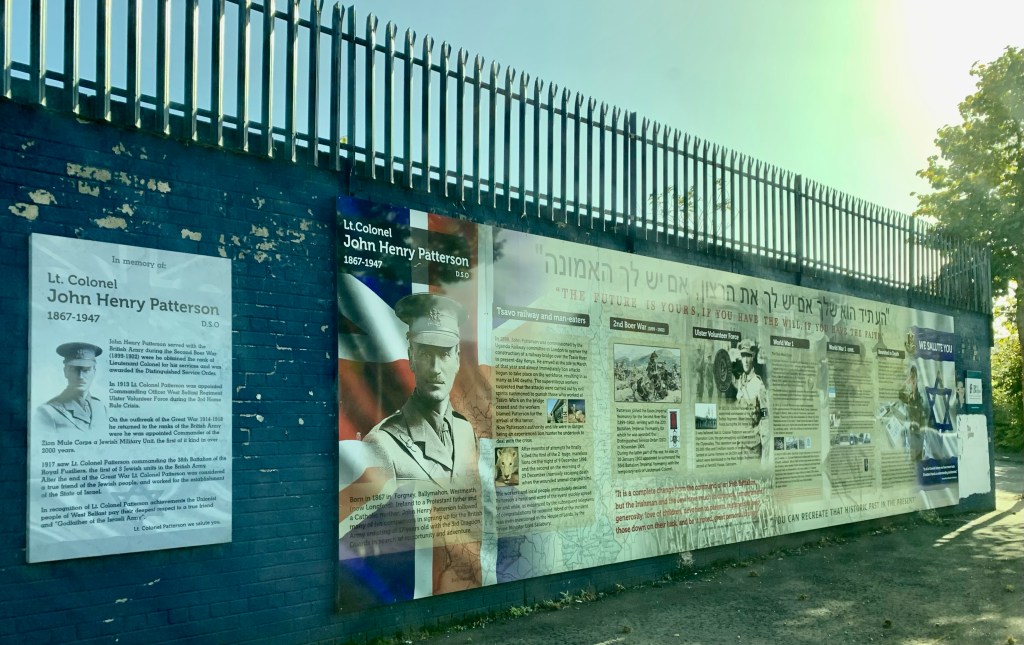
Political murals are deeply entrenched into the psyche of Belfast, particularly in West Belfast, where working-class communities of Catholics and Protestants live cheek-by-jowl. A lot of the more overtly political murals have been replaced but some can still be found within the Shankhill (Protestant) Falls (catholic) communities.
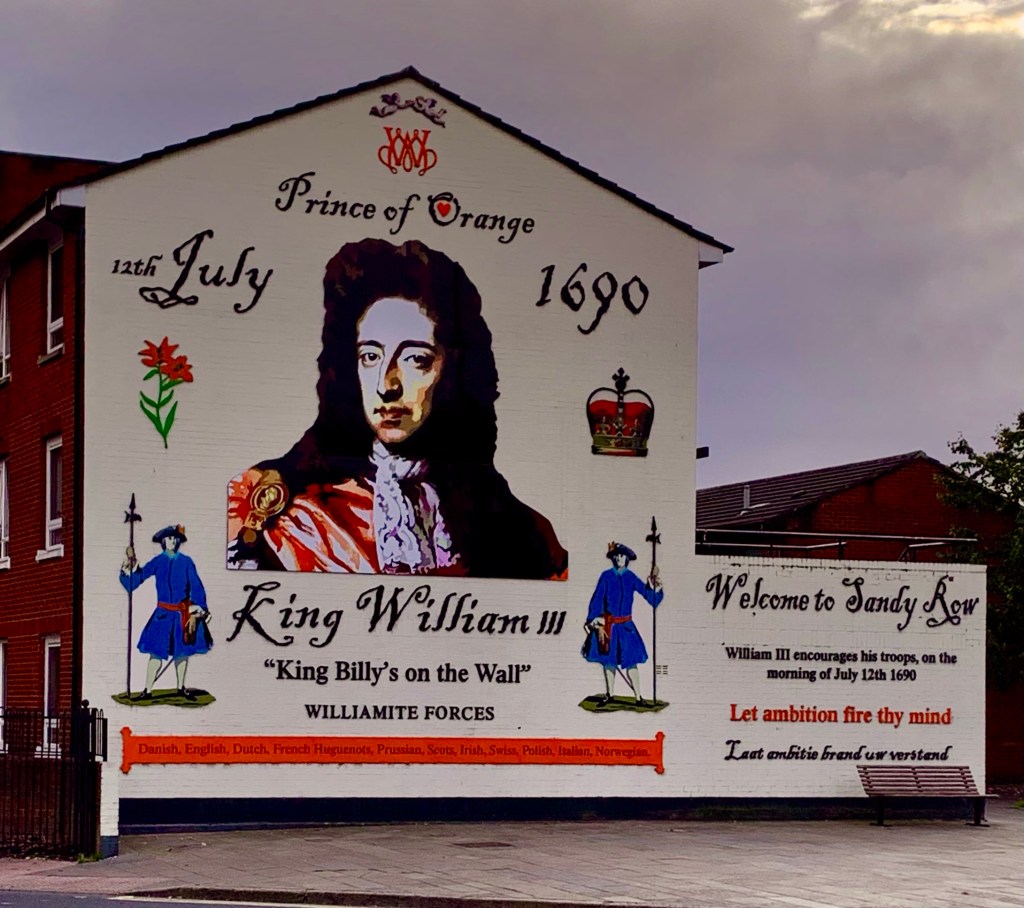
Another prevalent mural (on the loyalist side) is of King William III, who was a Protestant king who won decisive wars against the catholic forces including the Battle of the Boyne 1690, it is still celebrated annually to this day on the 12th of July by Unionist communities. Which can lead to acrimony on both sides of the divide.
One of Belfast’s most famous murals (certainly on the republican side) is the smiling figure of Bobby Sands an IRA volunteer and prisoner who died during the hunger strike of 1982. Bobby Sands was also elected as the MP for the area during this time, sending a powerful message to the British government at the time.
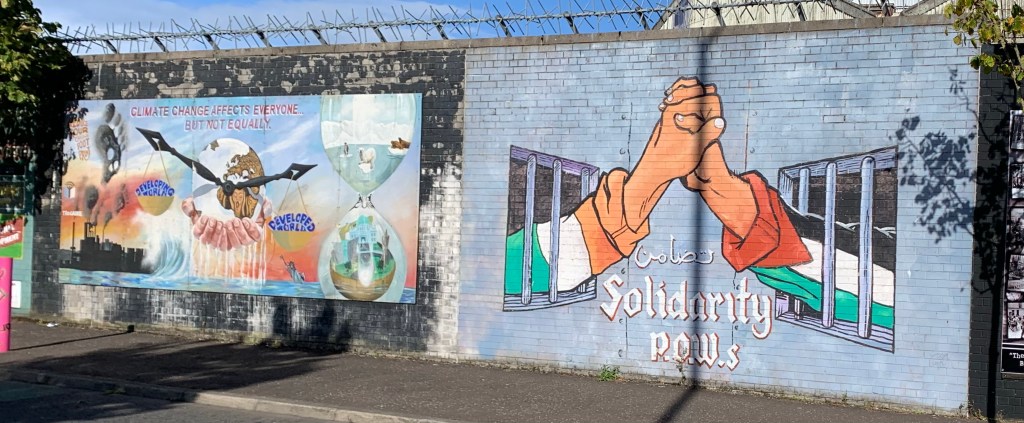
Solidarity Wall on the Falls Road features a collection of murals expressing support for global causes such as Palestinian liberation and Basque independence.
Peace Walls
They are still visible to this day and many can be found in Belfast. They have now become somewhat of a tourist attraction with tours around them, especially in West Belfast where they are adorned with political murals. They are designed to separate Catholics from Protestants where the two communities converge on each other.
Section of the peace wall on Shankhill Road
These peace walls are particularly significant as they separate Falls Road from Shankhill Road. What is somewhat depressing 25 years after The Good Friday Agreement, these are still locked and both communities are reluctant for them to be demolished.
Peace wall on the Falls Road (republican)Peace wall on the Shankhill Road (loyalist)
Some short videos of two of the many peace walls. The peace walls are located in the Falls Road and Shankhill Road. These were constructed during The Troubles to separate Catholic and Protestant communities.
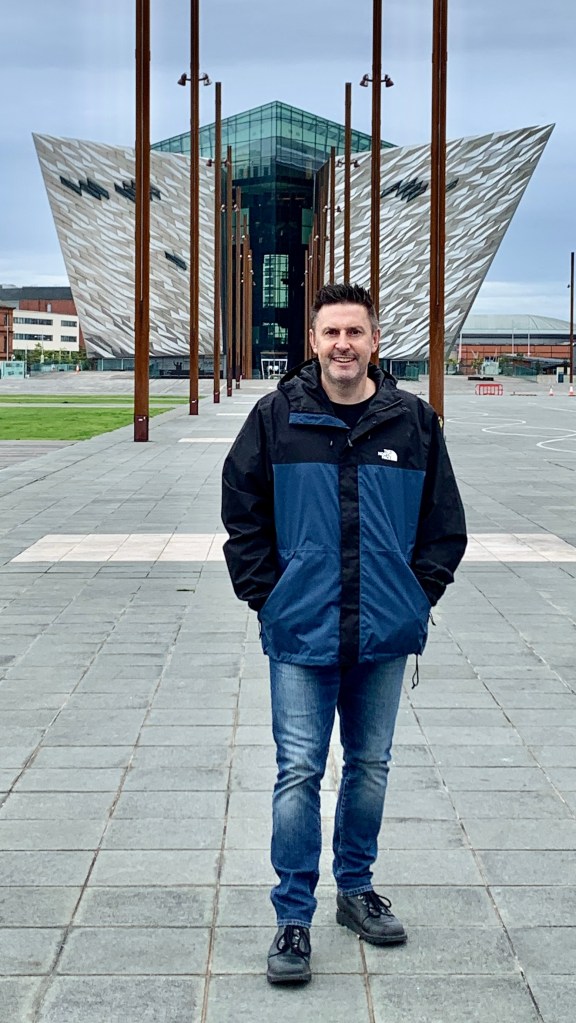
The Titanic Quarter
What once was a neglected desolated industrial wasteland, has now become one of Belfast’s most exciting, attractive and economically viable areas in just under 10 years. It’s one of Europe’s largest waterfront regeneration schemes
One of Belfast’s most instantly recognizable landmarks, the Harland and Wolff cranes Samson and Goliath, can be seen in The Titanic Quarter. Samson was built-in 1974 and stands 348 feet, Goliath is older built-in 1969 and stands 315 feet. The cranes are protected under The Historic Monuments Act of Northern Ireland.
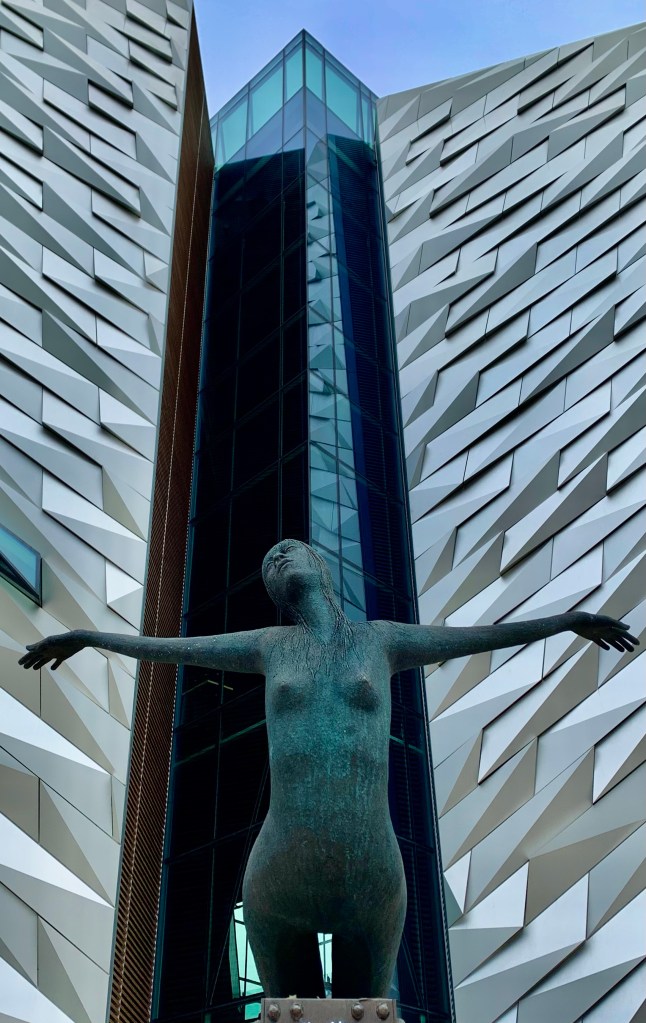
It is home to the Titanic Belfast a £90 million investment on the site of the former Harland and Wolff shipyard. In a short space of time, it has become Northern Ireland’s second most popular visitor attraction with over 800,000 visitors in 2019 the last pre covid figures.
Since opening in 2012 it has been credited with helping transform tourism in Belfast and Northern Ireland.
The Titanic Belfast was voted Europe’s best visitor attraction in 2016, it is a collection of artefacts, special effects and galleries on 9 floors. The site is huge and covers a floor space of 12,000 square meters (130,000 square feet)
We visited on our last day before flying home. So time was limited to what I could discover. The Titanic Belfast was an interesting visit although very busy and not the cheapest attraction in Belfast, compared to others we visited many which were free.
You can visit the SS Nomadic with your Titanic Belfast entry ticket. It was a tender ship for the Titanic. A very miniature version of the Titanic and the only one in existence.
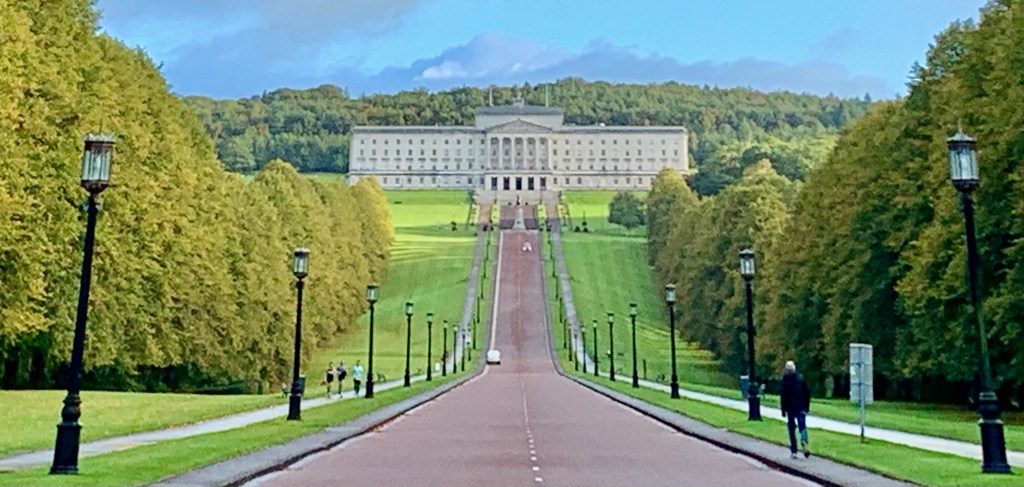
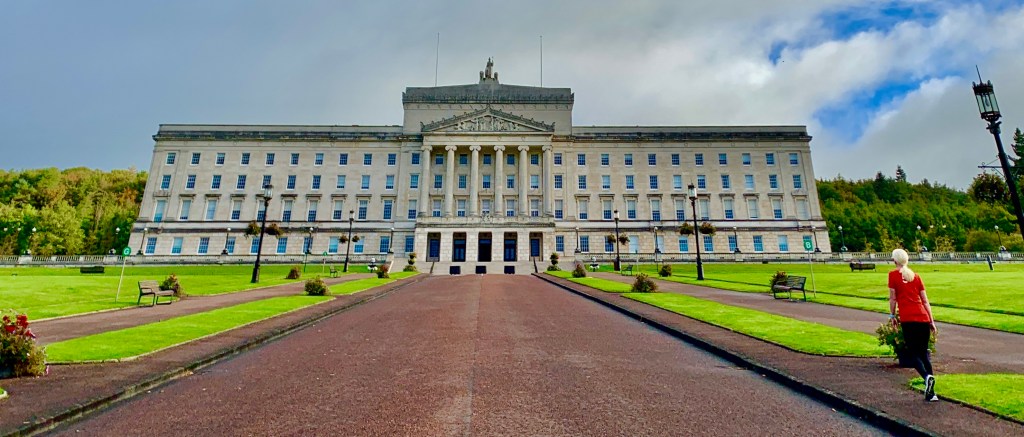
Stormont Park Run
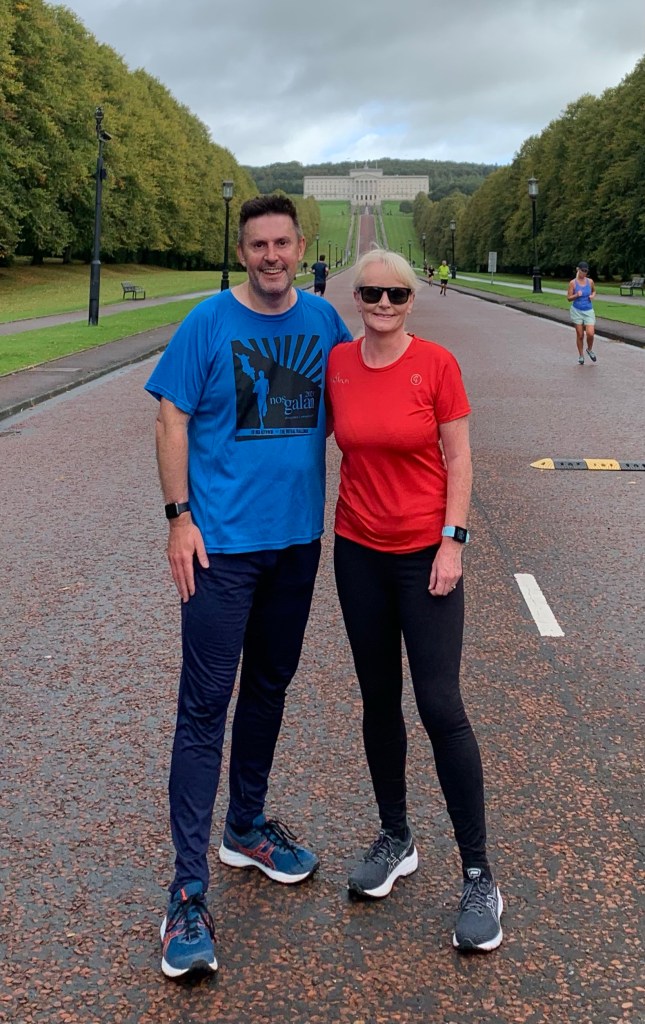
Our destination this morning was the Stormont Estate in east Belfast. Home to the Stormont Park and Stormont Parliament Building, built in 1932 after the partition of Ireland. It became Northern Ireland’s Parliament Building.
The Stormont Estate grounds are open to the public. Facilities include a boardwalk, fitness trail, outside gym and various outdoor activities. There is a playground and cafe situated there.
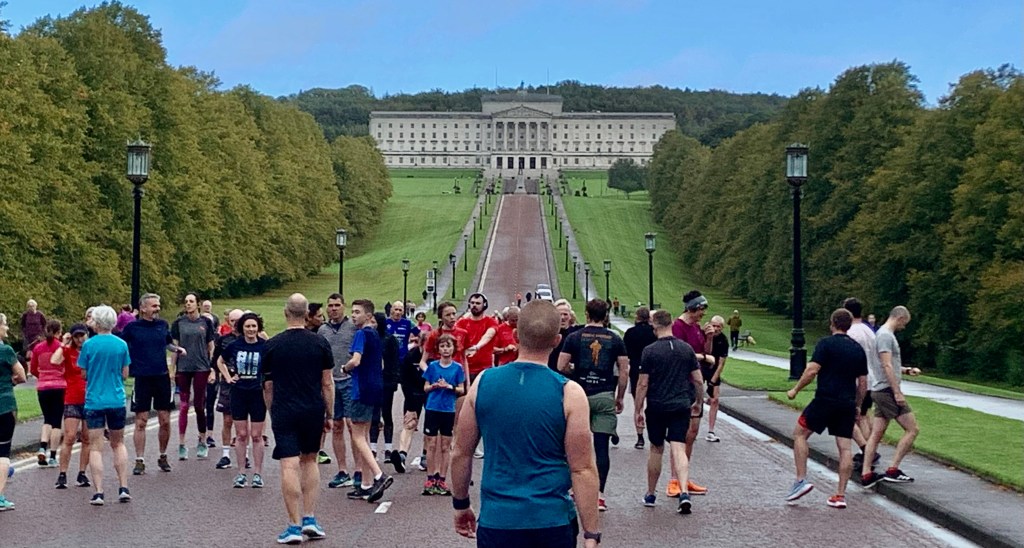
Although our primary reason for visiting was to participate in the 5-kilometre Parkrun, which is held in this rather splendid setting.
As a rather sporadic member of a running club, I try and participate in Parkrun, it’s even better to visit a new venue I haven’t run before, often in conjunction with a place of interest. This certainly was the case at the Stormont Parkrun, Home to Northern Ireland’s Parliament Building. It allows me to visit one of Belfast’s most impressive buildings and take part in a new Parkrun a win-win for me.
A beautiful course around The Stormont Estate grounds was a perfect setting for a Parkrun, as always a big thank you to the organisers and volunteers who give up their time for free and without them, these runs go ahead. A further thank you for the very warm welcome we received there 😄
Europa Hotel
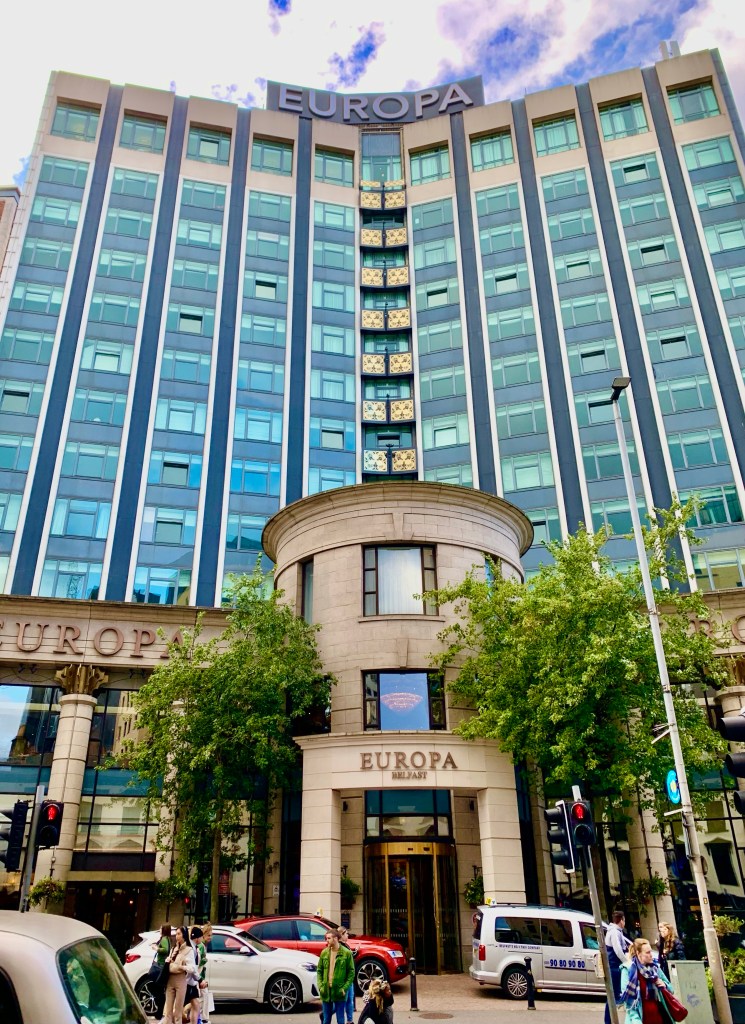
Our base for our stay was the rather grand Europa Hotel. It wasn’t always able to stay so grand. During The Troubles, it was bombed on 36 occasions giving it the unenviable title of Europe’s most bombed hotel.
Today in more peaceful times the hotel has been beautifully refurbished, located near the city centre and most central attractions within walking distance.
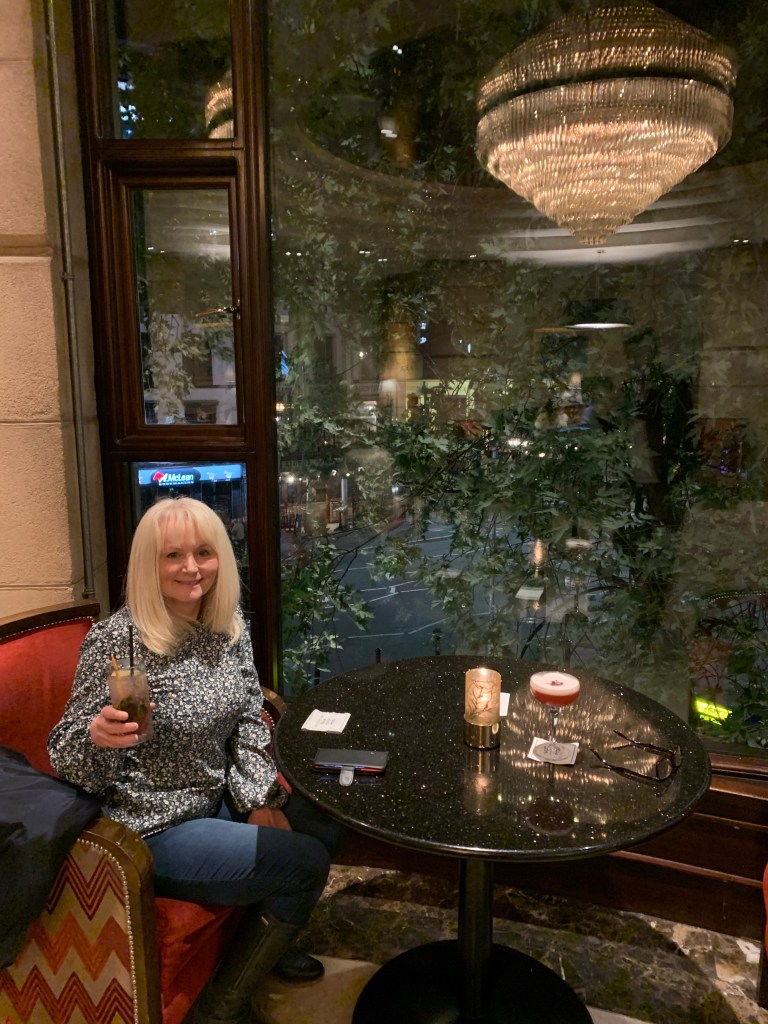
It’s home to the iconic first-floor piano bar where you can gaze down on the bustling crowds that pass by. The legendary Crown Bar sits directly opposite the hotel one of the most famous pubs in Belfast.
In the rather grand lobby of the Europa hotel, there is a poignant display of the history of the hotel during The Troubles.
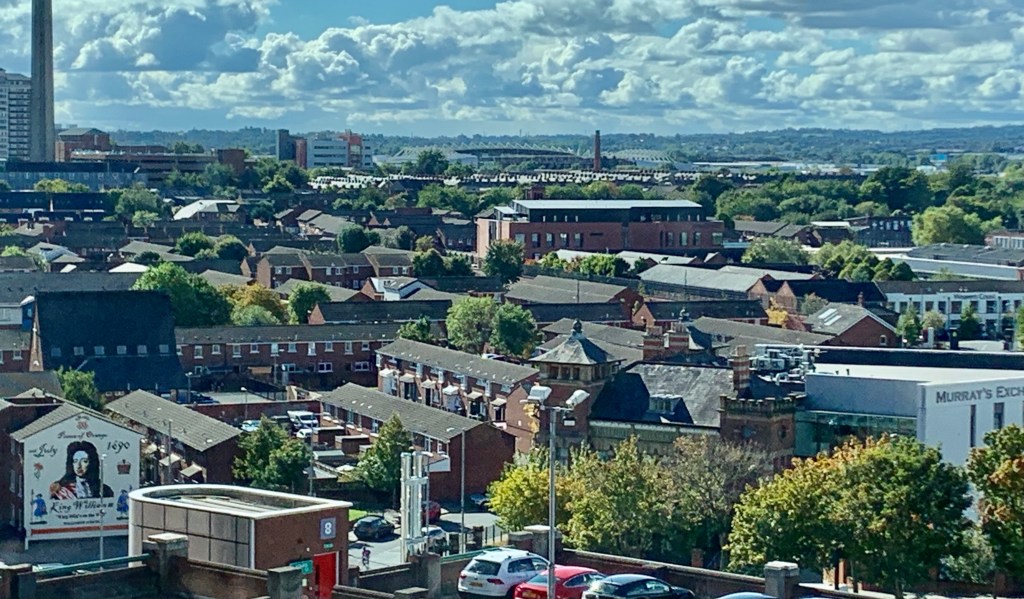
The high-rise design of the hotel gives excellent views of the city, from our room on the 8th floor we could see Sandy Row and its mural of King William III, Belfast City Hospital with its distinctive orange tower block and Windsor Park home of the Northern Ireland football team.
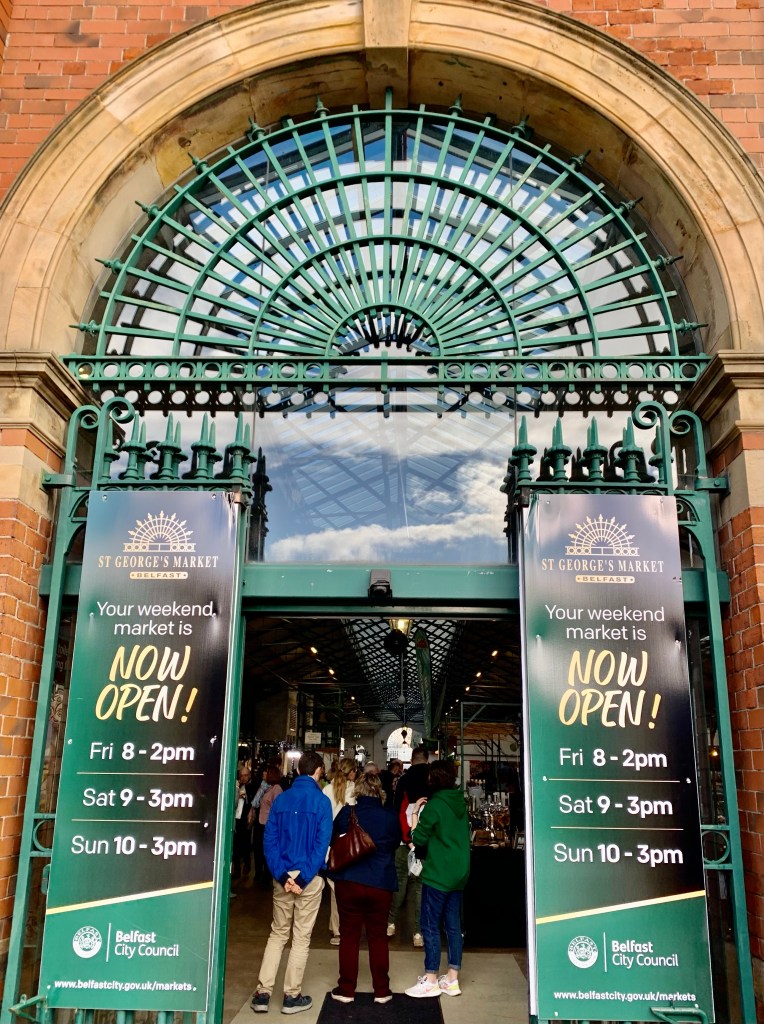
St George’s Market
The last covered Victorian market in Belfast.
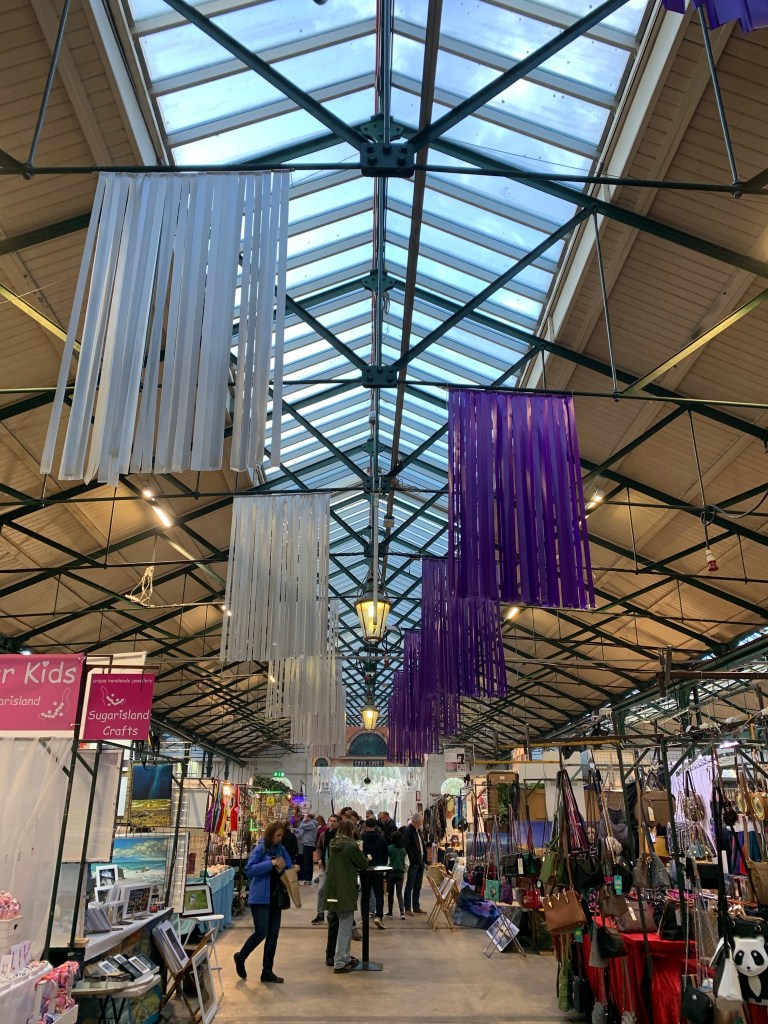
There has been a market on this site since 1604. The present St George’s Market was built between 1890 and 1896 and is one of Belfast’s oldest attractions.
Completely refurbished in 1997 for £4.5 million it rejuvenated this Victorian building to its former glory. Making it one of Belfast’s most vibrant and colourful destinations.
However, like a lot of traditional markets, St George’s had to reinvent itself to secure a meaningful future for the market. It has now become a weekend market open on Friday, Saturday and Sunday. As well as being home to some fine local produce it has become something of a gastronomic centre.
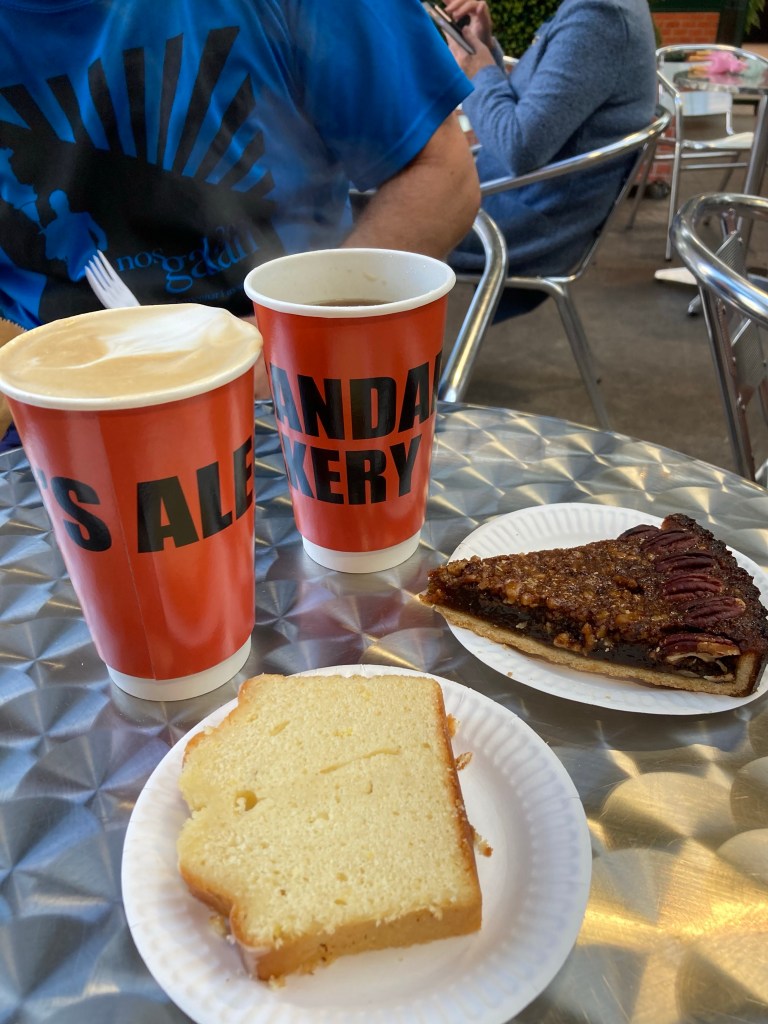
It is the perfect place to sample some home-cooked and artisan food from the various food stalls located within the market, with plenty of seating to enjoy your selected indulgence with a delicious coffee to perfectly complement your choice. A perfect location to sit and relax.
Cathedral Quarter
Is the nightlife and cultural hub of Belfast. Centred around St Anne’s Cathedral.
When considering a night out in Belfast The Cathedral, Quater has a wide selection of bars, clubs and restaurants that imbue the story of the city.
The Dark Horse
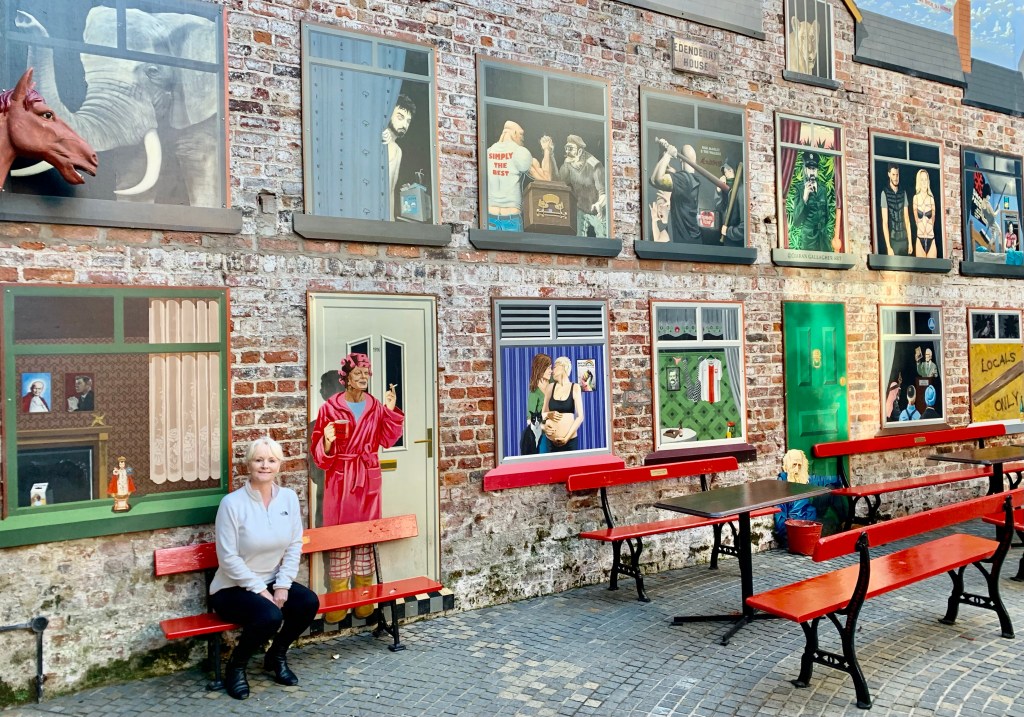
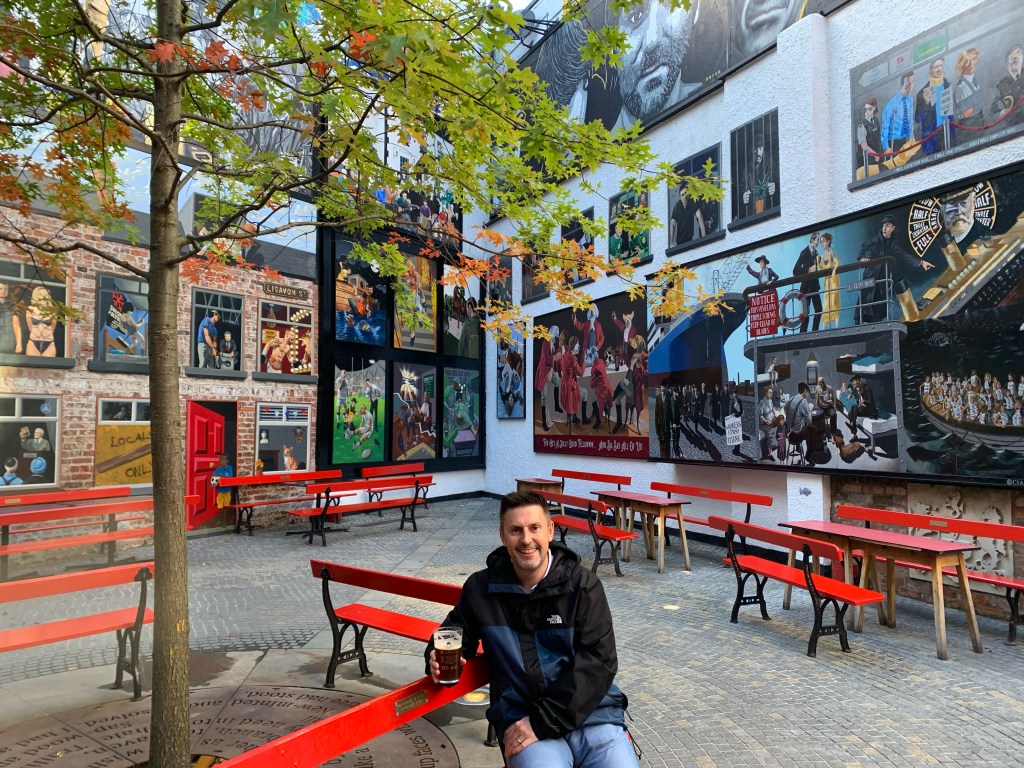
This is situated opposite The Duke of York and is part of the same company that owns The Duke of York and the Harp Bar in the same location. This is well-known for its courtyard and open-air artwork.
It can be viewed as long as buy a drink at The Dark Horse and is well worth a visit to see the many murals and artwork that can be seen in the adjoining courtyard. We visited in the afternoon and were able to view the artwork in peace.
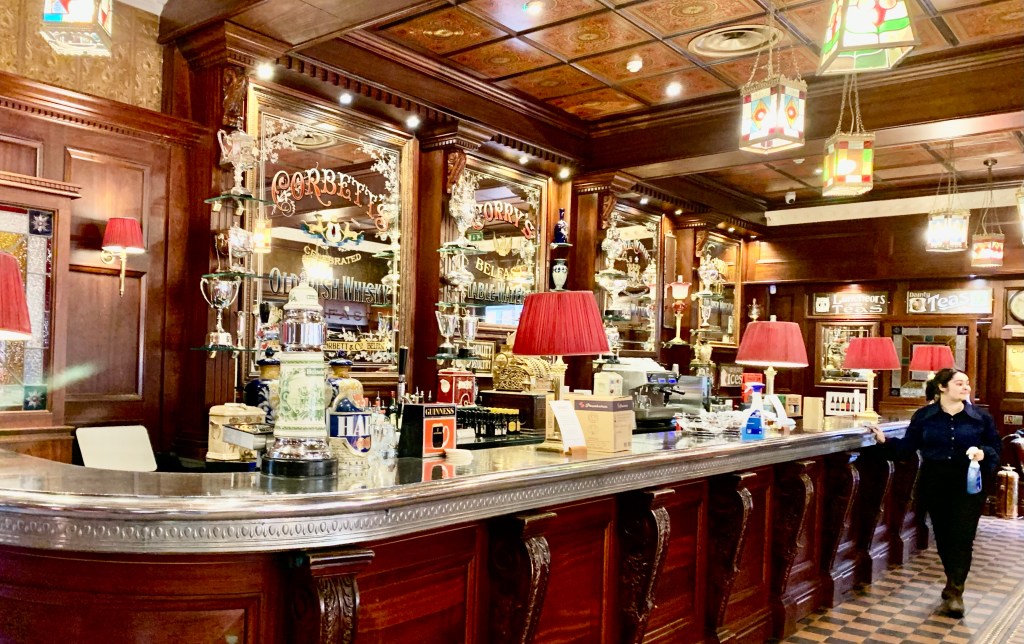
The courtyard at the Dark Horse is brimming with street art depicting scenes of Northern Irish history and culture. A popular spot due to its mural-covered courtyard and its sumptuous traditional lounge.
The Merchant Hotel
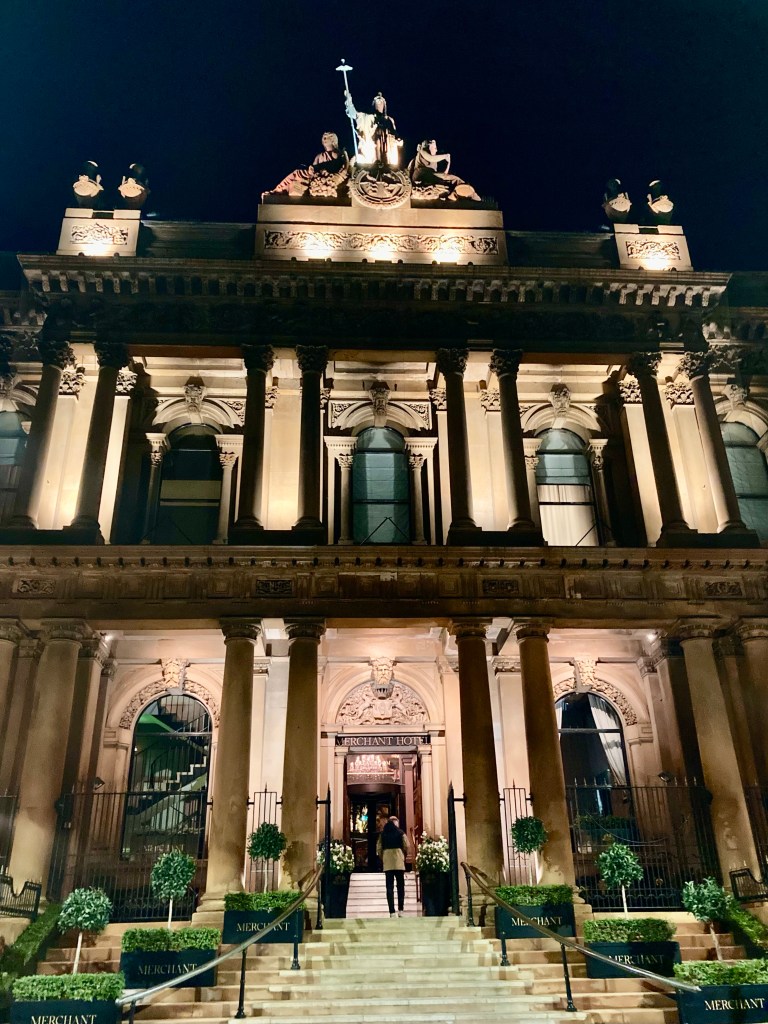
One of Belfast’s five-star hotels The Merchant is situated in the heart of the Cathedral Quarter. Its distinctive architectural style comes from its former life as the headquarters of the Ulster Bank.
The cocktail lounge at The Merchant Hotel.
My pockets are not deep enough to afford a stay at The Merchant. An evening’s visit to the cocktail bar won’t break the bank while visiting this former bank. I certainly had an impeccable list of cocktails to choose from. Don’t fancy a cocktail there is also a pub at the hotel The Cloth Ear a quintessential Irish pub, with more reasonable prices
Public art in The Cathedral Quarter
You will find public works of art all over Belfast and I viewed plenty in The Cathedral Quarter. This mural in particular made me chuckle, a rather contemporary view of political satire.
The Albert Memorial Clock
Completed in 1869 The Albert Memorial Clock is one of Belfast’s best Jn know landmarks.
At the edge of the Cathedral Quarter, we came across this rather unusual clock. I thought my eyes were deceiving me as the clock was sloping to one side. However, this famous Belfast landmark The Albert Memorial Clock is sloping and built on wooden piles on marshy reclaimed land the clock tower does lean 4 feet off the perpendicular.
Belfasts Traditional Pubs
Last but certainly not least, if you have come for a drink there is no shortage of beautiful, ornate traditional pubs to choose from. Just a few from a large number to choose from.
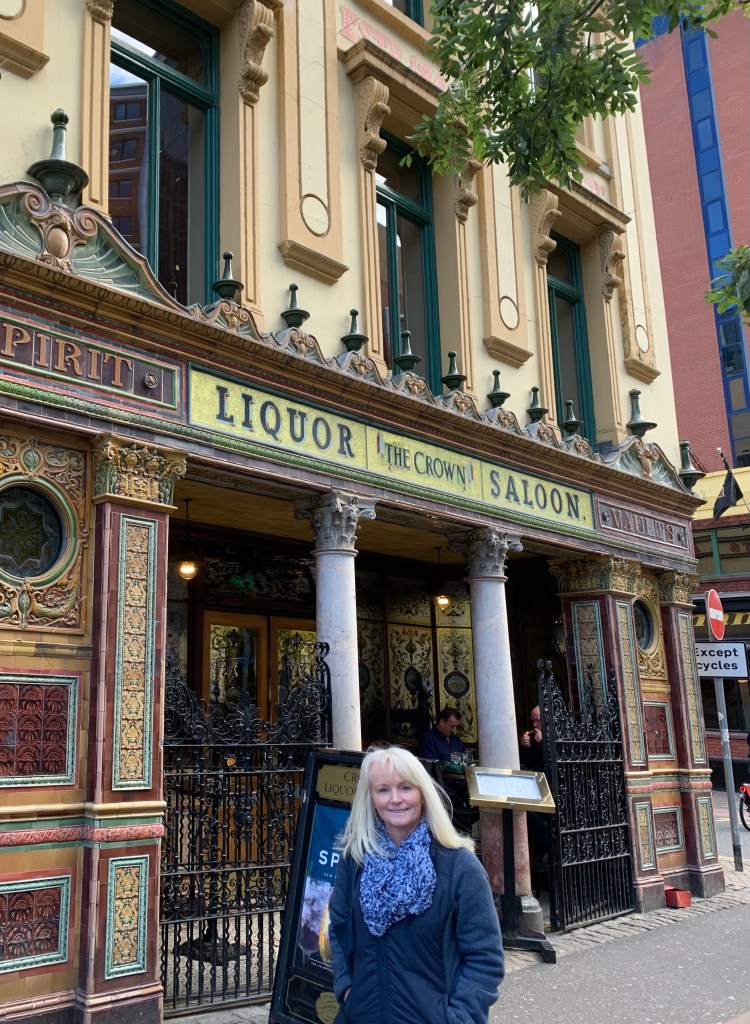
Crown Bar
A pub that is owned by the National Trust, is certainly a first for me. It’s a Grade I listed building a beautiful example of a traditional Victorian gin palace.
The impressive facade is one of Belfast’s most popular photo locations.
Possibly one of if not the most famous pubs in Belfast, The Crown Liquor Bar. It was originally a Victorian gin palace and has been loving restored at a great cost to its former glory.
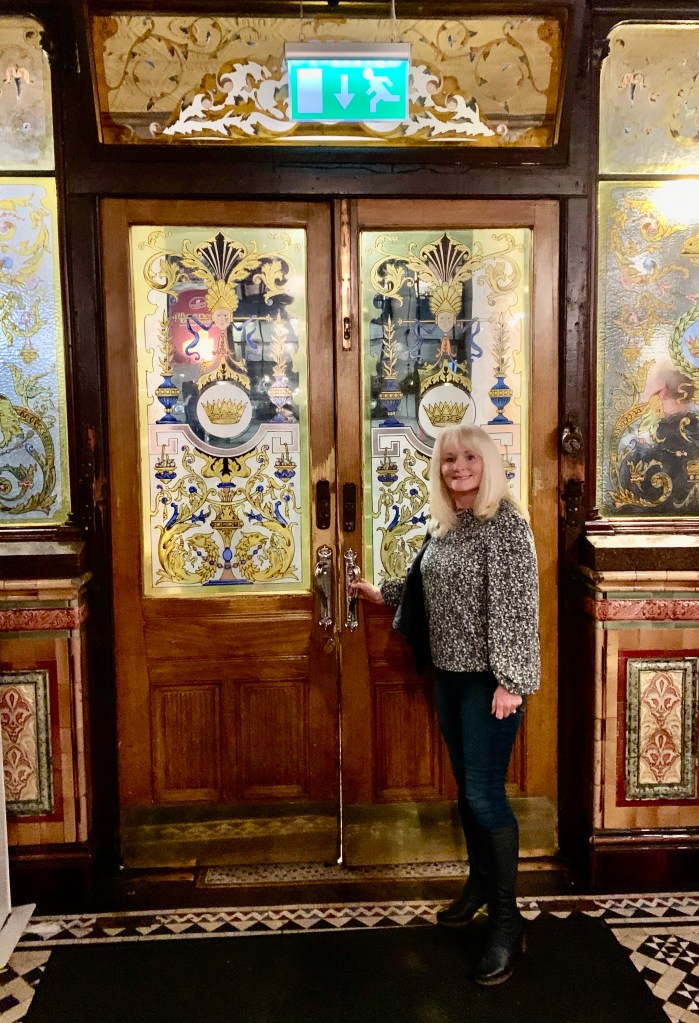
Initially designed to protect Victorian drinkers from the prying eyes of The Great Victorian Street. The stained glass windows are etched with fairies, pineapples, fleur-de-lys and clowns.
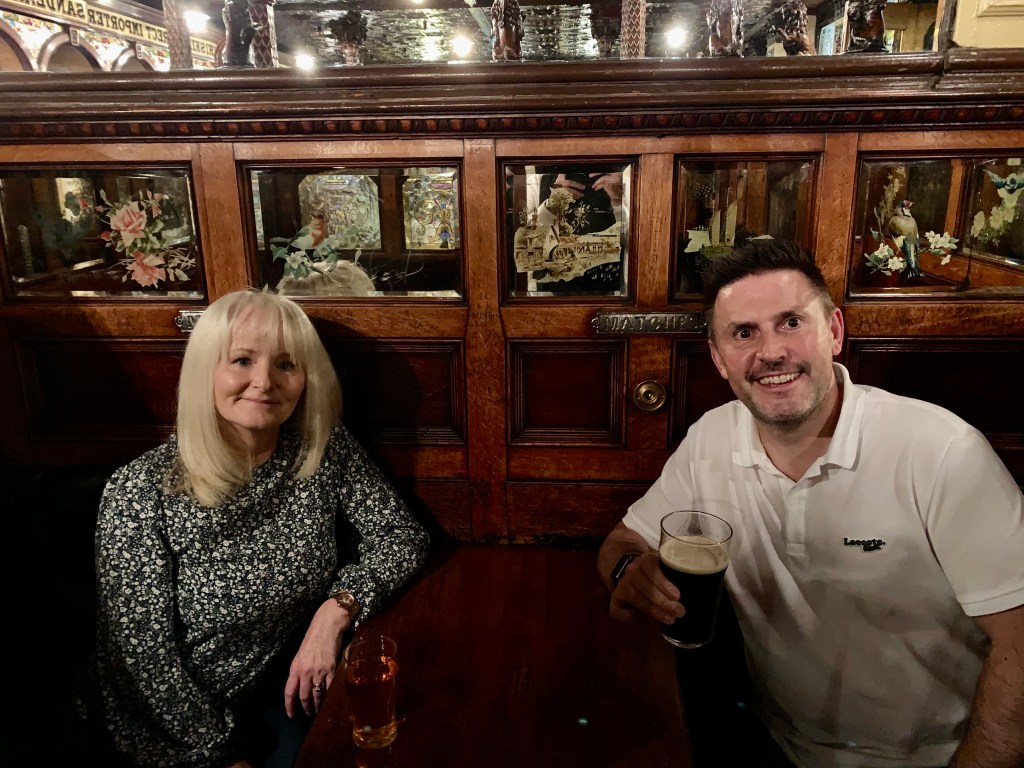
The booths are decorated with old advertising mirrors and finished in dark wood.
We visited on a few occasions as we were staying at the Europa located opposite and were fortunate enough to get one of the famous snugs. This is one of the most evocative features of the Crown Bar and there are 10 in total. The doors can be closed for the customer’s privacy, very important in the more puritan Victorian times.
Bittles Bar
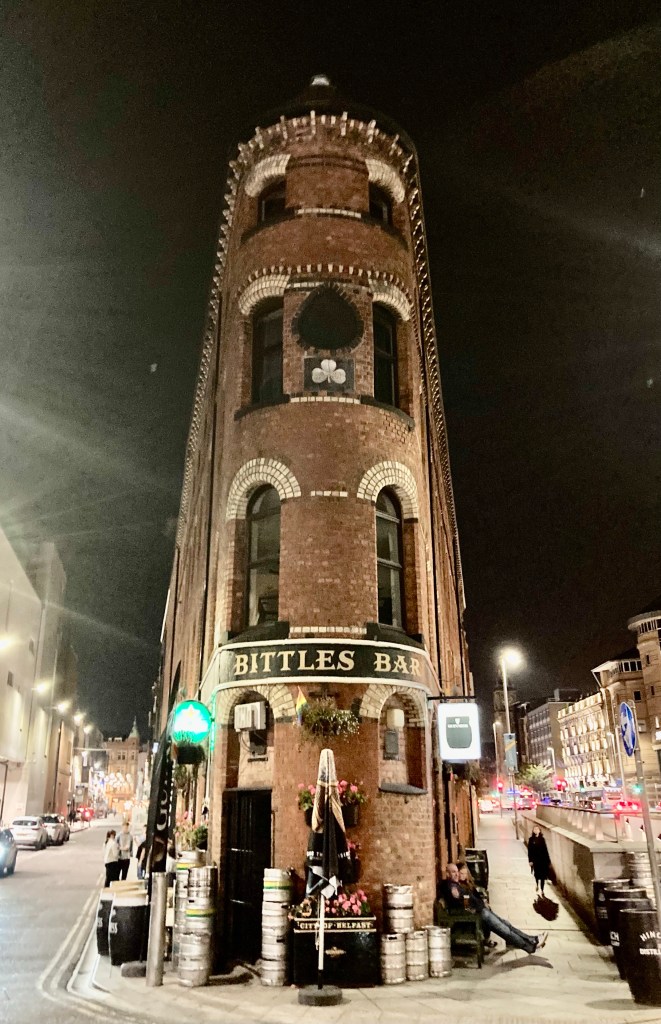
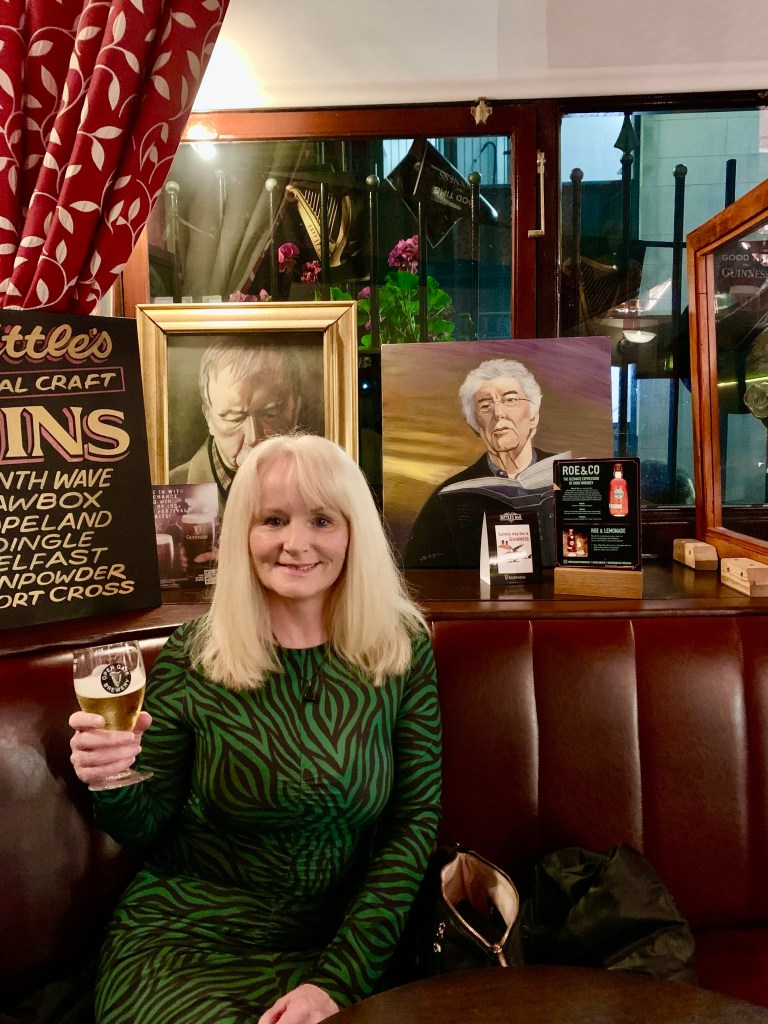
This pub is situated in one of Belfast’s most iconic buildings, known as the Flat Iron Building. I can marvel at this unique beautiful architecture while enjoying a traditional pint, what’s not to like.
If the impressive architecture wasn’t enough inside there were many murals and paintings chronicling Northern Ireland’s political, sporting, literary and social history.
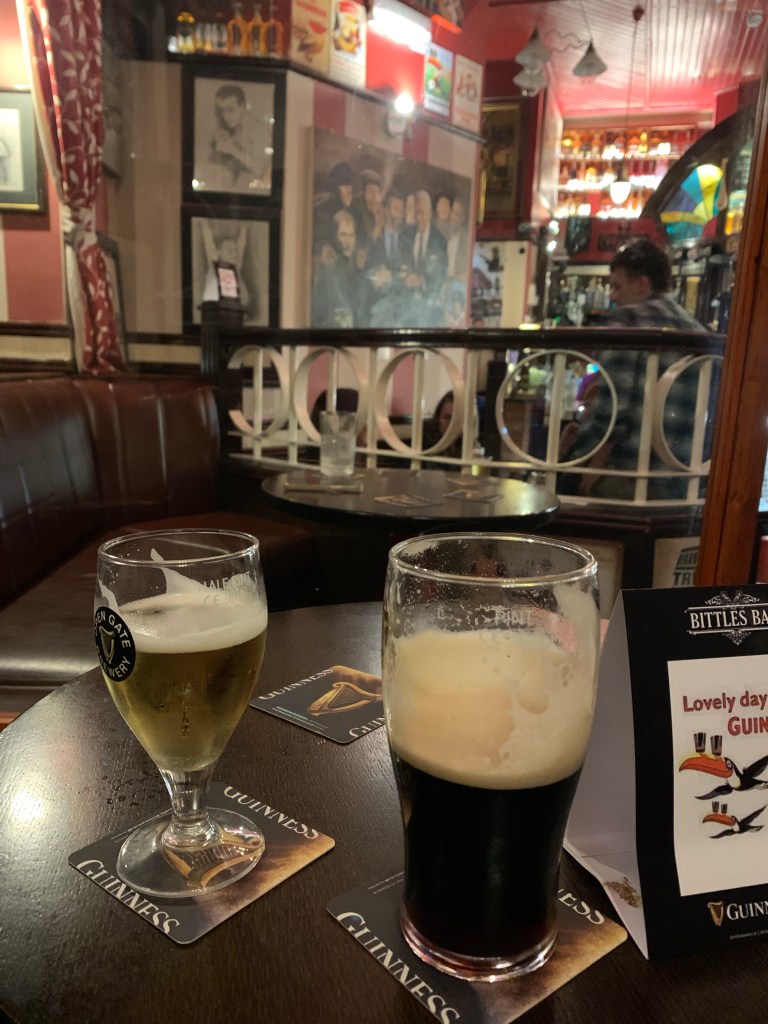
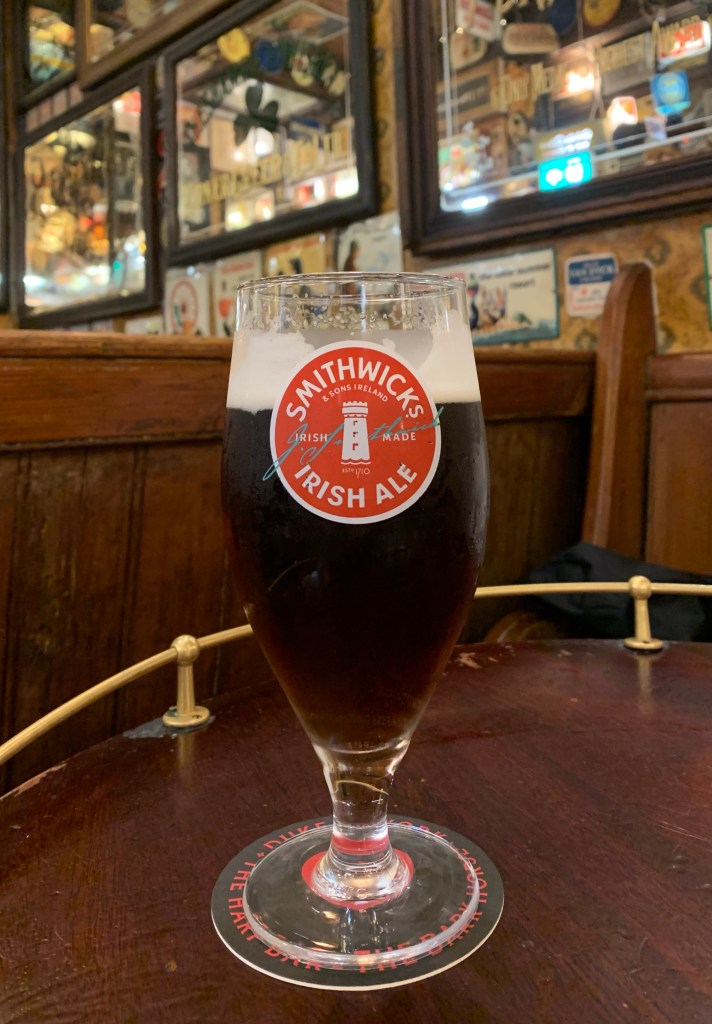
Did I mention that they also serve a beautiful pint of Guinness at Bittles, the Irish cider isn’t half bad either. Beautiful architecture, and fantastic artwork I almost forgot I was sitting in a pub.
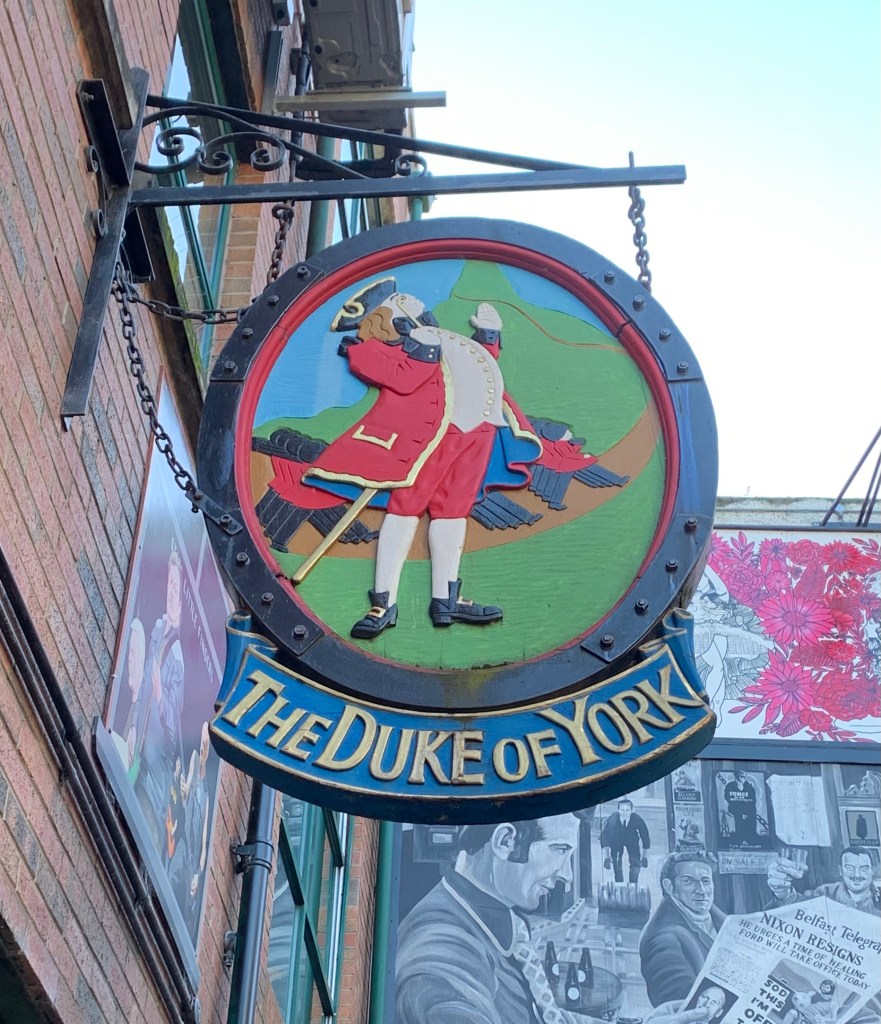
The Duke of York
This is one of several bars owned by the same people in the historic Half Bap area of Belfast.
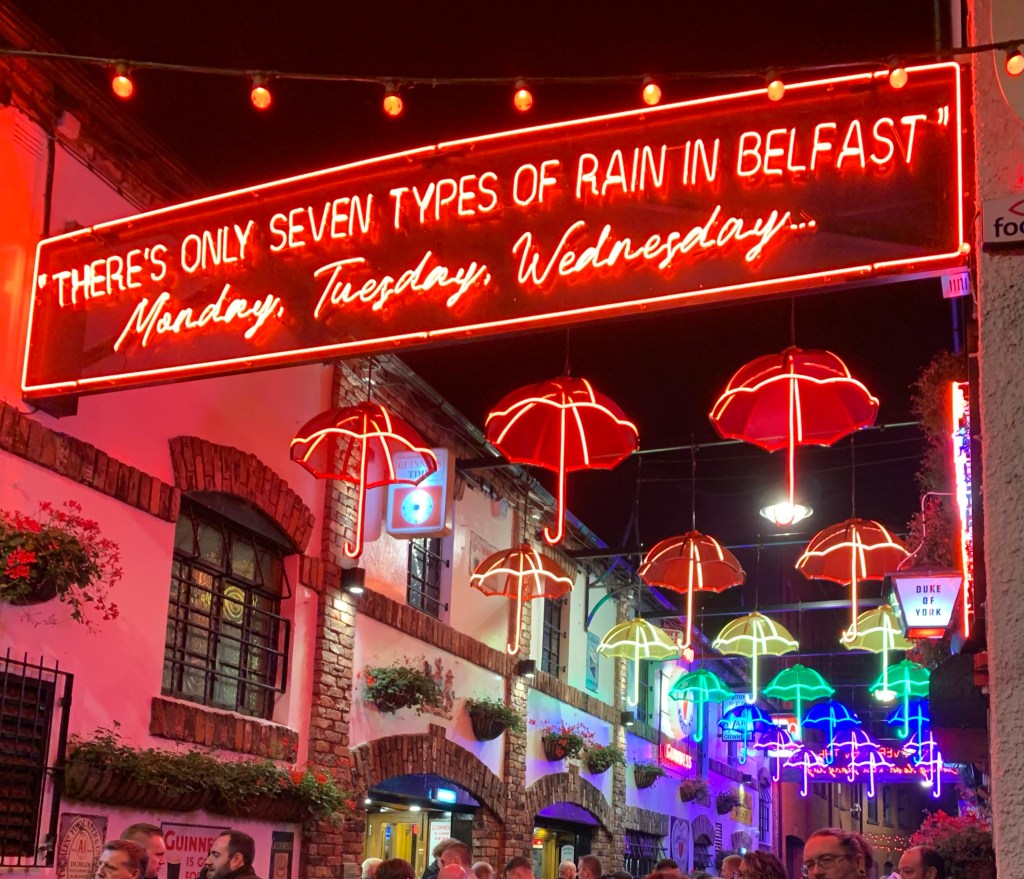
The Duke of York is somewhat of a Belfast institution. Popular with both locals and visitors alike. Blown up by a bomb in 1972 and totally rebuilt it still has the charm of a traditional Irish pub.
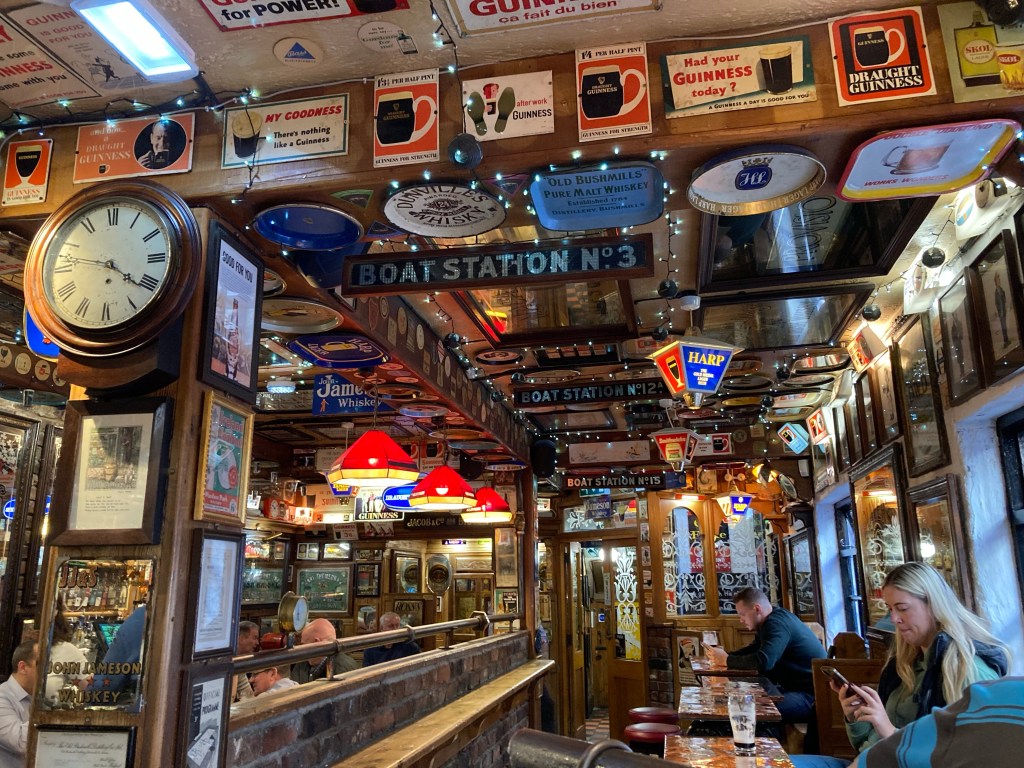
We visited in the evening and afternoon, I took photos in the afternoon where you can enjoy an atmospheric pint and enjoy the traditional surroundings. By night it’s a very different place packed to the rafters with everyone enjoying the craic.
A quiet afternoon pint at The Duke of York.
The bar is well known for its brewing memorabilia on display which has been collected from all over the country. They are original artefacts from the Irish brewing industry and add a certain character to the pub.
It’s not all about the Guinness, Irish Beer and cider have been expertly made.
We also visited Robinsons next to the Crown Bar, The Cloth Ear, The Dirty Onion and The John Harding in The Cathedral Quarter and a few others 🥴. Not experiencing these traditional pubs you will be missing out on a part of the local culture and it will allow you to enjoy the craic.
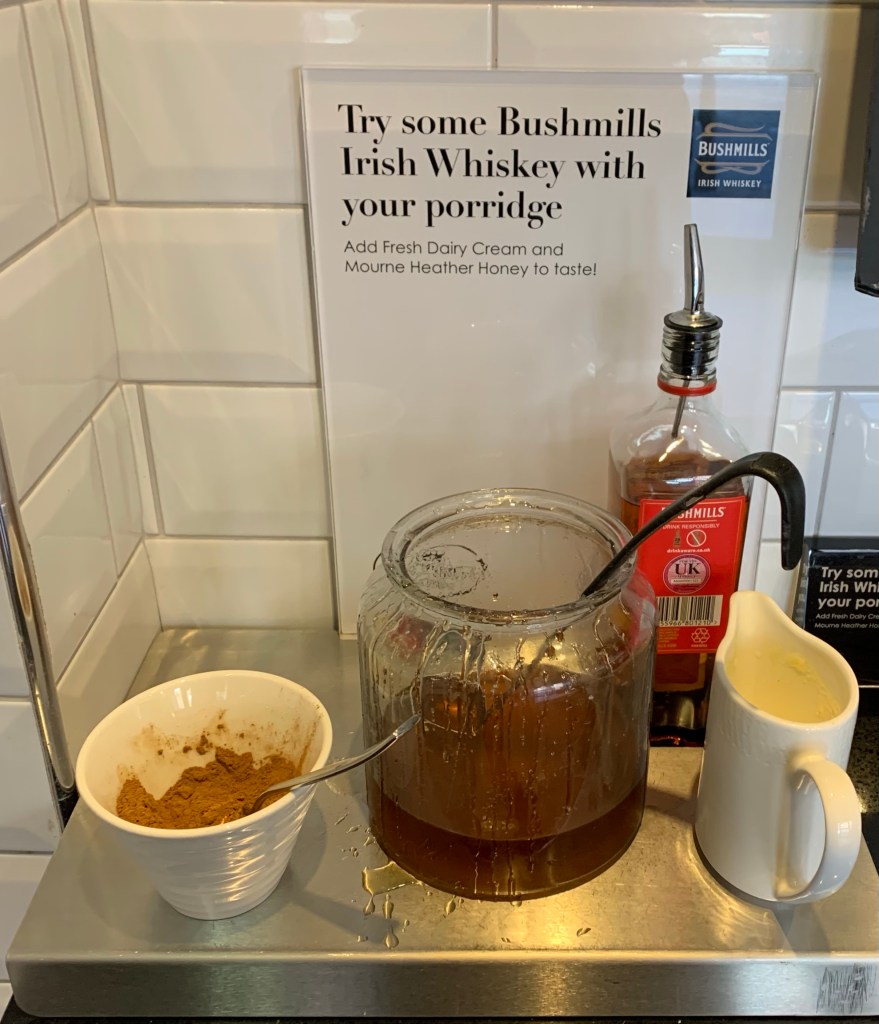
And finally when in Northern Ireland who was I to turn down this breakfast delight at the hotel, a shot of locally produced Bushmills whiskey 🥃 on my porridge? The breakfast of champions? or the start of a slippery slope for the day? Delicious nonetheless with honey and fresh cream😋
A first-time visit to the city of Liverpool. Numerous people had always recommended Liverpool as a great city to visit. I had always been a bit sceptical as I have no interest in football and had never liked the Beatles.
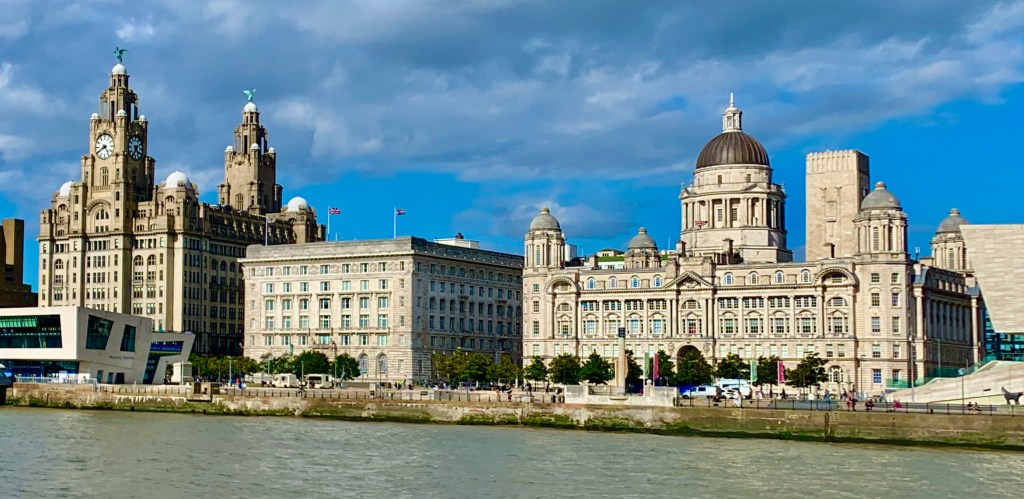
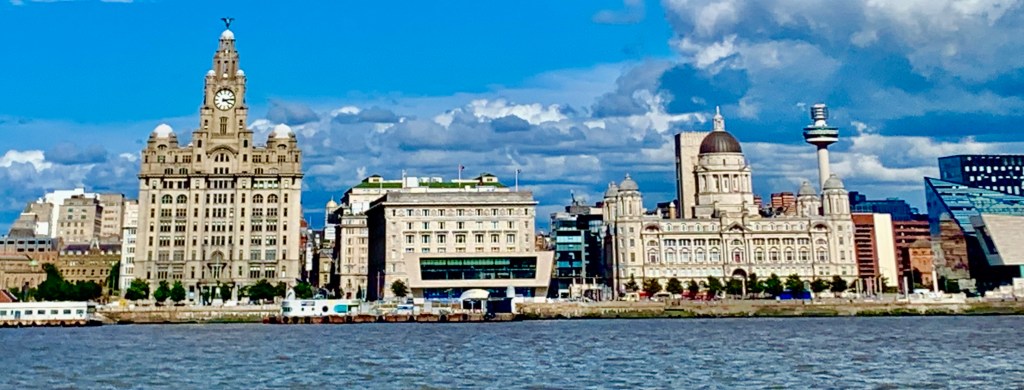
Named the Three Graces far left the Royal Liver Building, centre The Cunard Building and right the Port of Liverpool Building.
Growing up in the late 70s and early 80s Liverpool was a much-tarnished city within media circles , with a lot of unjust publicity regarding crime, run-down communities, a politically corrupt city council and the stereotypical scouse git. It had a negative reputation due to its high unemployment and economic turmoil
Fast forward to the present day, Liverpool is still the victim of some adverse publicity, the city has considerably re-gentrified itself. The once-decaying docks area is now a fantastic example of urban redevelopment and the city has more listed buildings than anywhere outside London.
Excellent transportation links, extremely friendly locals, reasonably priced accommodation and eating and drinking won’t leave you out of pocket either. I for one have been set straight to all the delights Liverpool has to offer and will certainly be returning.
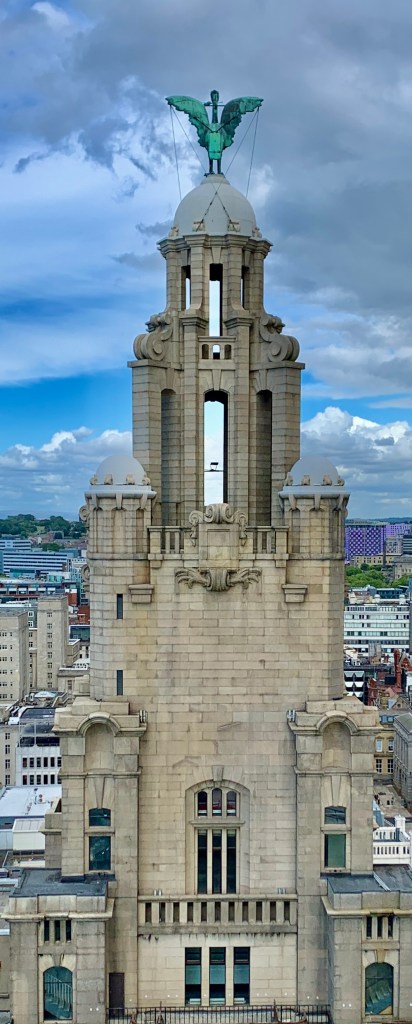
The Royal Liver Building
The Royal Liver Building is a Grade l listed building located at Pier Head. It is one of Liverpool’s most recognizable landmarks.
View of the Royal Liver Building from the River Mersey
As we were staying just opposite The Royal Liver Building, and just arrived for our weekend in Liverpool. Where better place to start our adventure to fully utilize the time we had.
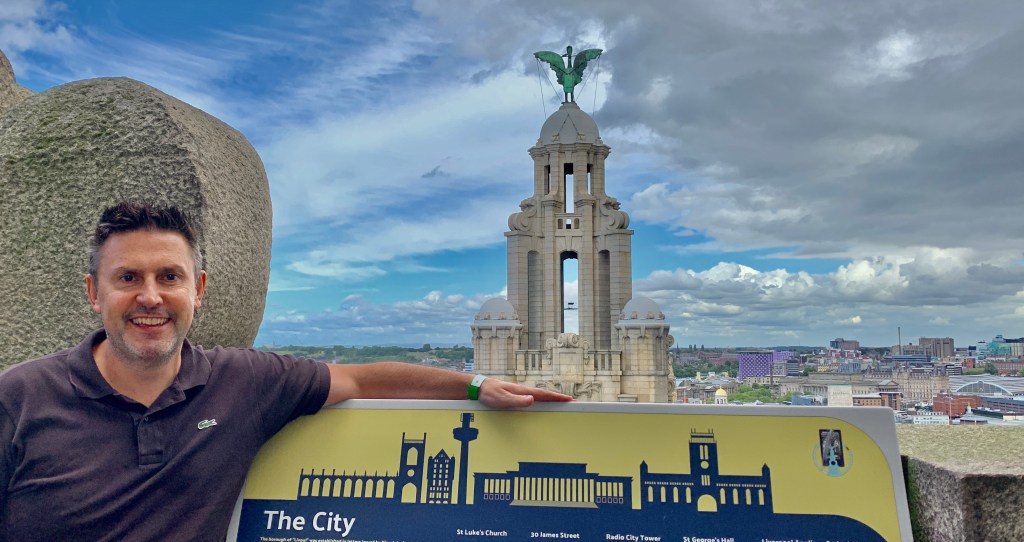
View of one of the Liver birds from the top of the building
We didn’t need to book and we made the 14.30 tour with about 10 minutes to spare. There is no getting away from the fact that it’s certainly a very impressive building. It is 340 feet tall and was one of the first buildings in the world to be built using reinforced concrete. On completion in 1911, it was the UK’s tallest building.
The Liver birds themselves which are situated on both the towers are 18ft tall. Popular legend has it that one of the Liver birds looks over the city to protect it’s people while the other Liver bird overlooks the sea for new sailors. Although Liverpool humour dictates the male Liver bird (Bertie) is looking what time the pubs are opening and the female Liver bird (Bella) is looking for a new sailor coming into port.
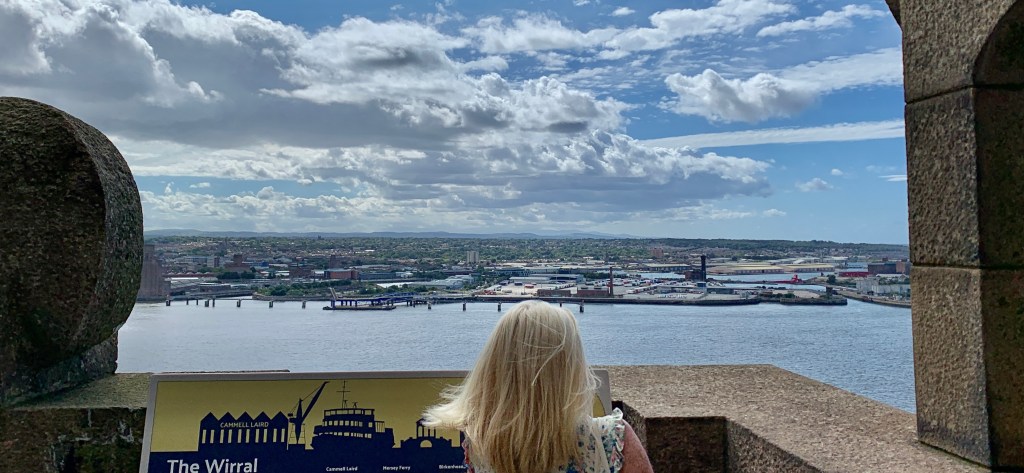
Continuing on the subject of birds I was rewarded with a bird’s eye view of the River Mersey and the Wirral Peninsula which is located directly opposite the Liverpool waterfront.
Mersey Ferries “Fezzy across the Mersey”
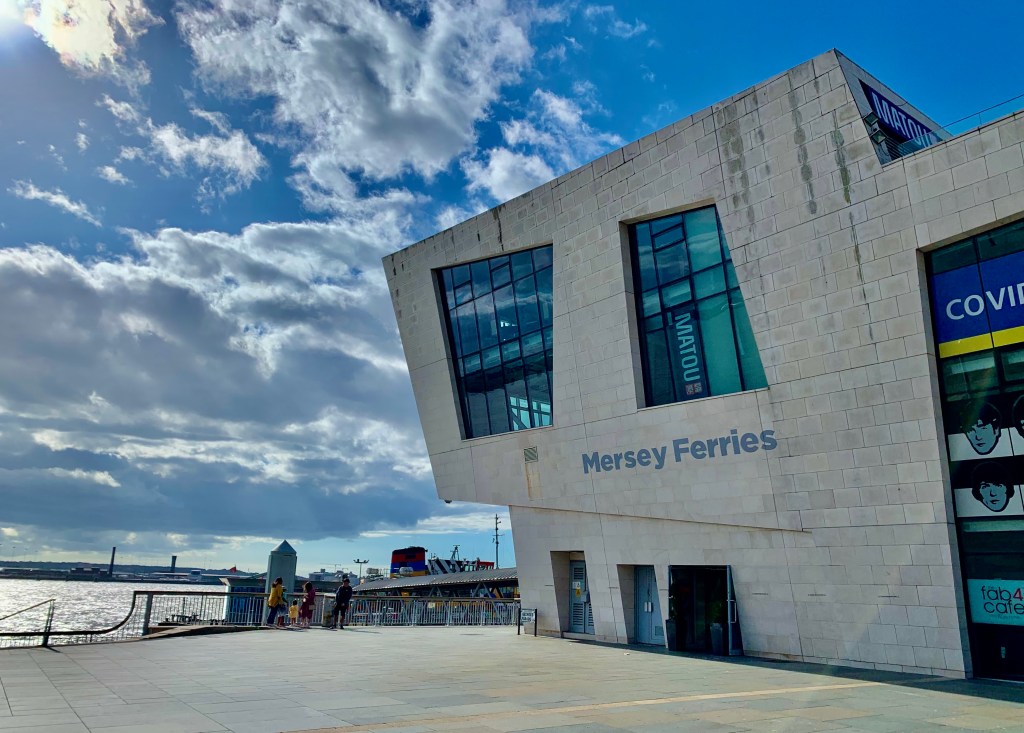
From one Liverpool icon to another, the Mersey ferries are located just in front of the Royal Liver Building on Liverpool’s riverside.
A ferry across the Mersey is nothing new there has been a crossing since at least the 12th century and even to this day, it remains a popular mode of transport for visitors and locals alike.
Ferries depart from the Gerry Marsden ferry terminal and Woodside terminal on the Wirral. We took the 50 minute River Explorer Cruise, pre booking is advised however I booked on the day and didn’t have a problem.
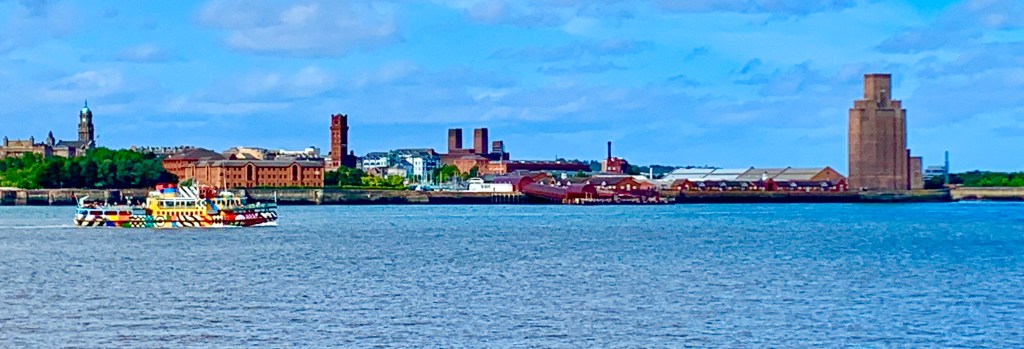
The 50-minute ferry journey gives outstanding views of Liverpool’s iconic waterfront as well as some fantastic views of the Wirral Peninsula which is situated directly opposite Liverpool.
The Three Graces taken from the ferry. Left to right The Royal Liver Building, Cunard Building and Port of Liverpool Building.
Although the highlight of the cruise for me was the view of the Three Graces which are probably the most famous buildings on the riverfront. These magnificent buildings were constructed as visible symbols of Liverpool’s prestige and commercial standing as one of the world’s busiest ports.
Liverpool Waterfront
Onetime a vast area of Post-industrial decay. The area was redeveloped by the Merseyside Development Corporation in 1981 and officially reopened in 1984. It is now a lively cultural hub on the River Mersey.
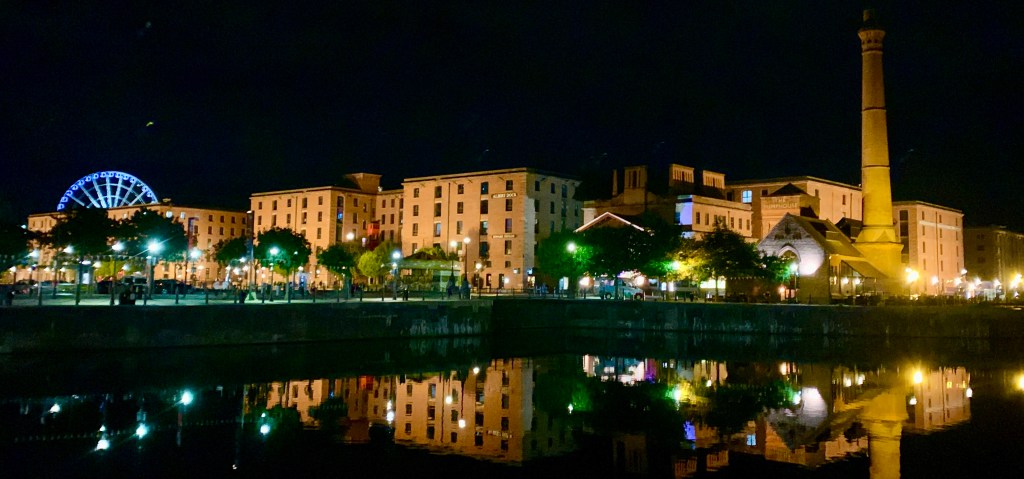
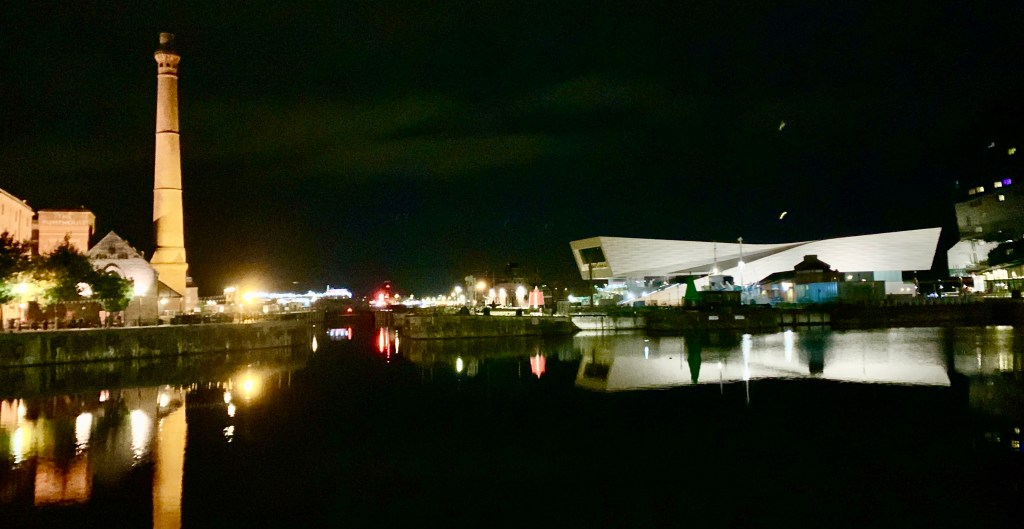
Liverpool waterfront by night
There is no denying the fact that the waterfront is one of the most stunning parts of the city. It’s the visitor hub of Liverpool where you will find the Royal Liver Building, Mersey Ferries, Albert Dock and the Beatles Statue just to name a few attractions located there.
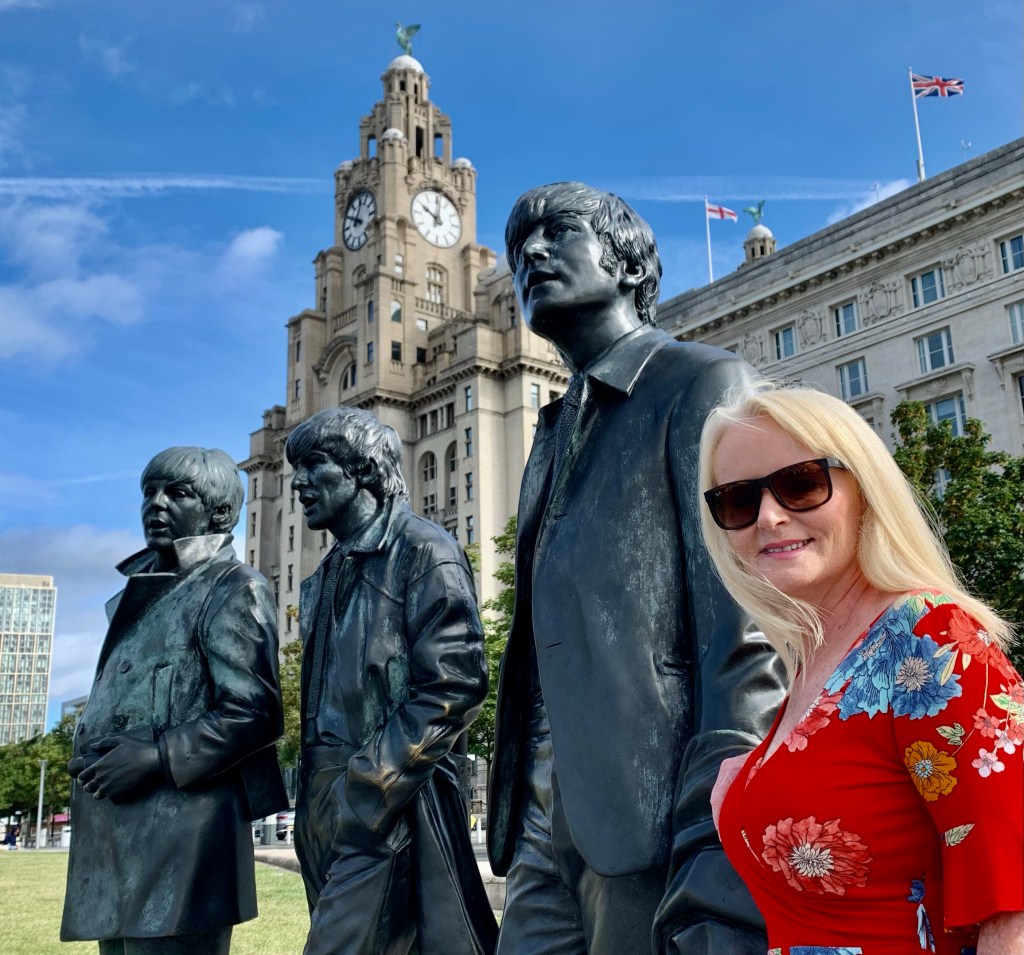
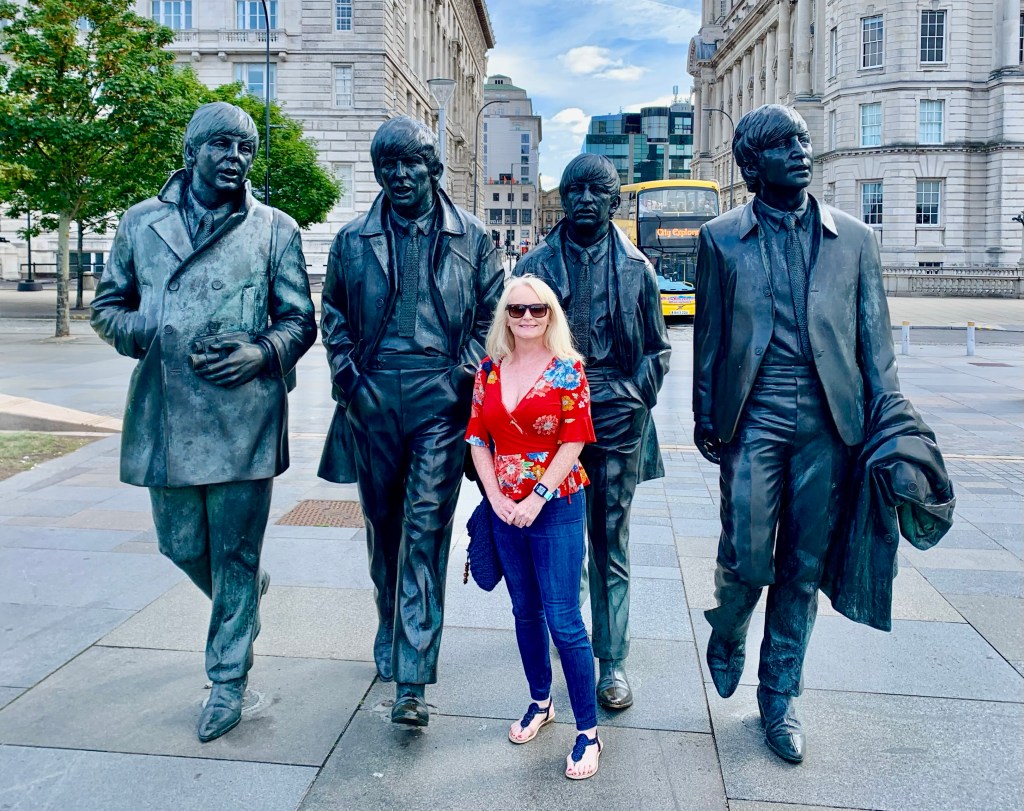
Although not a fan of the music at all, it would be rather churlish of me not to grab a photo of the Fab Four on the Liverpool Waterfront.
It’s hard to miss in between the Mersey ferry terminal and the Cunard Building it certainly has pride of place on the dockside, the fab four in front of Three Graces, two liver birds and one iconic waterfront.
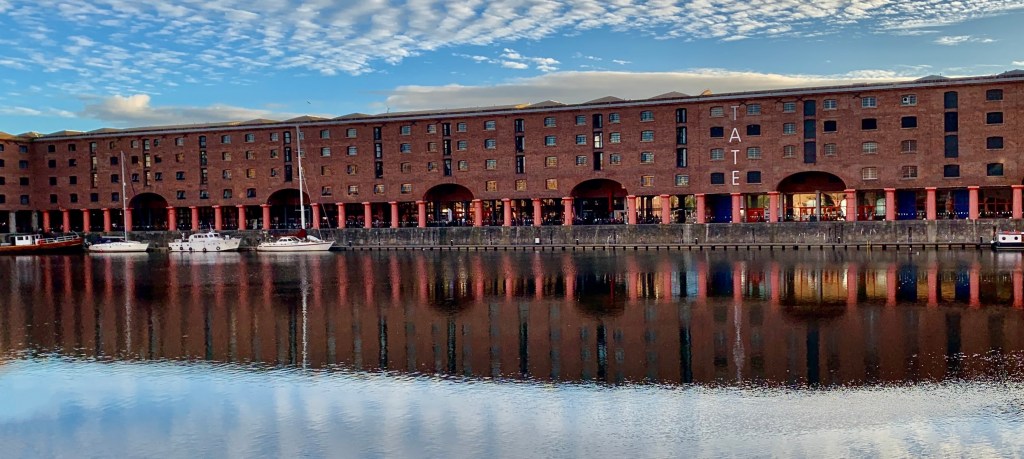
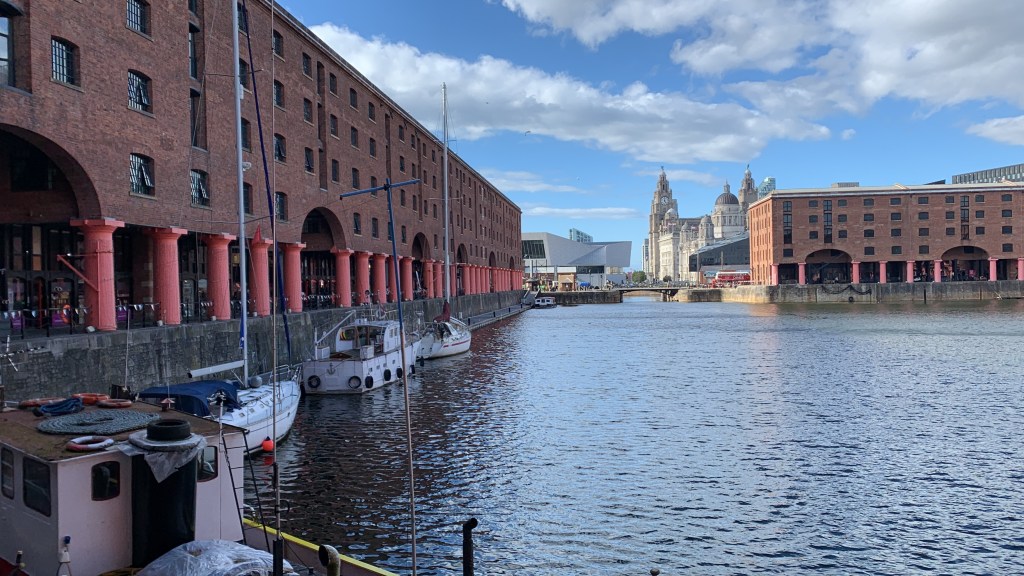
Another major attraction on the waterfront is the Royal Albert Dock. This is a central visitor hub where you can take advantage of the impressive retail, leisure and culinary offerings at the dock.
Tate Liverpool, Maritime Museum, The International Slavery Museum and The Beatles Story can also be found at the Royal Albert Dock.
The Royal Albert Docks is the most visited multi-use attraction in the UK outside of London. The docking complex and warehouses also comprise the largest single collection of Grade I listed buildings anywhere in the UK.
Parks in Liverpool
Princes Park
A grade II listed park in the heart of Toxteth
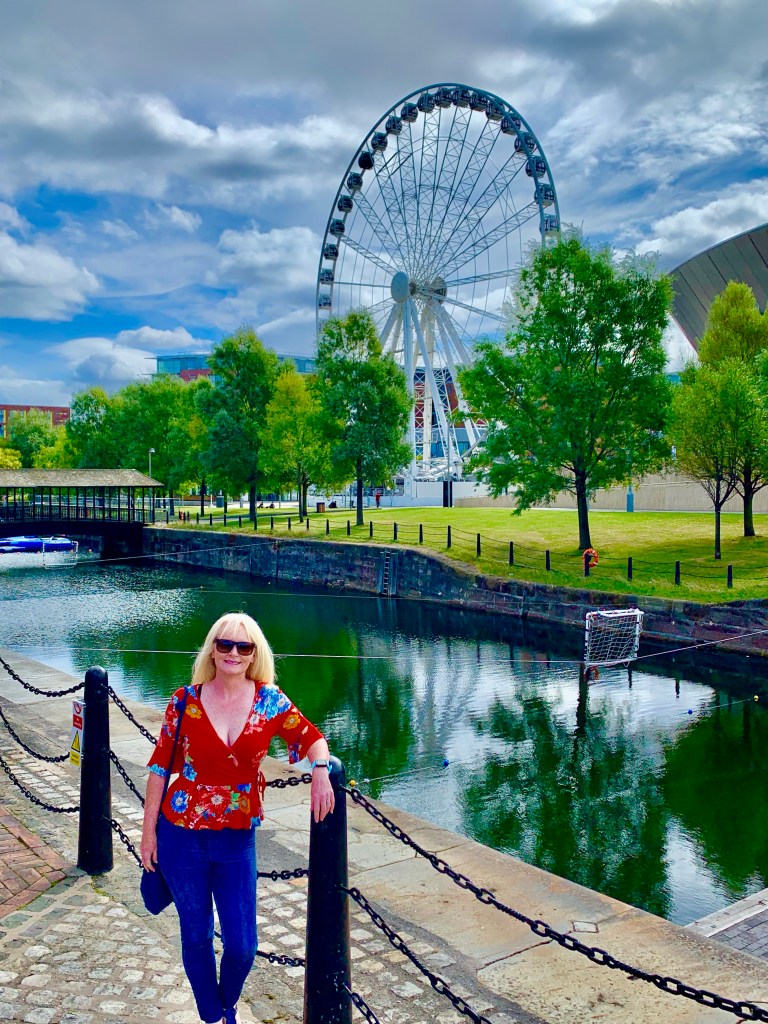
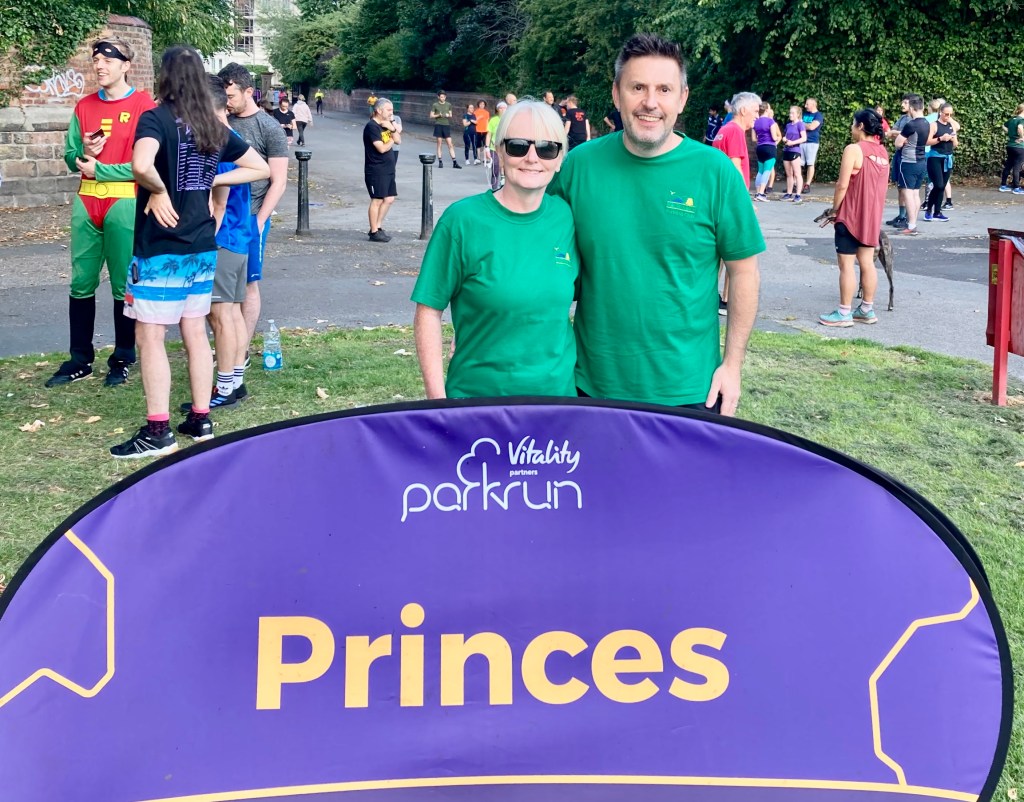
For us, it was the location of the nearest park run to our hotel in Liverpool. Less than two miles away this very pleasant park is situated in Toxteth, an excellent location to participate in the 5 kilometres park run. Full of friendly locals and a big thanks to volunteers who allow these park runs to take place.
The park itself was opened in 1842. As inner city parks go it isn’t bad, with impressive entrances, a carriageway perimeter drive which the park run follows for much of the route and a picturesque lake.
Sefton Park
Liverpool’s largest park is easily accessible by public transport or car.
Located near Princes Park is Sefton Park another Grade 1 historic park. This 235 acre park is a Green Heritage awarded site.
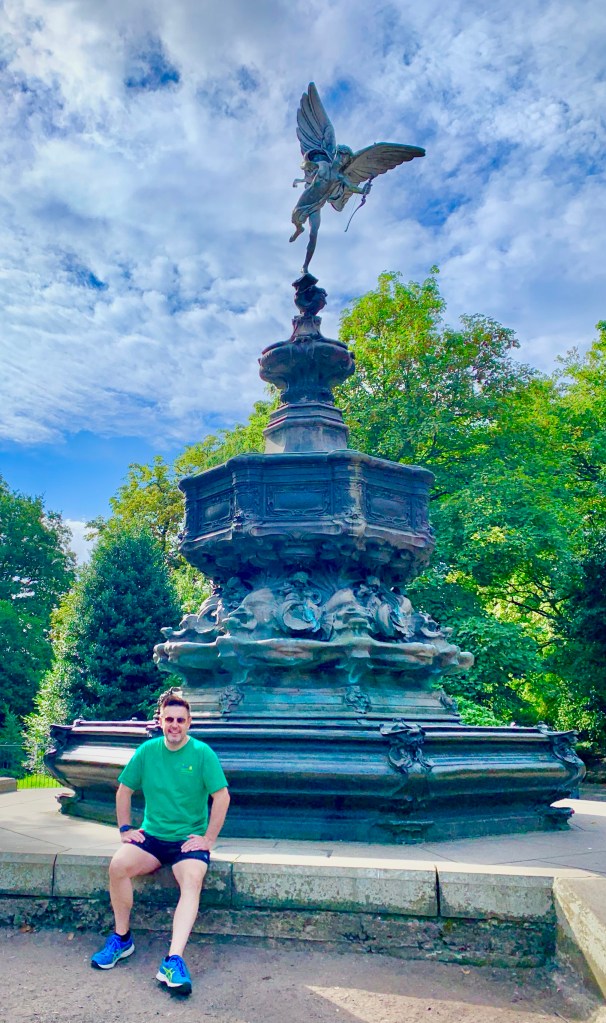
There are several impressive monuments situated in the park, including the Eros Fountain, Peter Pan statue and the Grade II listed Shaftesbury Memorial.
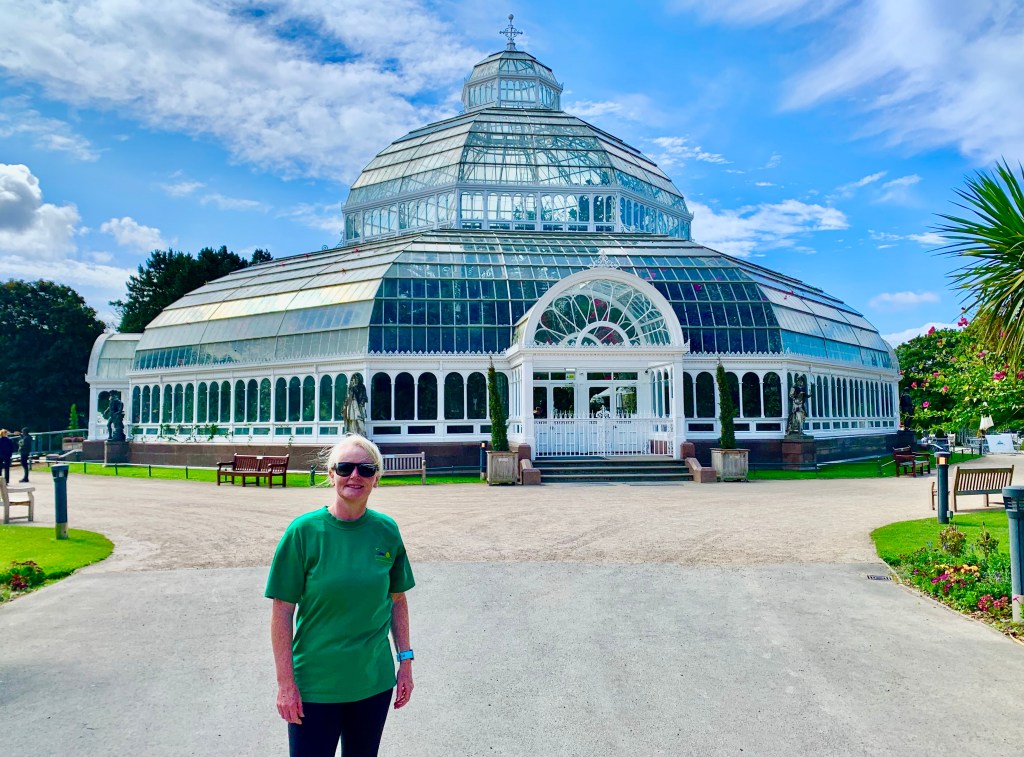
At Sefton Park, you will find its most impressive building the Palm House. Which is a Victorian glasshouse first opened in 1892. Badly damaged during WWII, rescued by the Save the Palm House campaign in 1992 and officially reopened in 1993. It now houses over 200 plant varieties and is a popular wedding venue.
There is also a very large lake in Sefton Park originally a boating lake. The lake was emptied in 2007 for restoration work and refilled in 2010. It was restocked with fish and is now a very popular location with anglers.
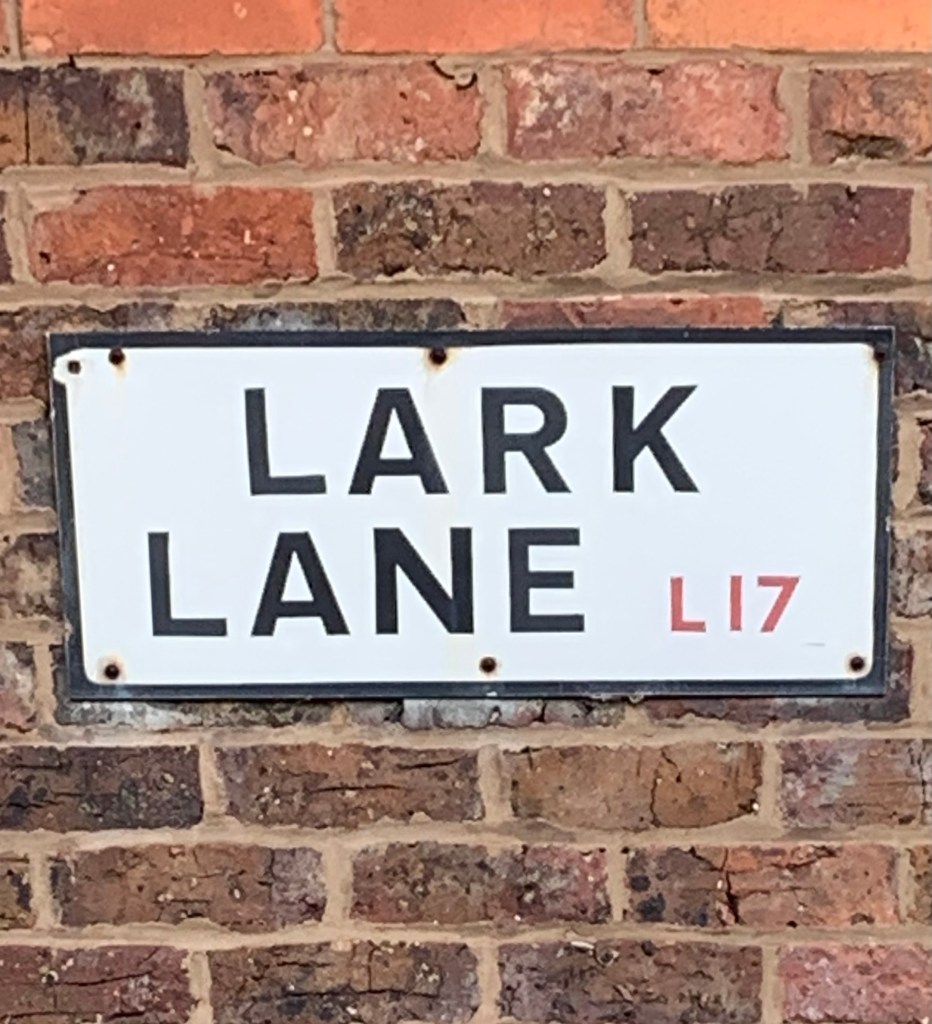
Lark Lane
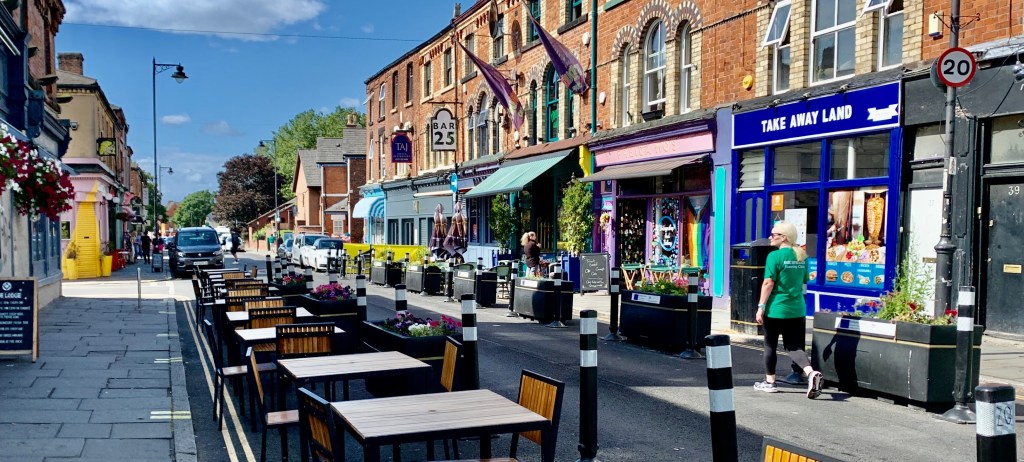
Just of Sefton Park, you will find the rather delightful Lark Lane. Located just south of the city centre and worth exploring.
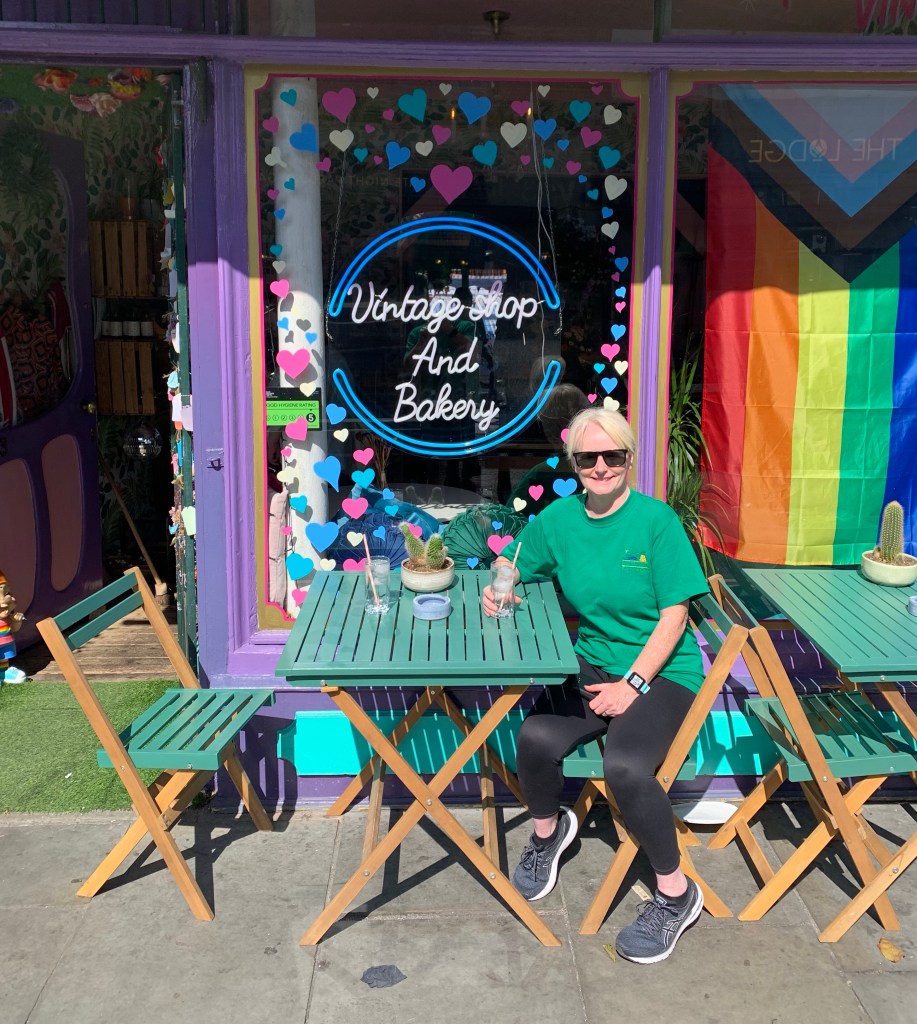
Lark Lane is a very colourful area where we found an eclectic mix of unique and independent retailers with lots of cafes and restaurants.
One of many independent businesses to be found at Lark Lane.
Lark Lane is very much the centre of Liverpool’s alternative scene with an art centre located in the old police station holding regular events such as holistic healing, craft fairs and flea markets.
Toxteth’s Welsh Streets
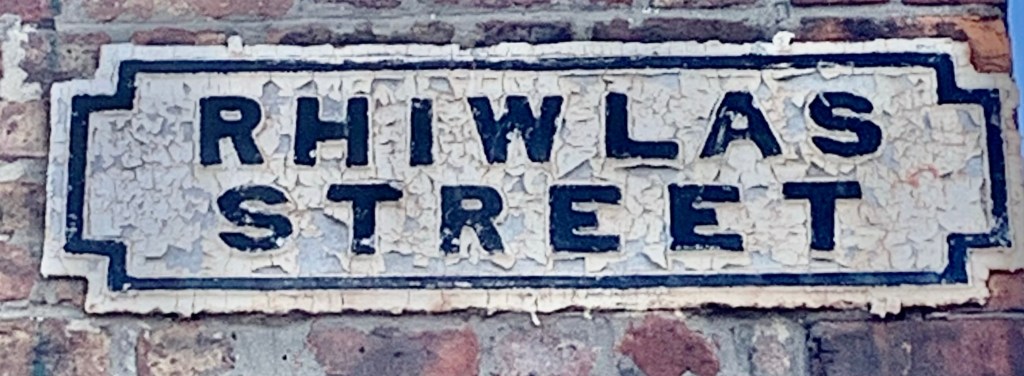
It has been jokingly said that Liverpool is the Capital of North Wales due to its links and proximity to North Wales. This can be seen in Toxteth where I found a group of late 19th-century Victorian terrace houses where a large community of Welsh people lived.
The history of Liverpool’s Irish community is very well known. Less well known is Liverpool’s Welsh community. Many came to Liverpool for work and many areas of Liverpool can trace its history back to the first Welsh community who settled there.
In Toxteth, many streets are named after Welsh places and landmarks. Over 10,000 terrace houses were built in Toxteth for Welsh workers from the 1850s onwards. There was also a large Welsh community in Everton. Over 80,000 Welsh people were living in Liverpool at the beginning of the 20th century.
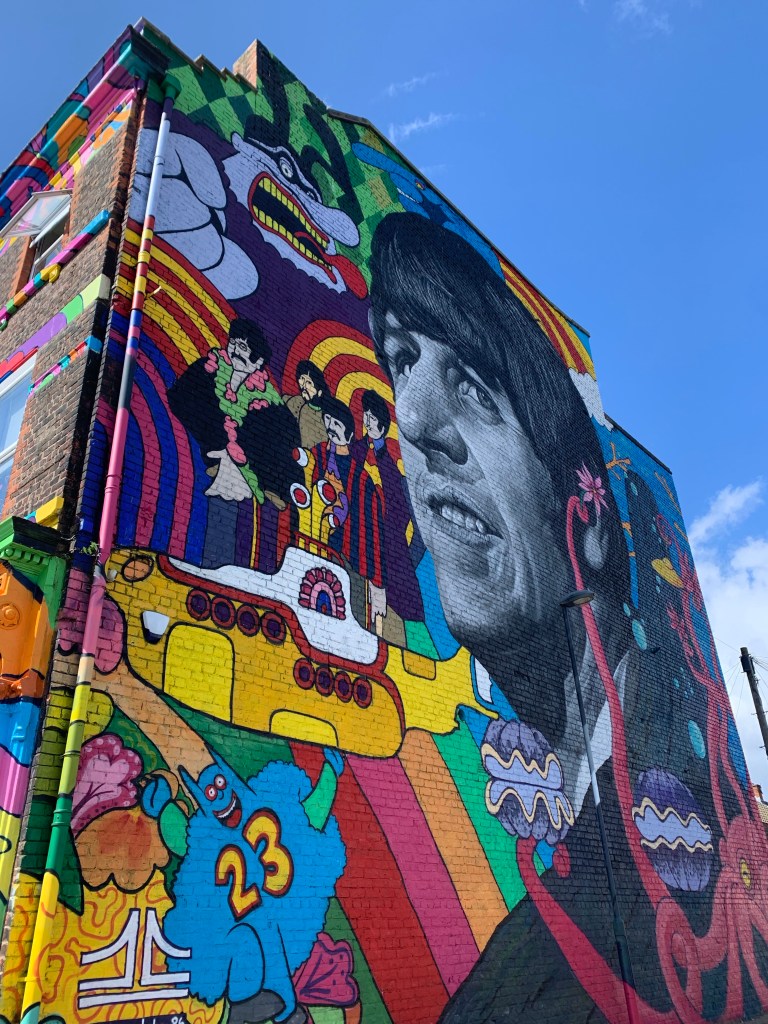
Welsh Streets was the home of Ringo Star where it forms part of the Beatle’s magical mystery tour. The area had become derelict in the later part of the 20th century. Nonetheless has been redeveloped and has now started to become a vibrant community once again offering the local community affordable social housing.
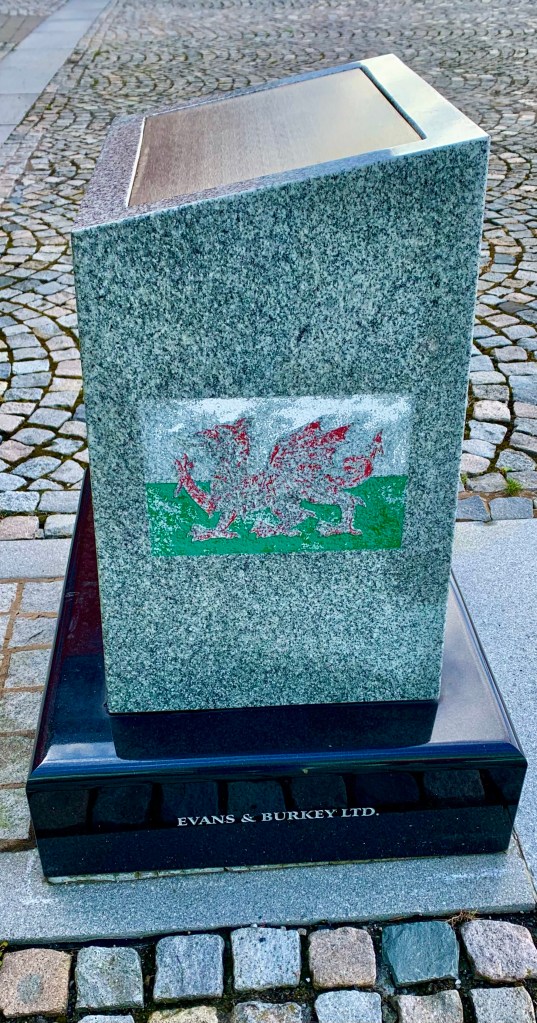
Continuing with the Welsh theme, on Liverpool’s riverside I found a small memorial to the first Welsh settlers who left Liverpool on the ship Mimosa in 1865 to start a new life in Patagonia Argentina.
The Cavern Quarter
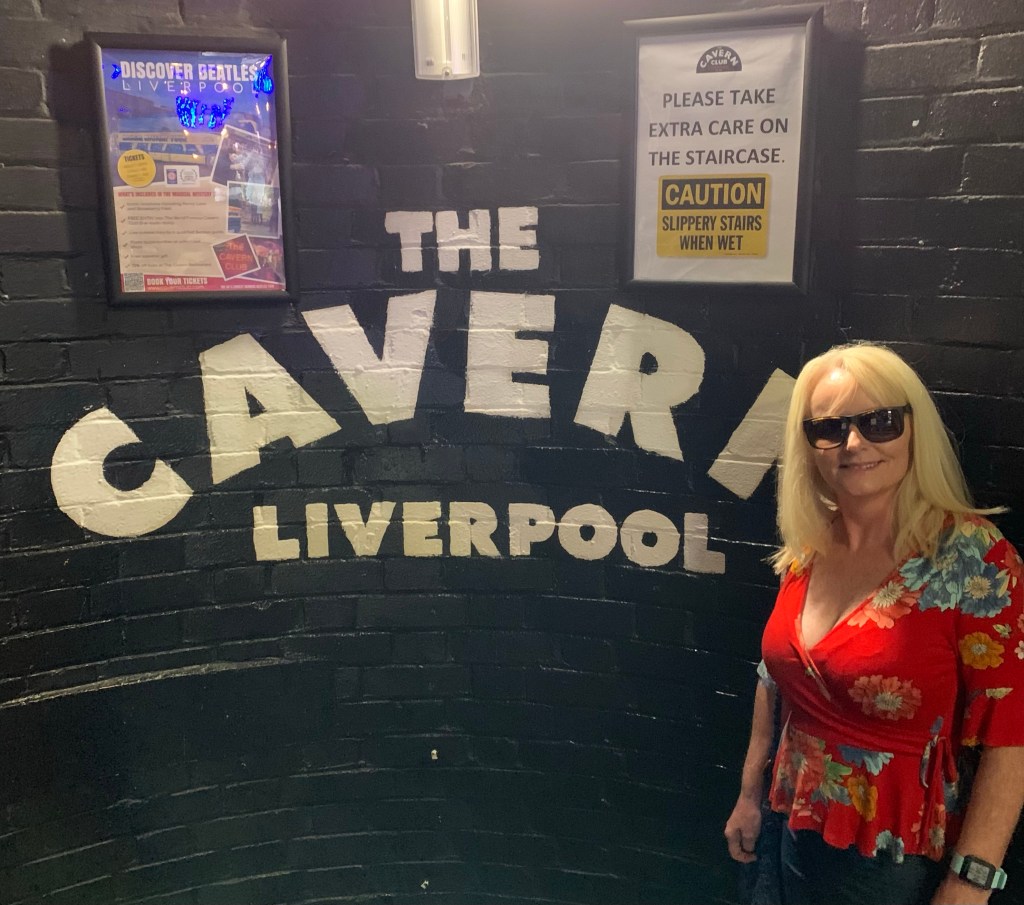
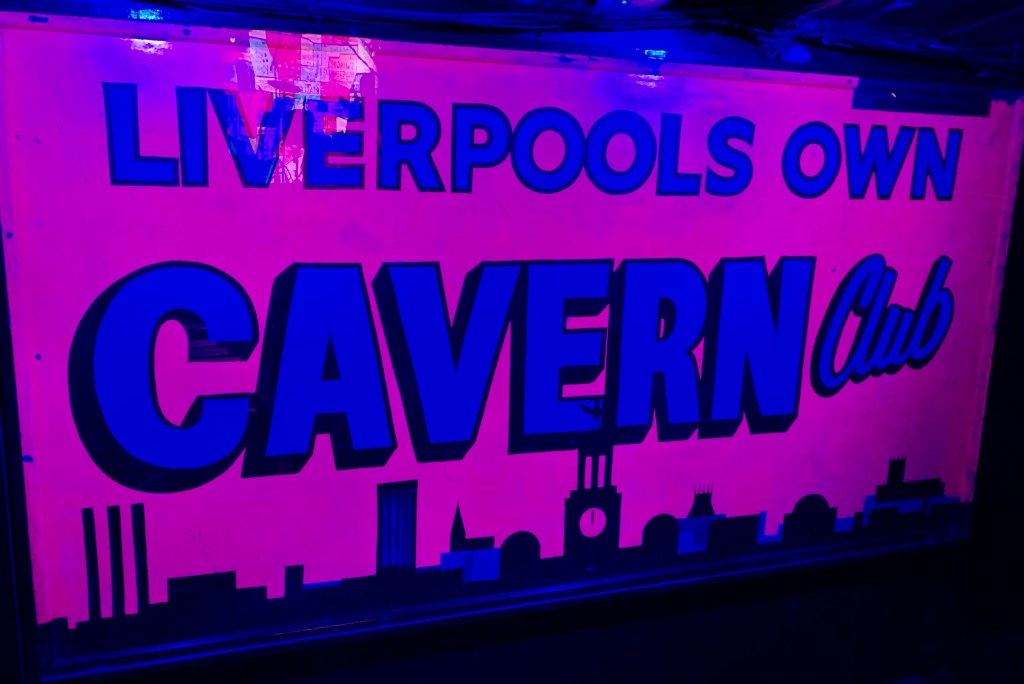
The Cavern Quarter is a pilgrimage to The Beatles. Located on Matthew Street it’s a popular destination for all things Beatles related.
If I am being honest a trip to the Cavern Club was well down on my things to do in Liverpool. Regardless, my wife was keen to visit so being a very amenable human being agreed to visit The Cavern Club. How many Beatles songs will I have the misfortune to have to listen to?
We paid the £5 entrance fee, there are bands in the Beatles pub opposite the Cavern Club, which has free entry, however, now I am here I might as well go for the full shebang.
Once inside I was surprised that there were not one but two stages, The artists were very good and not glorified Beatles cover bands. Songs were predominantly Beatles but they played some non-Beatles songs as well. Despite my reservations, a very entertaining afternoon was had. The atmosphere was excellent, the performers were fantastic and the bar prices were very reasonable. Not the overpriced tourist trap I was expecting.
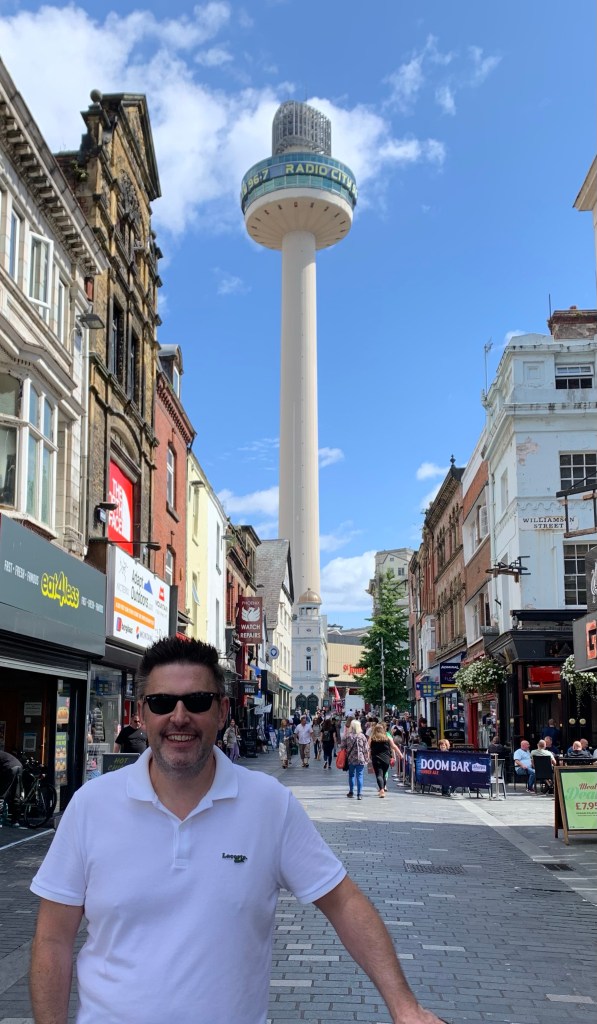
Radio City Tower
A radio and observation tower in the city centre
First opened in 1969. The tower stands at 138 metres and is Liverpool’s tallest free standing building if you include its 10 metre antenna. The tower was listed as a Grade II building in November 2020.
The tower has had a very colourful history. It was a revolving restaurant until 1979 when it was closed due to health and safety issues. It reopened in the early 80s but closed again in 1983. The tower reminded empty until 1998, when Radio City bought and renovated the tower for £5 million and reopened in August 2000. In 2010 the first floor of the tower was opened to the public as an observation tower.
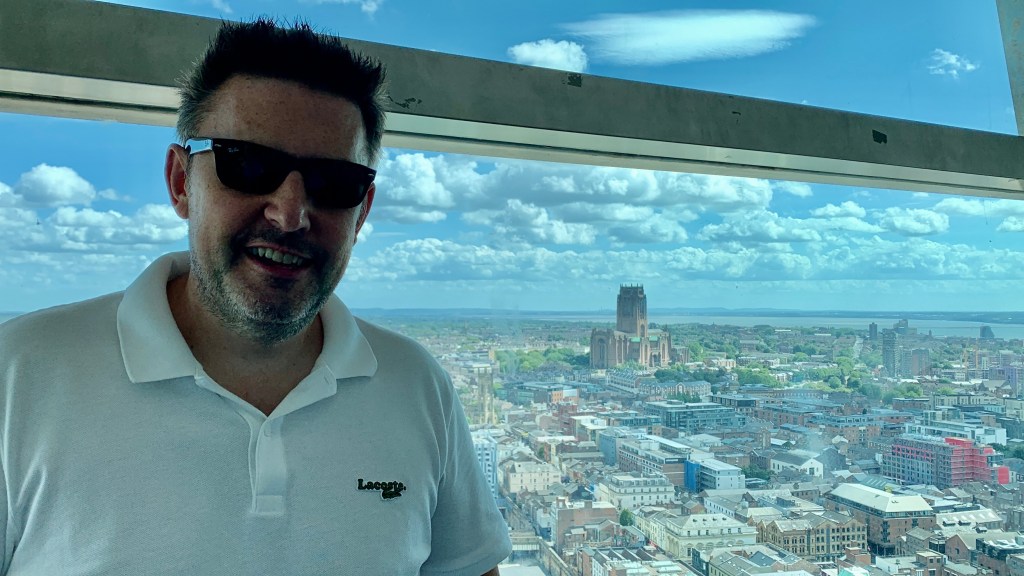
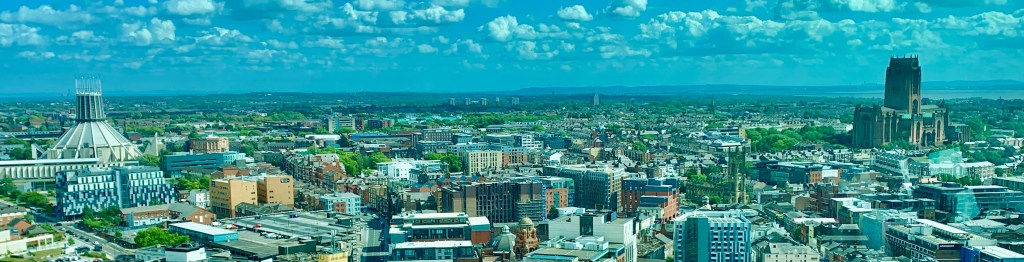
View from the tower with Liverpool’s two cathedrals in view are the ultra-modern Catholic cathedral far left and the ultra-traditional Anglican cathedral on the far right of the picture.
The viewing platform certainly gave me a unique perspective of the city as I walk around giving me a 360 degree of not only Liverpool and the Wirral but Blackpool, North Wales and Snowdonia.
Liverpool’s Chinatown
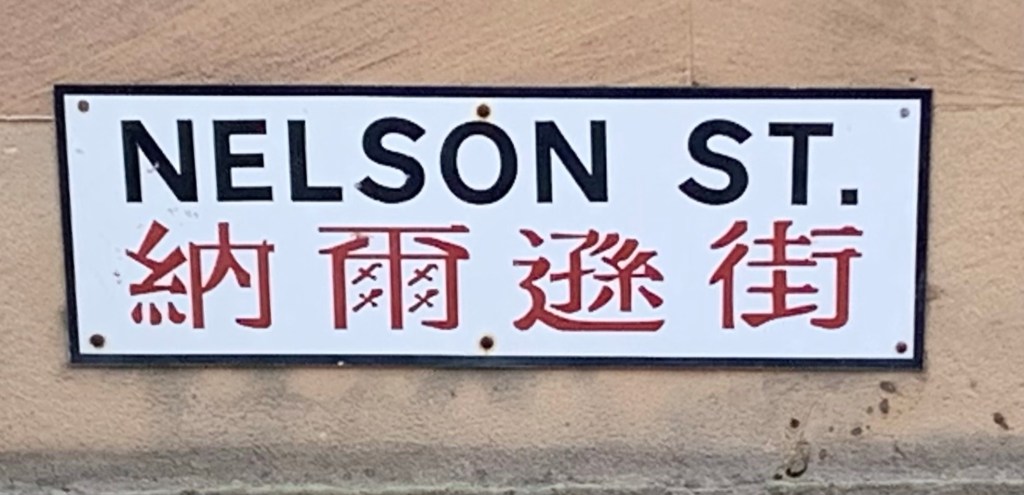
Liverpool has a very multicultural population. Along with Irish, and Welsh, Liverpool has Europe’s oldest established Chinatown. Over 10,000 Chinese people are living in Liverpool and its surrounding areas.
The Chinese arch stands at 15 metres and is adorned in over 200 dragons.
I certainly knew I was entering Chinatown it was hard to miss the traditional Chinese arch which was imported from Shanghai and assembled by Chinese craftsmen. The arch not only welcomes you to Chinatown it also celebrates the twinning of Liverpool with Shanghai.
St George’s Quarter
Part of Liverpool’s World Heritage Site and boasts one of the finest collections of Victorian architecture in the UK.
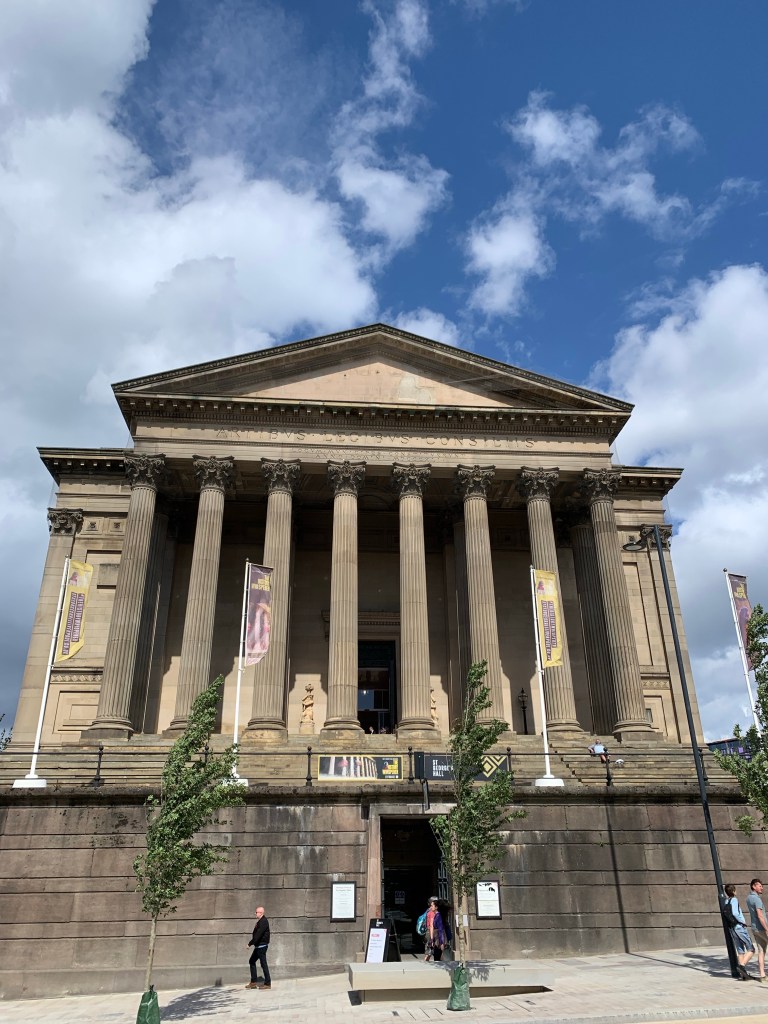
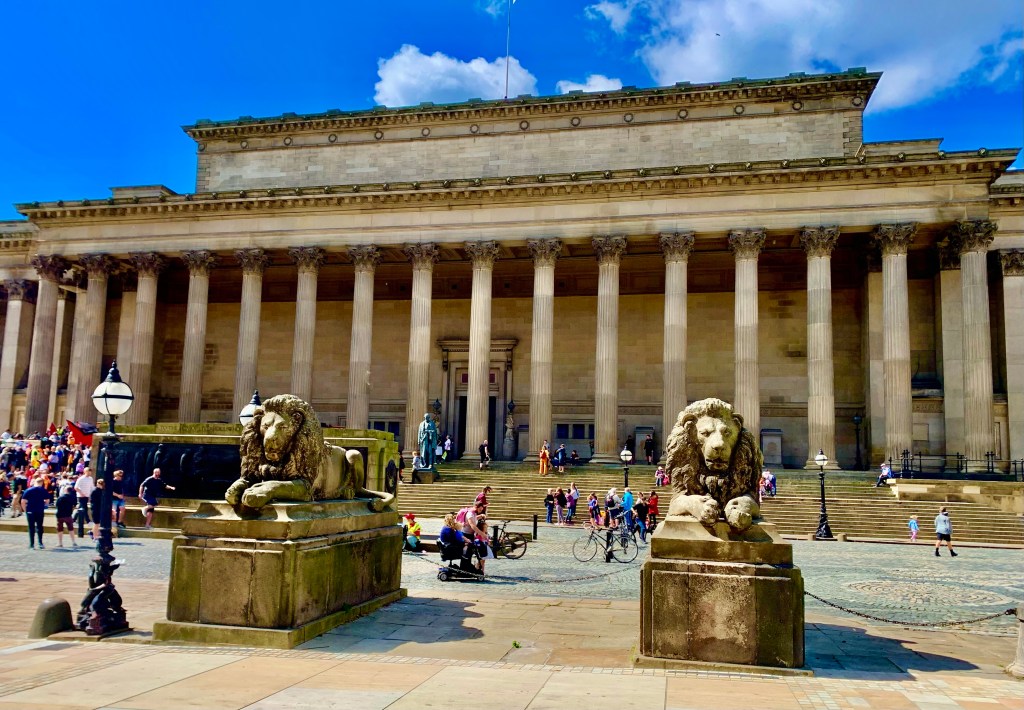
Liverpool has the greatest concentration of listed buildings outside of London. Many of the grandest buildings can be found in St George’s quarter. Some of the buildings include the Central Library, Royal Court, St George’s Hall, Walker Art Gallery, Royal Court and St John’s Garden.
Even if Victorian Architecture isn’t for you, the buildings on display are certainly worth a look as it’s right in the city centre. The square is a popular gathering place for political rallies, demonstrations and public meetings. So St George’s Quarter isn’t only steeped in architectural history but social history as well.
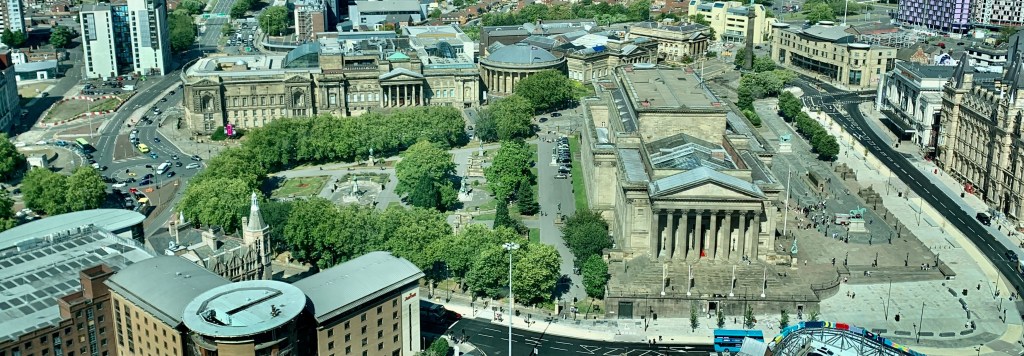
View of St George’s Quarter from the observation deck of the Radio City Tower.
Two faces of Liverpool at St George’s Quarter. The lion regally surveys the manor overlooked by Radio City Tower, while in the second picture Radio City Tower gives a birds eye view. of St George’s Quarter.
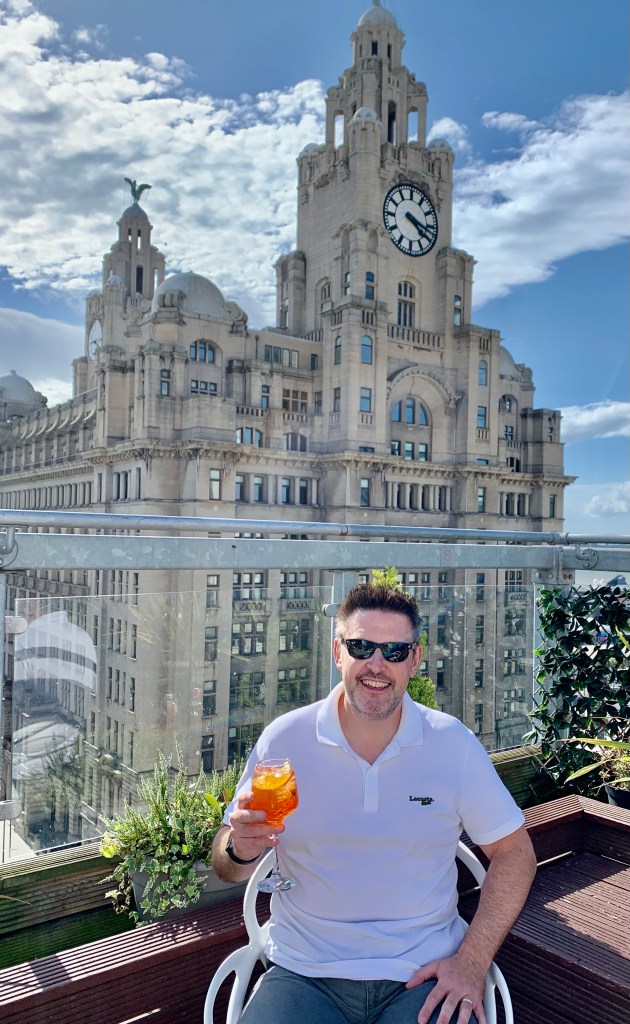
Rooftop drinks with a view!!!
Enjoy a spectacular view of Liverpool from a rooftop bar.
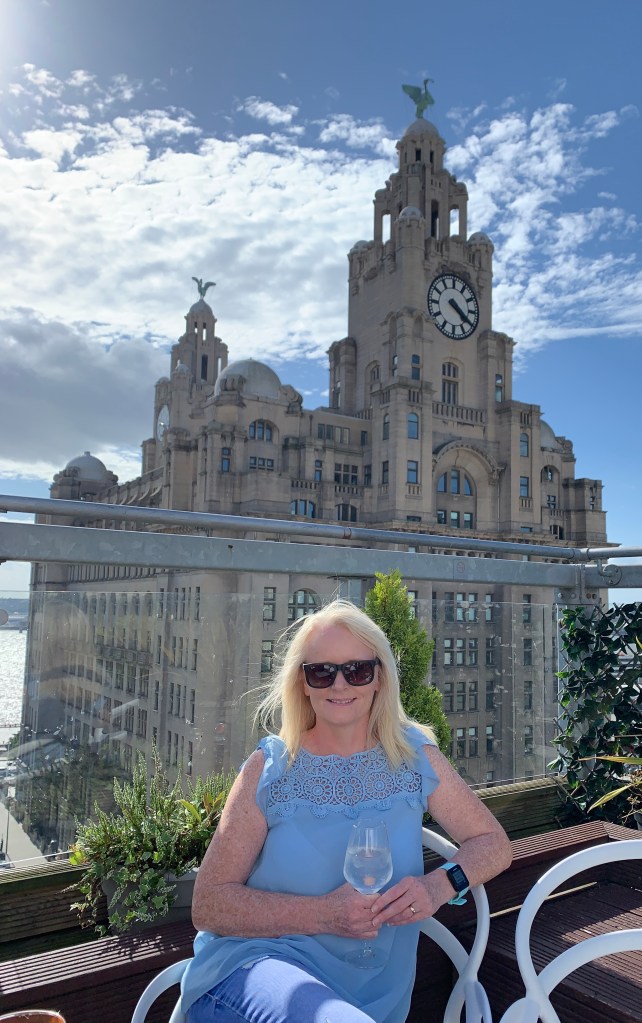
While I was staying in Liverpool the sun was shining and British Summer time was here 🌞 A drink at one of the rooftop bars was definitely in order if only to get a different perspective of Liverpool’s beautiful architecture 😆
We choose the delightfully named Oh Me Oh My as it was situated near to our hotel and for the fantastic view we got of The Royal Liver Building and the River Mersey. No pre-booking is required and drinks for the location in my opinion very reasonably priced, perhaps just one more drink to enjoy that exquisite view.
Unique night life
Liverpool’s not-so-secret cocktail bar.
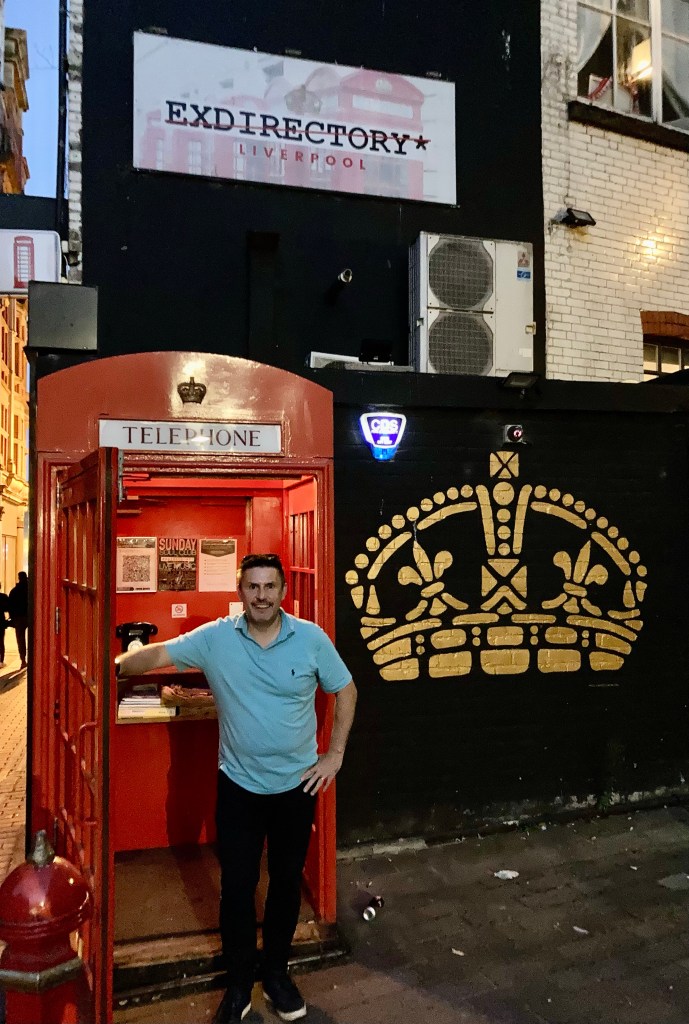
I was slightly intrigued to find this red phone box in one of the back streets of Liverpool. On closer inspection, it was the entrance to a rather quirky cocktail bar. I thought my wife had lost her marbles when telling me to look for a red phone box.
Pre-booking is required to gain entry at this establishment by phone ☎️ of course. As this guarantees a table as it can be a popular place.
Whatever cocktail you choose it’s going to taste purr-fect
An enjoyable visit which seemed to be very popular with the locals. Classic cocktails are served here however the signature cocktails are anything but traditional, Catwalk bellini served in a stiletto glass, put a ring on it served in a doughnut.
Not to mention some unique pubs
Old-school boozer or ultra-modern craft beer den? The best pubs in Liverpool run the gamut from traditional to boundary-pushing.
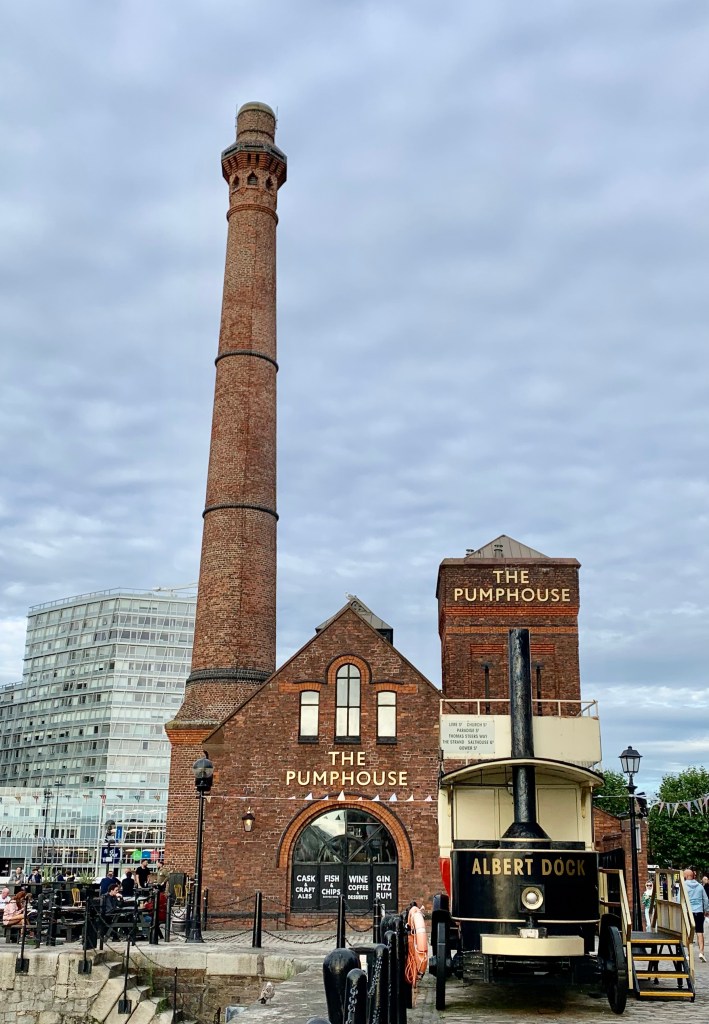
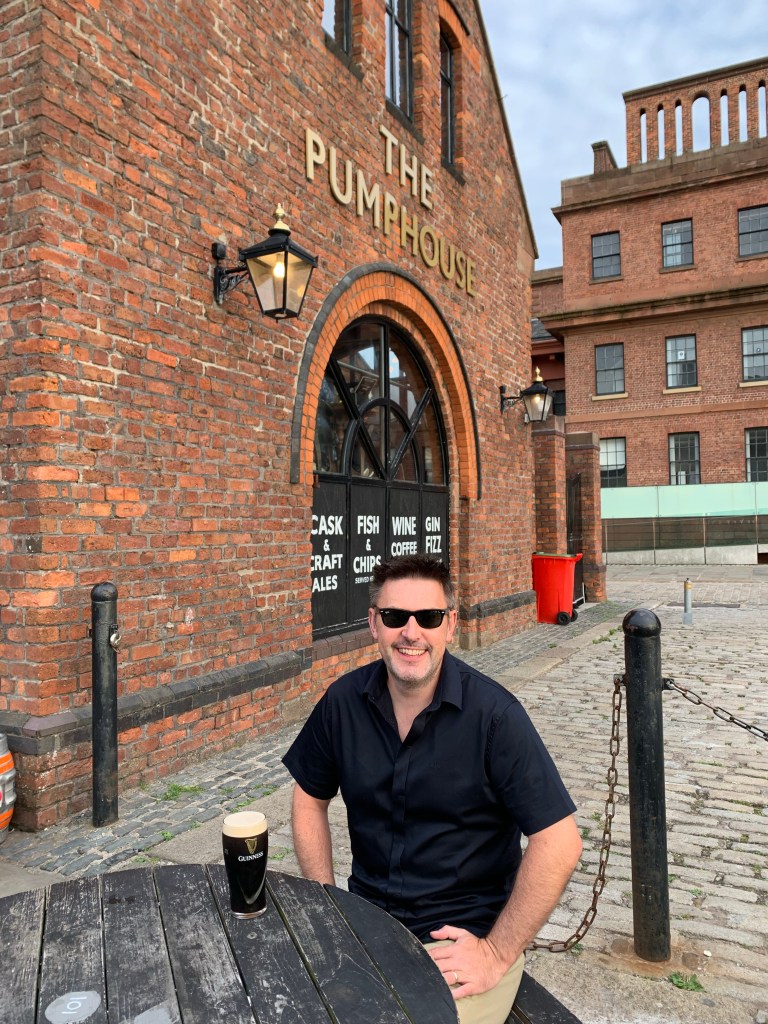
Being a man of a certain age I now have an affinity for tradition. This Grade II listed former pump house at the Royal Albert Dock fits the bill perfectly for me.
This is a pub in the classic mould, nothing wrong with that. A good selection of craft beers, real ales alongside traditional favourites and a good selection of gins, rums and wines.
It also boasts a wonderful dockside beer garden, a perfect place to delight in a sunset over Royal Albert Dock. Gave me time to contemplate the delights of this grand maritime city.
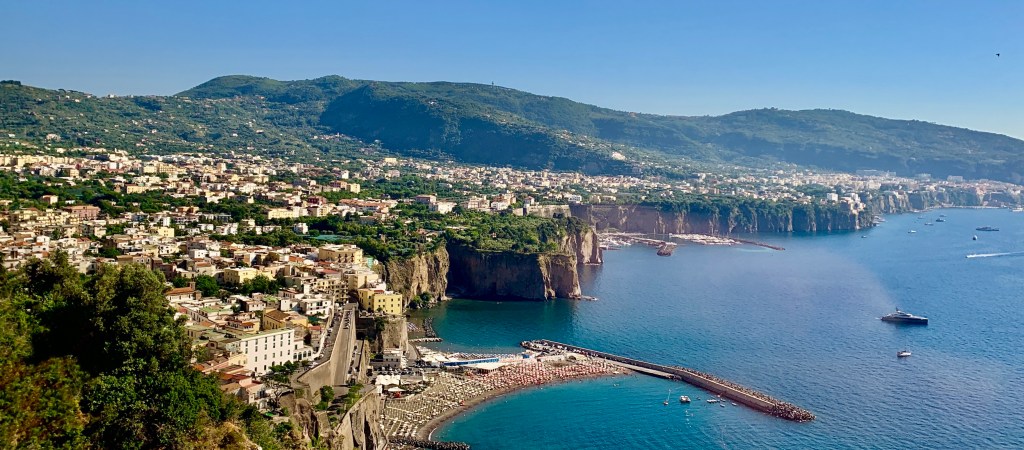
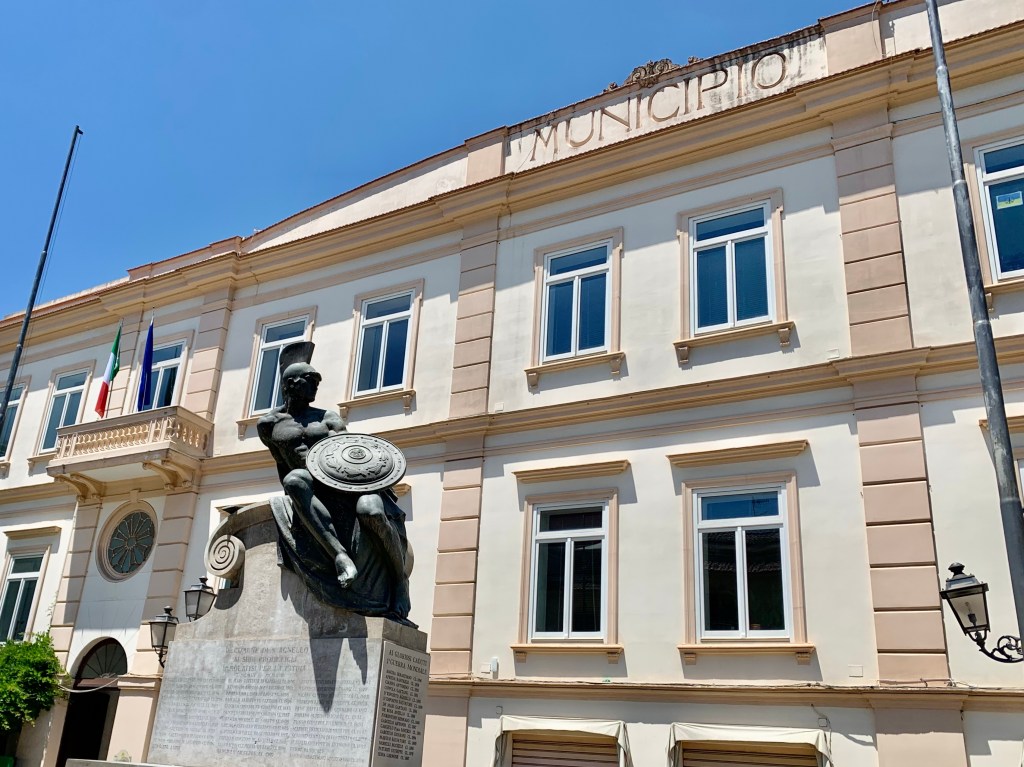
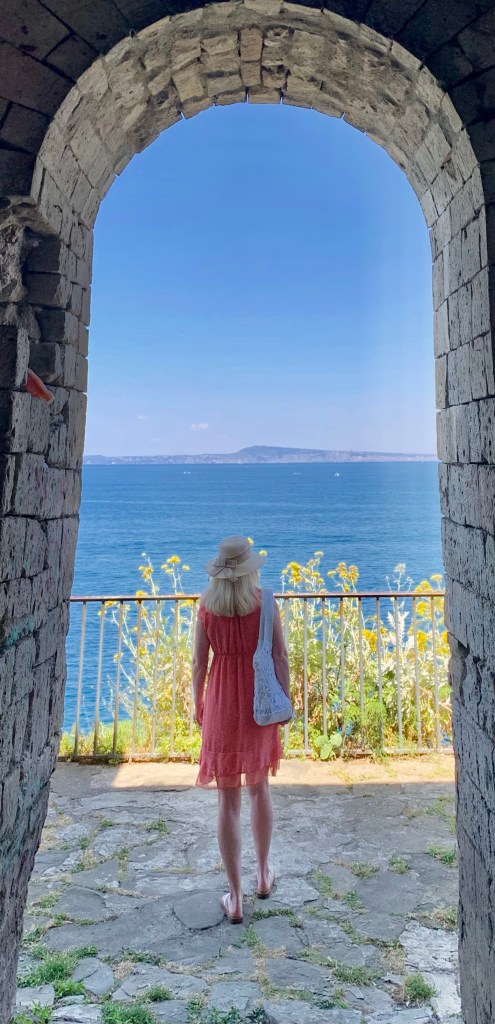
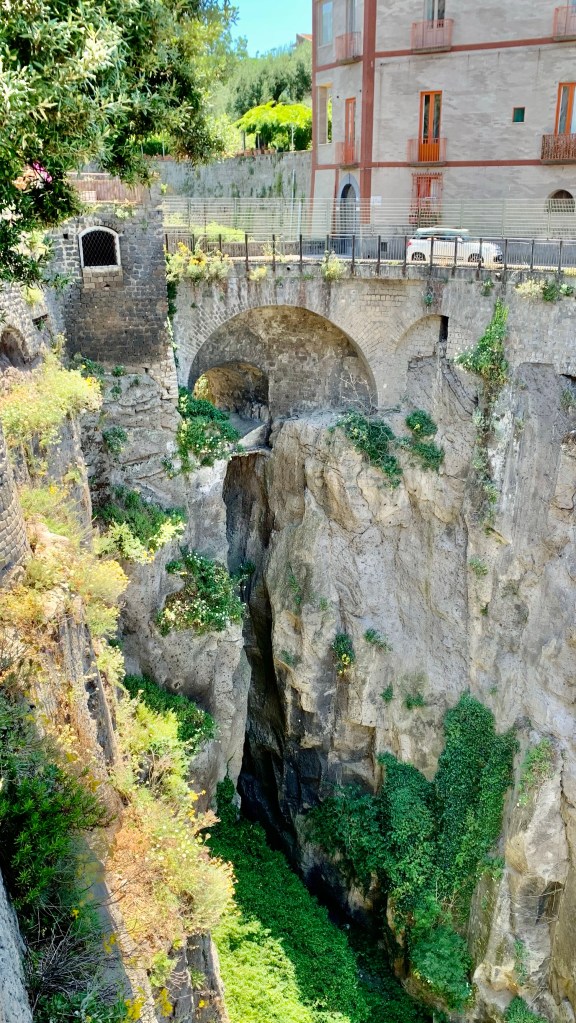
The Amalfi Coast may be the jewel in the crown, the rest of the coast is no less impressive. Sorrento and the Sorrentine Peninsula which juts out into the Tyrrhenian Sea with its rugged shores and spectacular beaches is a perfect example.
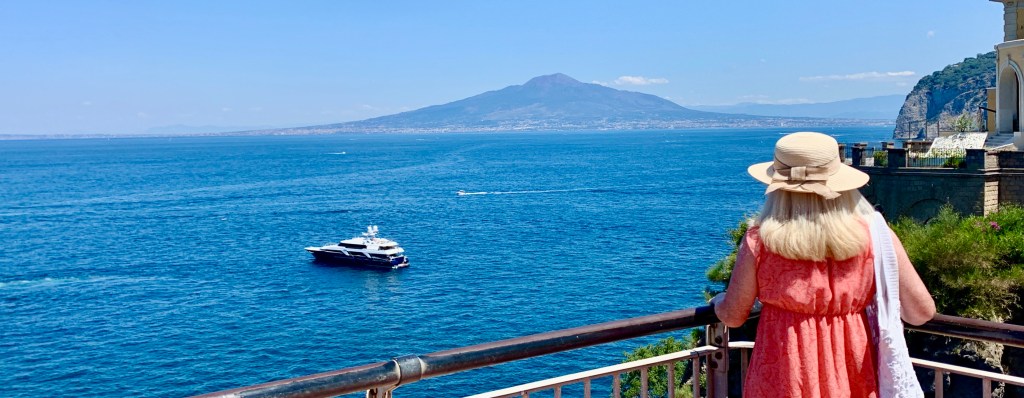
The Peninsula is named after its main town Sorrento. Located on the north of the Bay of Naples overlooking Mount Vesuvius. The Amalfi Coast is located to the south. The Lattari Mountains forms the backbone of the Peninsula. The island of Capri lies off the western tip of the peninsula.
Sorrento
A small resort with a big reputation. Know for is plunging cliffs, high class hotels and not forgetting lemons. It’s a place to explore on foot discovering the old town and soaking up the the best views and vantage points.
Although Sorrento is the main visitor centre. Look beyond Sorrento and you will be rewarded with some less well-known towns that are home to intriguing historic sites, beaches, fantastic bars and restaurants.
Sorrento has a long history of tourism going back to the 19th century as it was a compulsory stop on the “Grand Tour” it has long inspired a long list of literary geniuses Byron, Dickens and Tolstoy to name a few. With ferry connections to Naples and Capri, the western gateway to the Amalfi Coast, as well as a rail connection to Pompeii makes this an ideal base to explore the larger area.
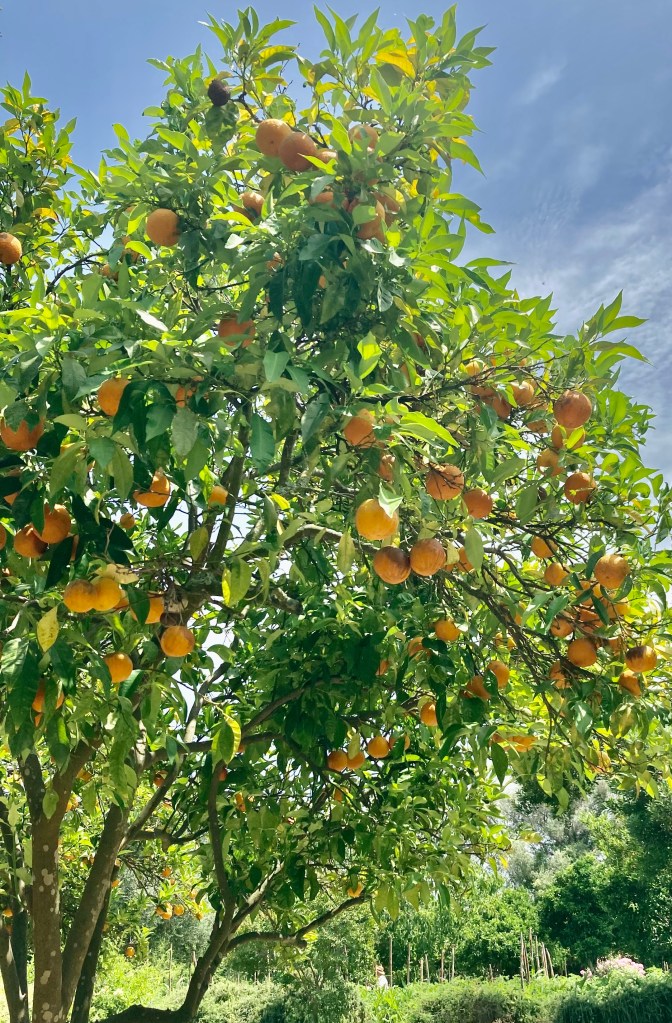
A typical lemon garden in Sorrento
Where do I start my Sorrento adventure? with lemons. Lemons are the most iconic symbols of Sorrento and the Campania region. There is even a variety of lemons named after Sorrento. Such is their importance Sorrento lemons have a PGI Protected Geographical Indication and have grown in the area for over two millennia. It’s used in every aspect of cooking, even the peel is not wasted as this is used in the process of making limoncello.
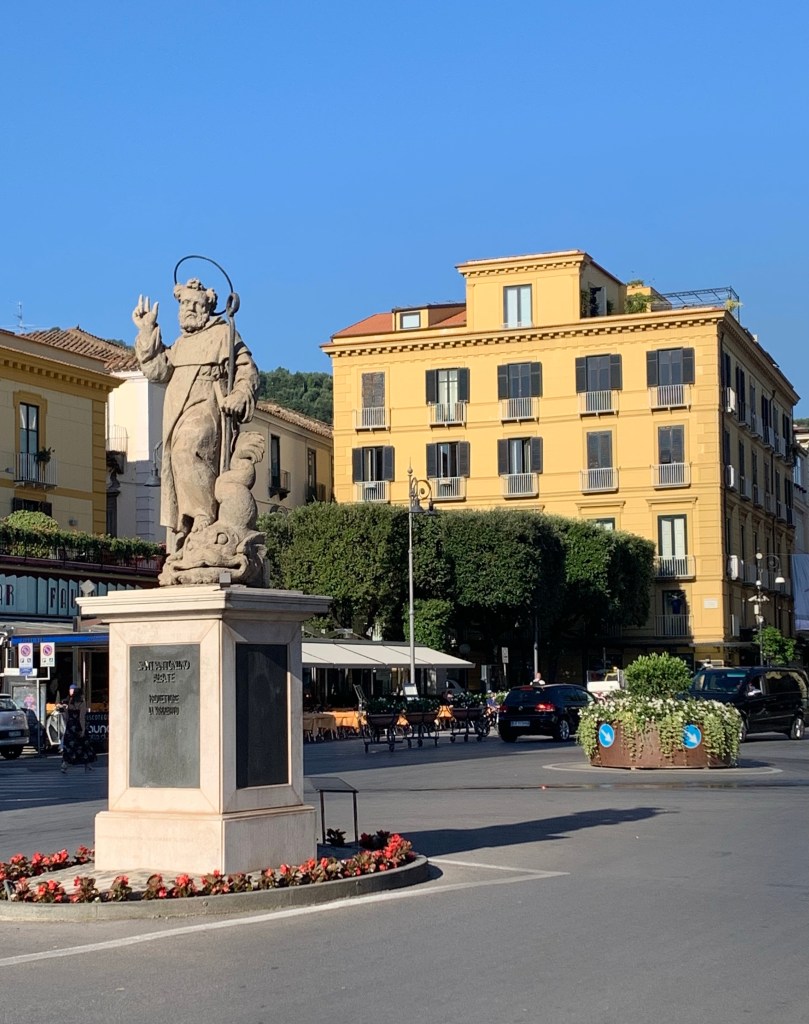
Piazza Tasso
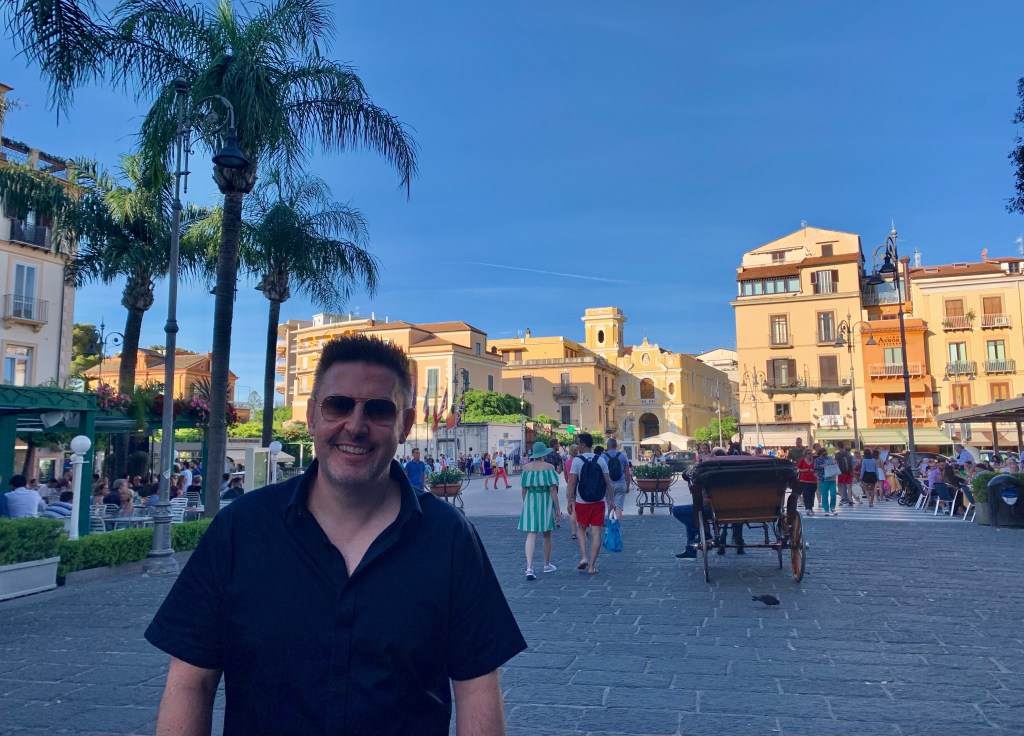
This is the beating heart of Sorrento named after Renaissance poet Torquato Tasso who was born in Sorrento. Today this busy square will be full of people, cars, vespas and the occasional horse and cart taking visitors on a ride around the old town.
Piazza Tasso is surrounded by cafes and bars and is the perfect location to people-watch as everyone seems to walk through the square, whatever the time of day morning, noon or night the square is always a hive of continuous activity.
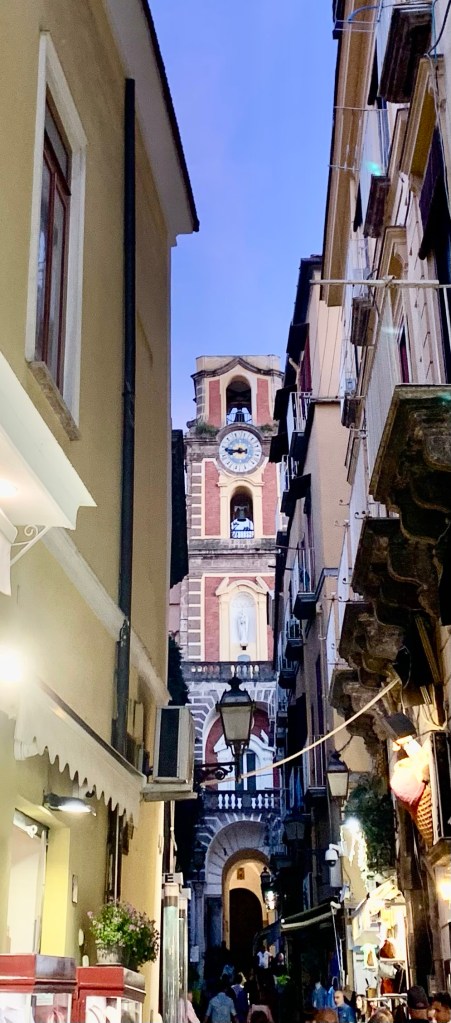
Just of the Piazza Tasso, you will find Sorrento’s historic centre a maze of narrow streets that run back from the cliffside. Medieval alleyways that twist and turn past cafés, bars and shops with churches, historic buildings and secret gardens intermingled amongst them. A confusing layout but you will have fun uncovering something different around every corner.
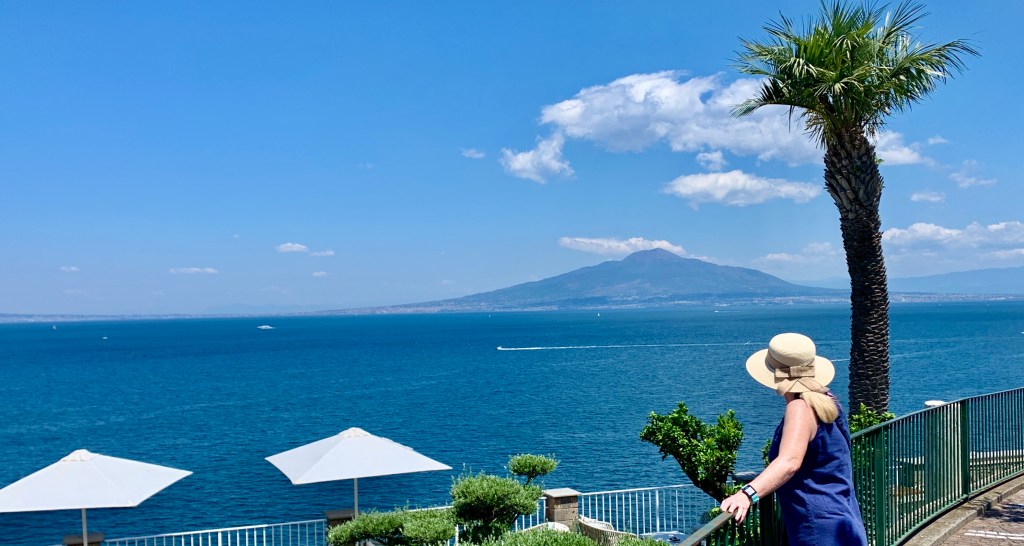
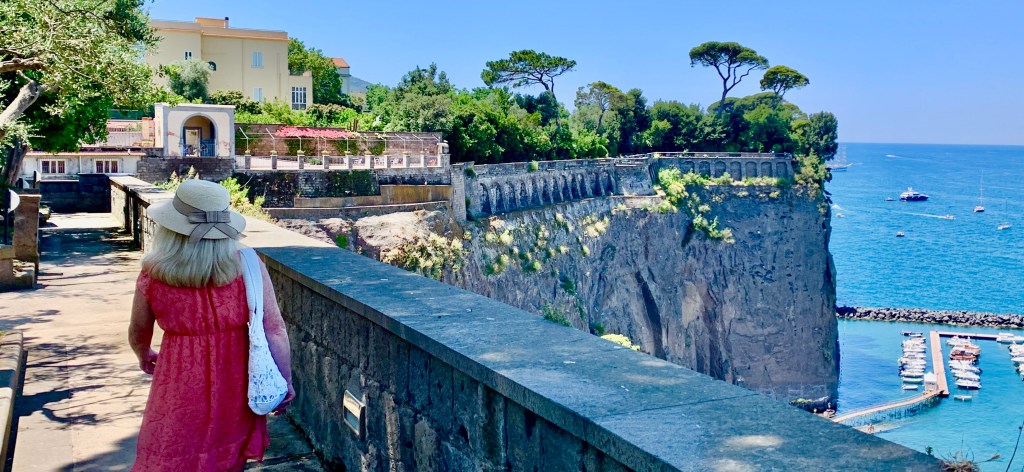
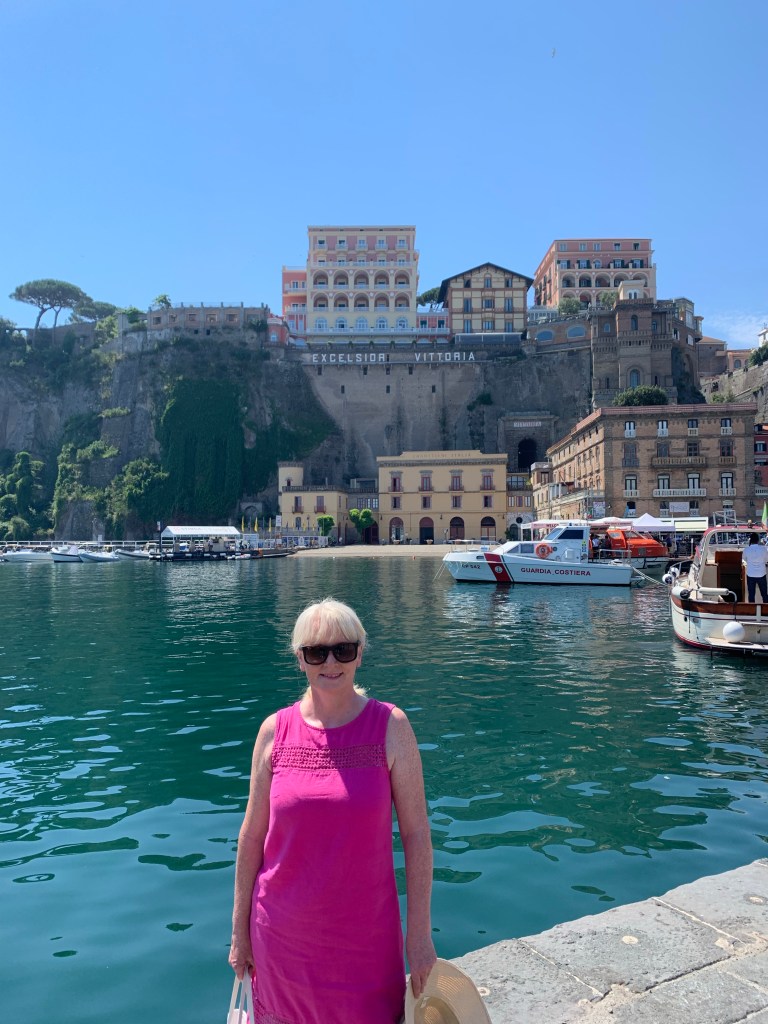
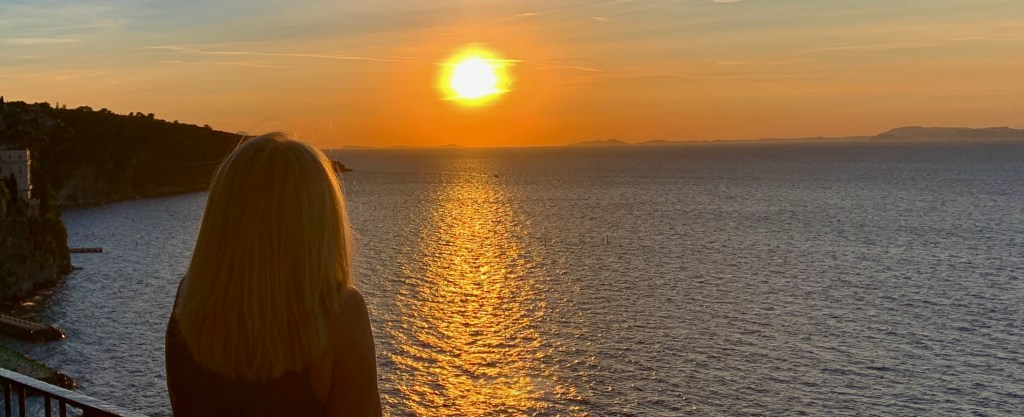
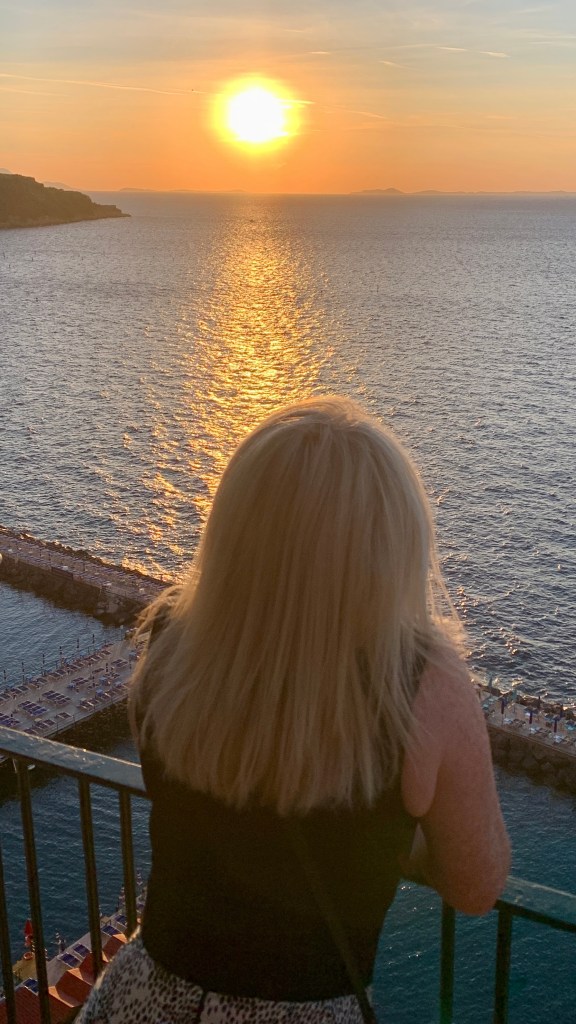
Just from the old town down towards the cliffside, we came across Piazza Della Vittoria. A shaded area of the town with trees and manicured gardens. Several of Sorrento’s most exclusive hotels are situated here. It is a very popular location to view a sunset as there are fabulous views of the sea looking over the Bay of Naples.
One thing you can rely on as with the rest of the Sorrentine Peninsula is the fantastic views of the bay. Although in reality many of the best viewing points are taken up by upmarket hotels and restaurants. There are a few areas in Sorrento where you can do this for free.
Sant’Agnello
I was staying in Sant’ Agnello. It’s one of the smallest towns on the Sorrentine Peninsula. It’s ideally situated if you want some peace. Only a 20-minute walk to Sorrento if you do want to enjoy its busier neighbour.
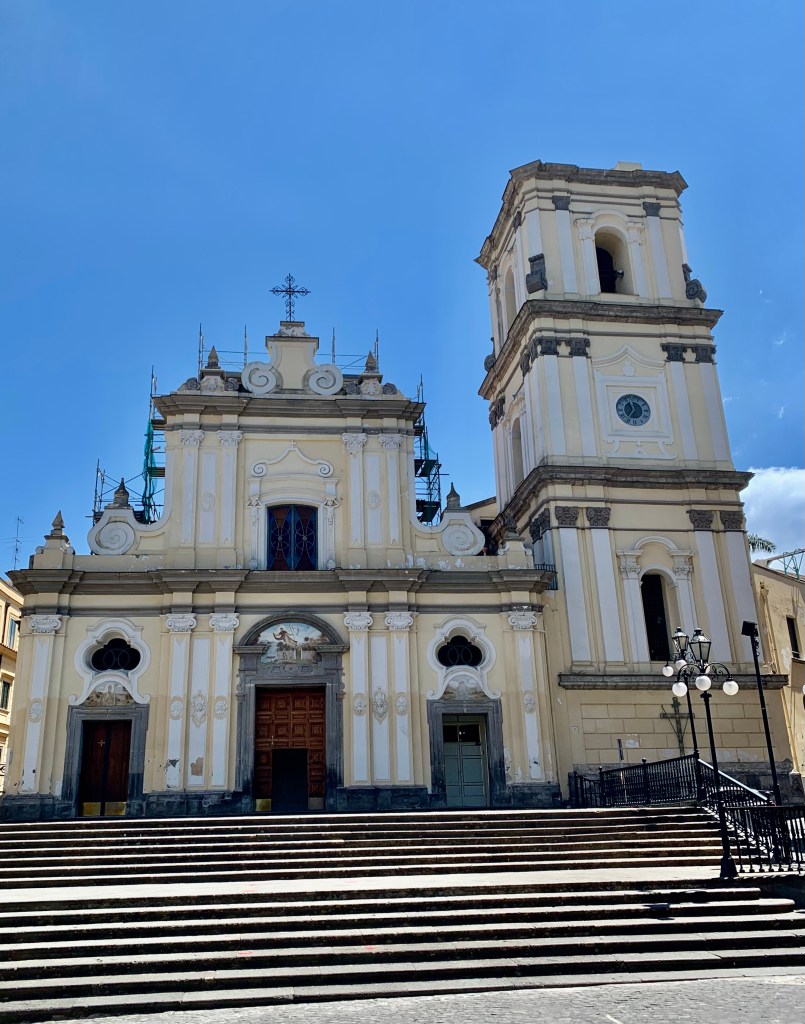
Sant’Agnello Church
The main square Piazza Sant’Agnello with its distinctive church sits aside from the main road to Sorrento. It’s a bustling area and a perfect place to people-watch.
Piazza Sant’Agnello by night
It’s not a major tourist centre like nearby Sorrento. The town has a laid-back vibe and a very authentic feel about it. There are a few bars and restaurants here which are very authentic and reasonably priced. It’s probably the best place for a few post-dinner drinks in Sant’ Agnello.
Piazza Matteotti
The other main centre in Sant’Agnello is Piazza Matteotti. This is in the historical part of town. There is one traditional cafe here and you will find the railway station very close by as Sant’Agnello is on the Naples to Sorrento line.
Sant’Agnello is the perfect retreat to get away from the hustle and bustle of Sorrento. It’s easy to fill your days here exploring the town, enjoying a walk to neighbouring towns or taking a walk to the nearby hills which surrounds Sant’Agnello.
Like the other towns of the Sorrentine Peninsula Sant’Agnello sits on the tufa stone directly over the sea. This offers fantastic views of the Bay of Naples. Where you can admire the clear blue sea as the sky meets the sea on the horizon.
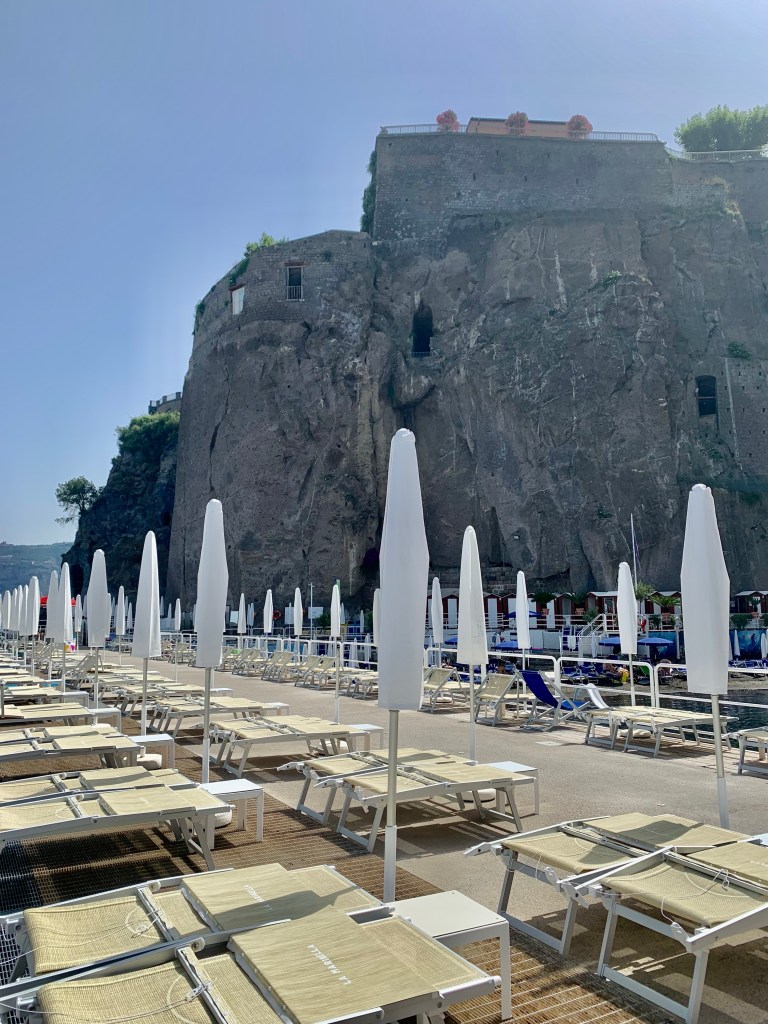
One of the best locations to view this is the Marinella a scenic overview with a fantastic panorama that stretches from Mount Vesuvius to the Sorrentine coast. A lot of Sant’ Agnello’s hotels and more upmarket restaurants are situated here. You will have access to the La Marinella beach club located at the bottom of the cliff.
Piano de Sorrento
Just a short walk from Sant’Agnello is the town of Piano de Sorrento. This is the main commercial centre for local people who come here to shop and socialise.
Although not a popular visitor centre it’s grown in popularity in recent years due to the growing Airbnb market. There is a marina and two beaches located in the town.
You will find the Villa Fondi which is probably the main attraction in the town. Due to its waterfront location on the top of a cliff with stunning sea views, it’s a very popular location for weddings. As you enter the property we were surrounded by lush gardens which surround the villa with a fabulous vista of the bay.
Piano de Sorrento is not a busy destination, but if you are looking for an authentic feel of a typical Italian town then this is a perfect location. Prices at bars and restaurants are less expensive than you will find at popular locations such as Sorrento. The atmosphere is more laid back here.
Exploring Sorrento on the water
To fully appreciate Sorrento’s natural beauty a trip on the water is in order. There are two marinas in Sorrento Marina Piccolo and Marina Grande. Confusingly Marina Piccolo is the largest marina, as piccolo is little in Italian and Grande is big.
Waterside at Marina Piccolo
If you are going to go on a ferry it will be from Marina Piccolo and most commercial boat trips depart from this location, it’s about a 20-minute walk from Piazza Tasso. Marina Grande is essentially a fishing port and is located further away from the main town.
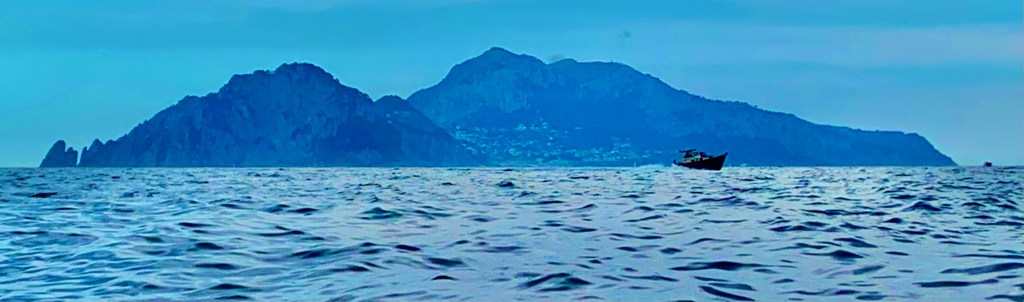
View of the island of Capri from the boat
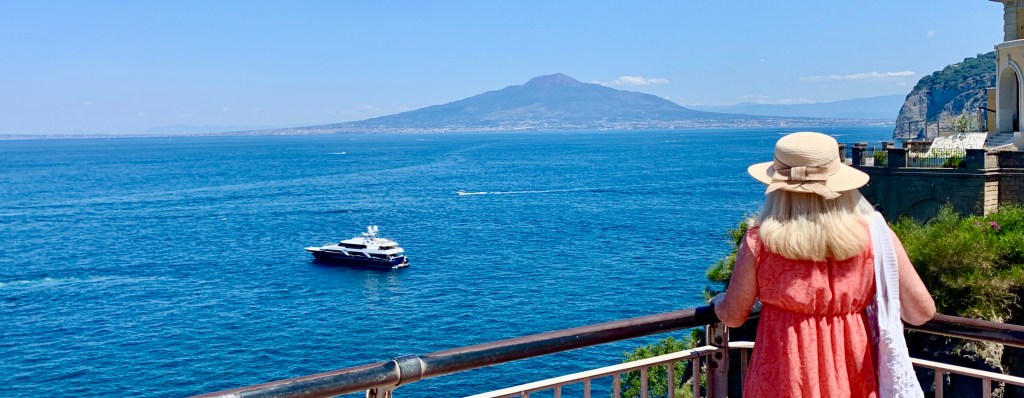
Boat trips to the bay are an excellent way of viewing all the main sights of the bay. This will include the cliffside waterfront of Sorrento, Mount Vesuvius and Capri.
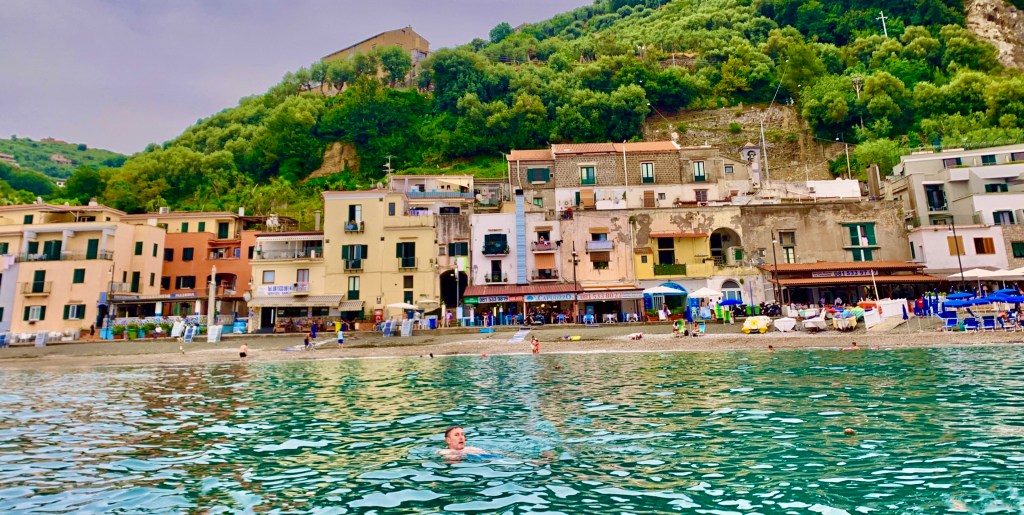
During our boat trip we docked just of Marina di Puolo. This is just on the outskirts of Sorrento and by Sorrento, standards have a big beach. It was a very pleasant spot for a swim with the backdrop of the town behind us.
Marina Grande was taken from the water.
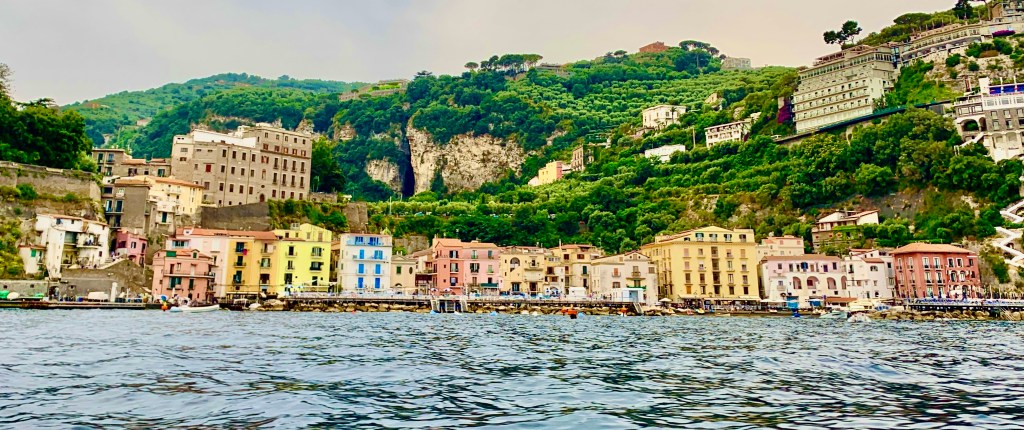
On our return journey back to Marina Piccolo we passed the other marina in Sorrento, Marina Grande. Which is instantly recognisable from the bright coloured buildings on the front of the marina.
Drinks with a view and aperitivo?
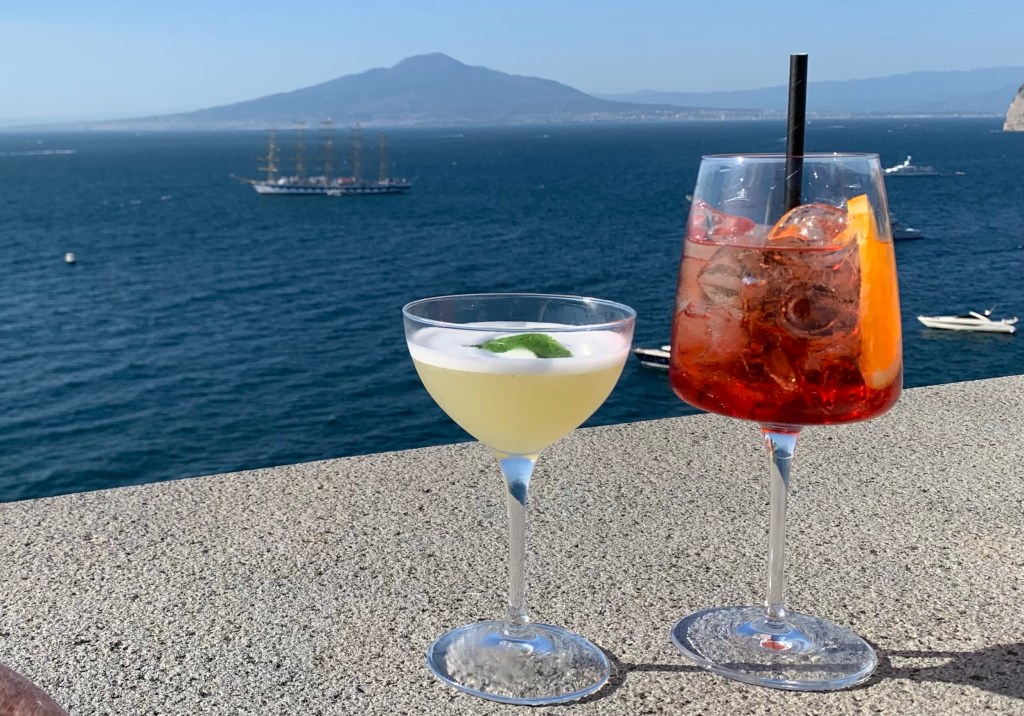
Tottering on a cliff edge overlooking the Bay of Naples, the colourful buildings hide a myriad of bars for an evening tipple, if that doesn’t appeal then what about a rooftop bar or a romantic lounge. One thing for sure we were certainly spoilt for choice for an early evening drink.
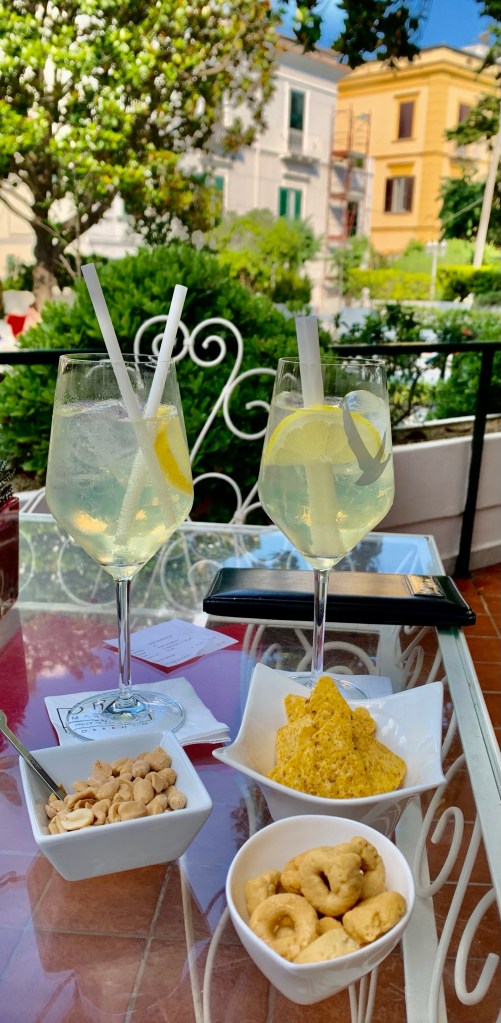
It goes hand in hand with aperitivo a uniquely Italian tradition, a pre-meal drink is very much a cultural ritual. Derived from the Latin aperire, the tradition is meant to open the stomach before dining. With such beautiful settings who was I to refuse tradition.
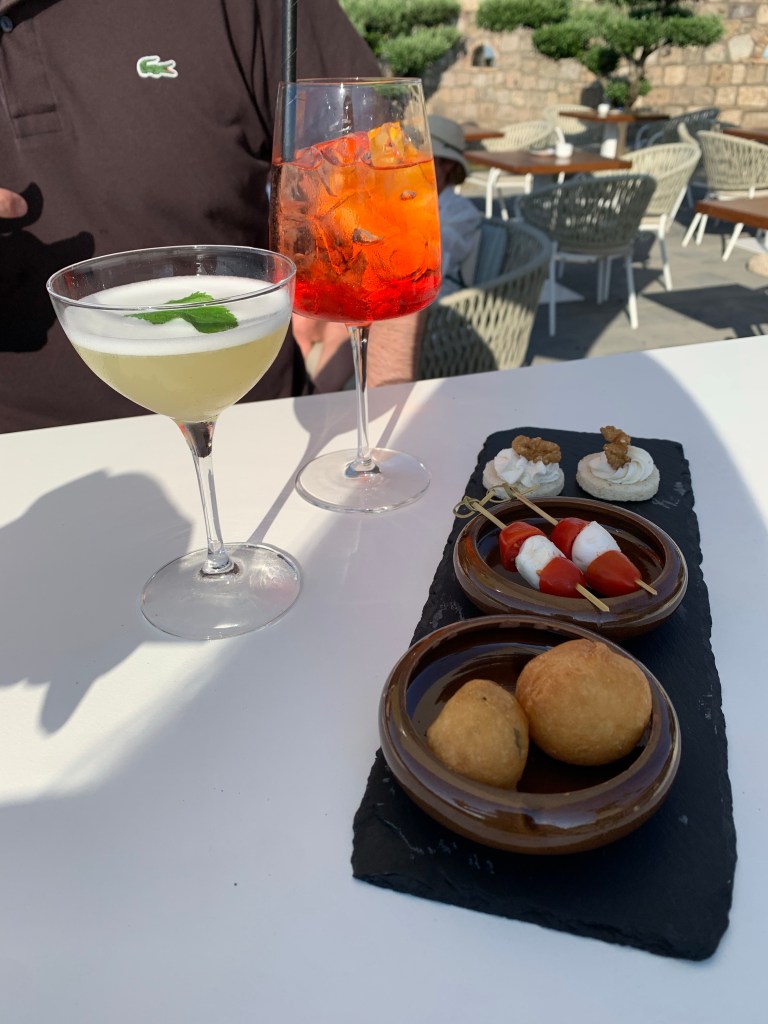
Aperitivo is usually taken between 7 pm and 9 pm as Italians eat very late, with our drink, we were provided with some “nibbles” typical aperitivo fare includes crackers, olives, meats cheeses and bread. Depending on the cost of the drinks, it can be as simple as a few peanuts at a local bar to very lavish small plates at more expensive establishments. The classic aperitivo drink is a spritz made with Prosecco, Aperol or Campari, bitter soda or tonic water.
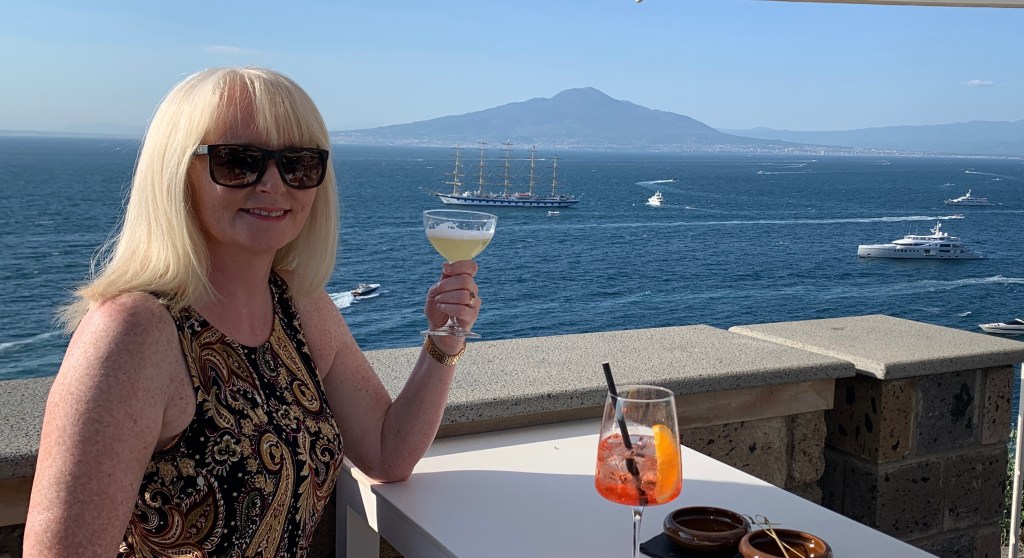
If the drinks and nibbles weren’t enough at this waterfront location we were treated to fabulous panoramic views of the Bay of Naples taking in Mount Vesuvius and Capri. The better the view the higher the prices is the general rule.
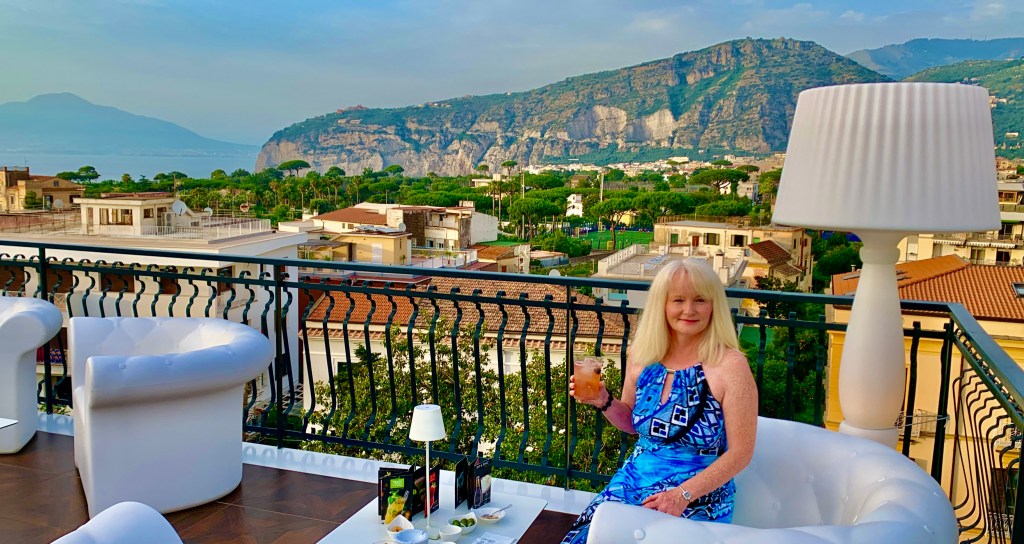
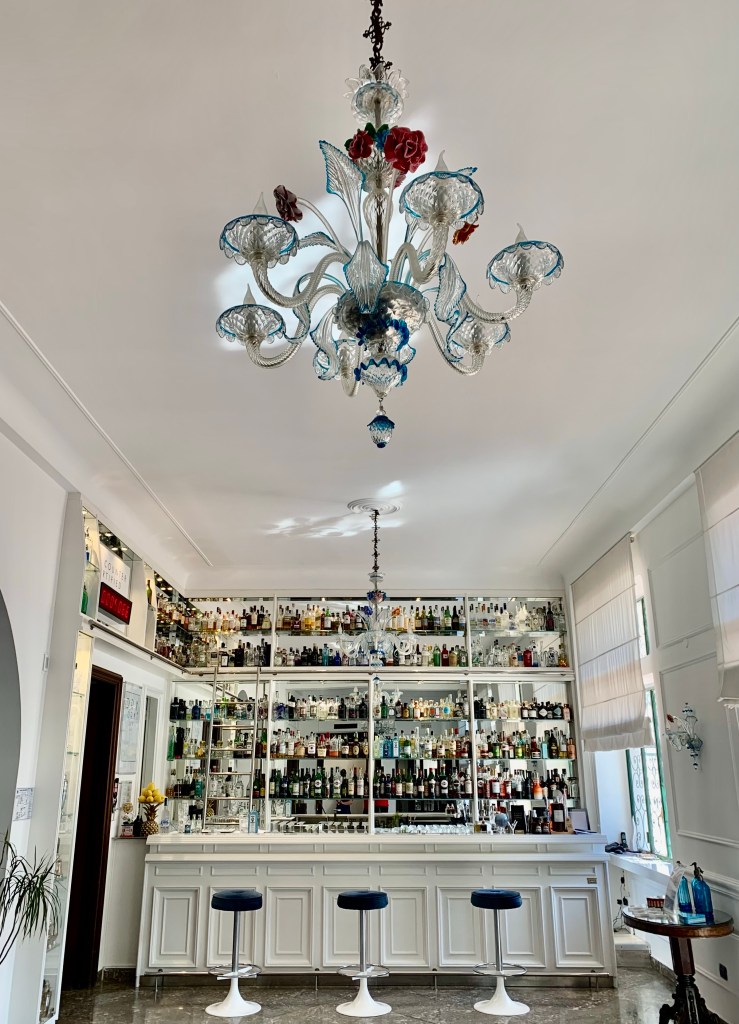
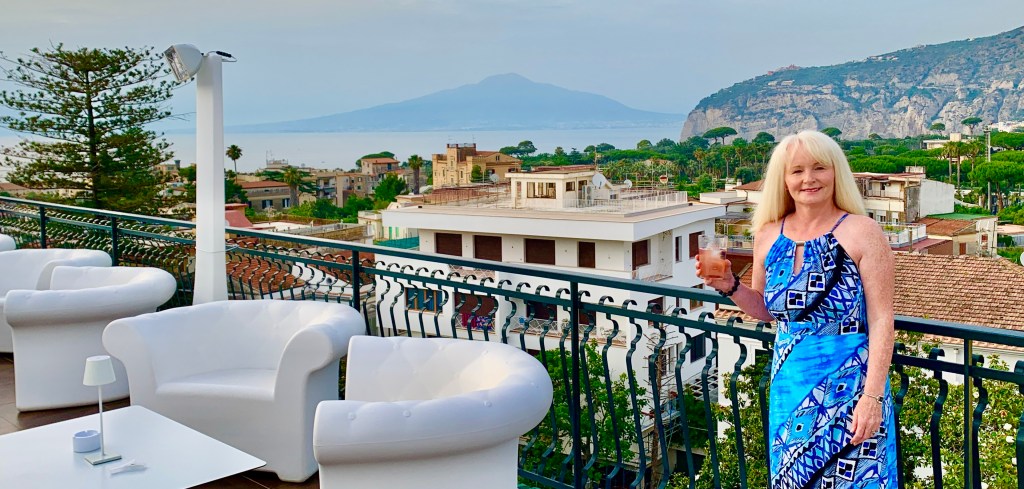
If beautiful waterside locations aren’t enough there are several rooftop cocktail joints complete with panoramic views. We were lucky enough to be staying at a hotel with its very own rooftop cocktail bar complete with a selection of over 200 cocktails to select from.
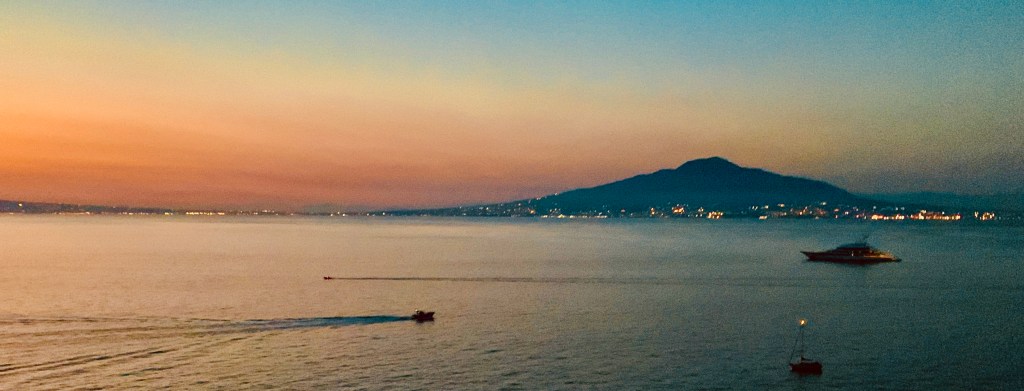
Although the cocktails were very agreeable it has to be said the real inducement is the unique rooftop location, with views of Mount Vesuvius, the Bay of Naples and the stunning backdrop of the Lattari Mountains. It was a fabulous location to watch the sun setting on another great day.
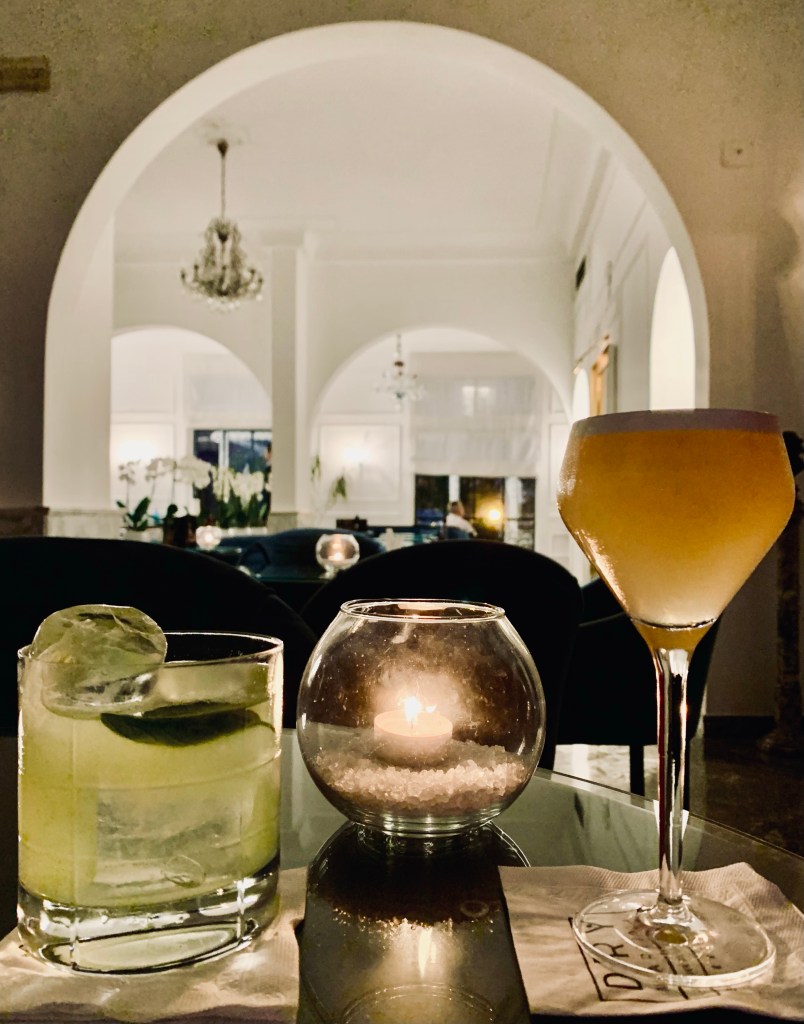
It’s not all about the aperitivo either after our meal and the sun had set it’s time for a post-dinner cocktail. In sophisticated bars or romantic lounges, there will be no shortage of tastefully decorated establishments to frequent. Bars stay open very late in Italy so there’s no need to rush many bars staying open till the early hours.
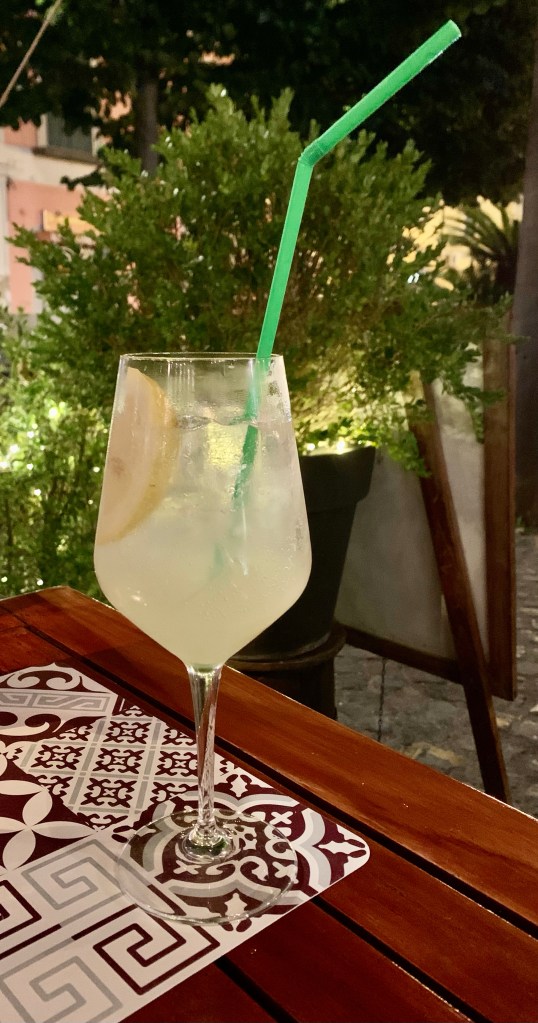
Finally, this being Sorrento home of the lemon 🍋 you will find Limoncello everywhere. A sweet liqueur, high in alcohol made with local lemons. Unlike an aperitif, this is traditionally drunk after dinner ice cold as a shot. However it’s equally delicious in a spritz with Prosecco, Aperol spritz pre-dinner and limoncello spritz after dinner sounds good to me.
Catch a Sorrentine sunset
Sorrento’s cliffside setting is a charming location and catching a sunset over the bay is a fantastic thing to do.
When the sun goes down, the hustle and bustle of Sorrentine life come to a stop, as people gather to watch the fat old sun dip into the sea, a perfect end to a summer’s day.
We are in Italy so don’t be surprised to see varying levels of emotions on display at these locations from strolling hand in hand to full-on petting as couples enjoy these romantic, scenic overlooks.
Beach club days
When visiting this part of Italy the beach clubs are an institution. A trip to this part of Italy wouldn’t be complete without visiting one to enjoy true Italian style and luxury.
As beautiful as Sorrento is if there is one minor downside it’s not full of pristine sandy beaches. What free beaches there are tend to be noisy and very crowded. What you will most likely find are cliff faces and rocky perches built into the rocks.
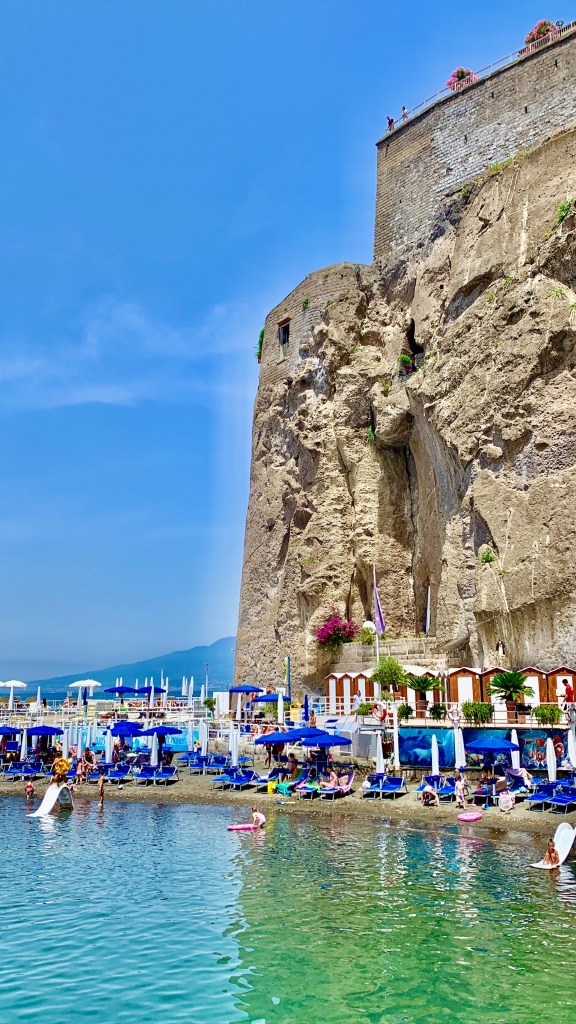
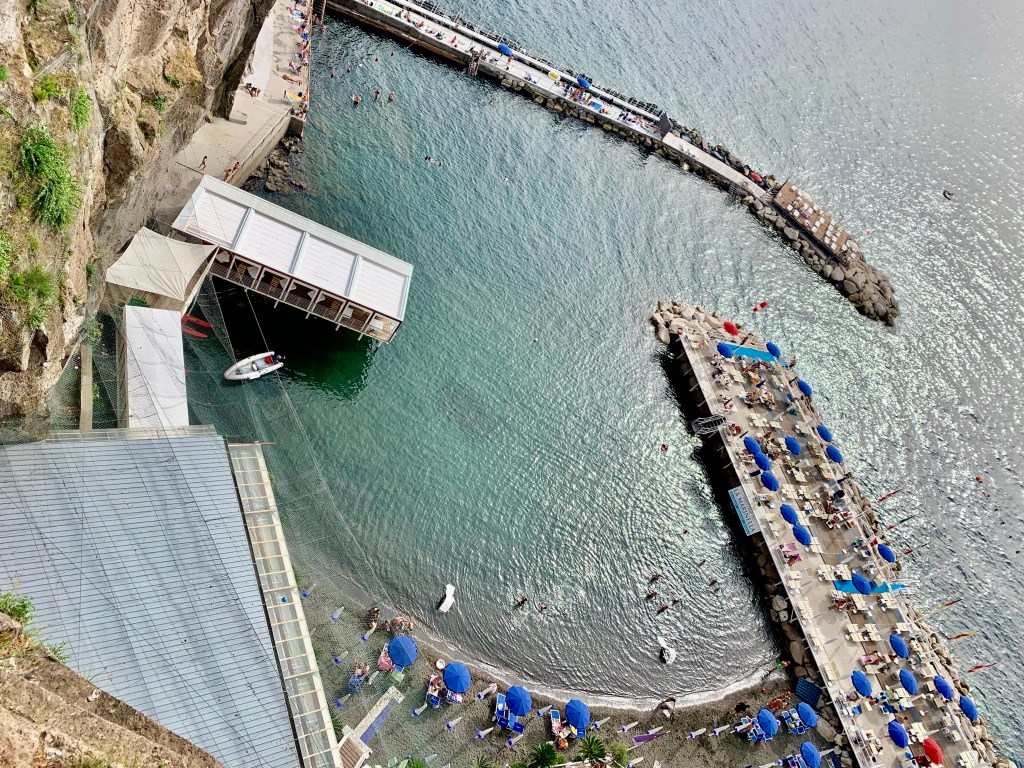
However, beach lovers need not worry what Sorrento lacks in beaches it makes up for with some rather unique beach clubs. You will find the Sorrento coastline teeming with long pier-like beach clubs that stretch into the Bay of Naples. Where you will see rows and rows of coloured umbrellas and sun loungers.
The beach clubs can make life easier, as your body isn’t full of sand from the day out at the beach. As Sorrento is made up of rocky shorelines, you can relax in the comfort of renting a lounger and umbrella, taking full advantage of all the amenities on offer, rather than sitting on a crowded beach under the full glare of the hot sun.
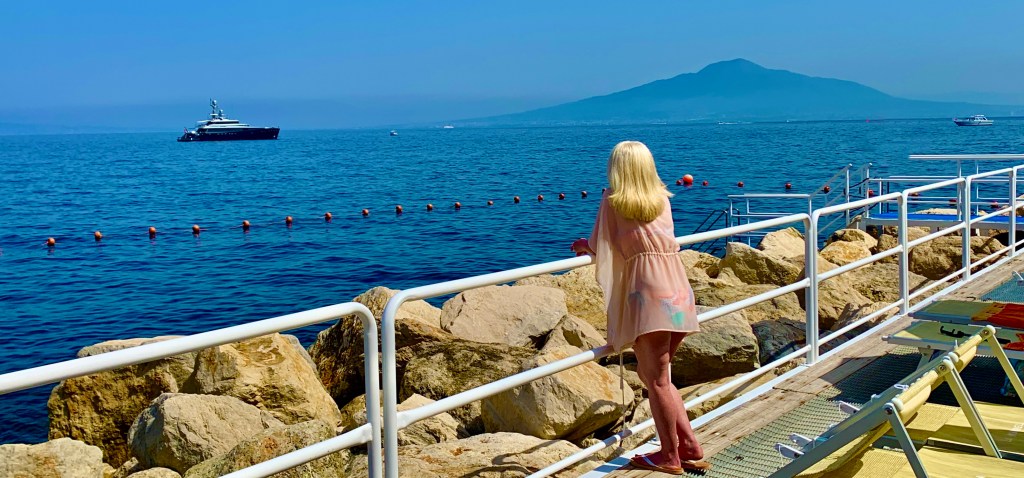
Fancy a swim? The beach club we were visiting had a small beach where you can swim, which was shaped like a small bay, it also had ladders on the seafront where you can climb down straight into the sea.
Perfect views of Mount Vesuvius from the beach club
The beach club we visited was in Sant’ Agnello just outside Sorrento. Although compared to some other beach clubs this did feel rather grandiose. It’s less busy than some others in the area and had a feel of some of the more expensive beach clubs to be found in Capri or Positano. At €38 for the two of us plus lunch, it’s not cheap compared to sitting by the hotel pool for free, but you have to visit a beach club at least once to get the quintessential Italian experience.
After a very busy time discovering what the area has to offer it was nice to have a relaxing day doing nothing. The facilities are top notch with a lovely bar with soft furniture and a restaurant located over the sea for a nice lunch overlooking the Bay of Naples, there is a small beach area here which is very unusual. There is even a lift to get you down if you don’t fancy the walk down.
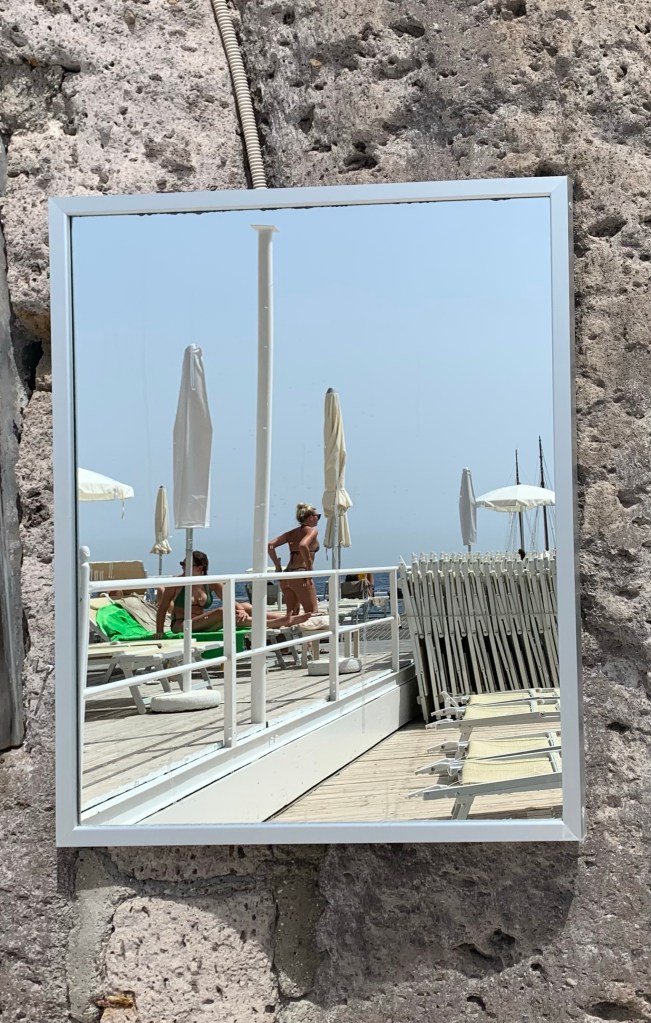
One thing that took me by surprise was the many outside full-length mirrors, for people to be able to look at themselves, only in Italy would this vanity pass as normality.
Eating and drinking
One thing is for sure there are plenty of great dining options in Sorrento. You will be spoilt for choice with prices to suit most budgets.
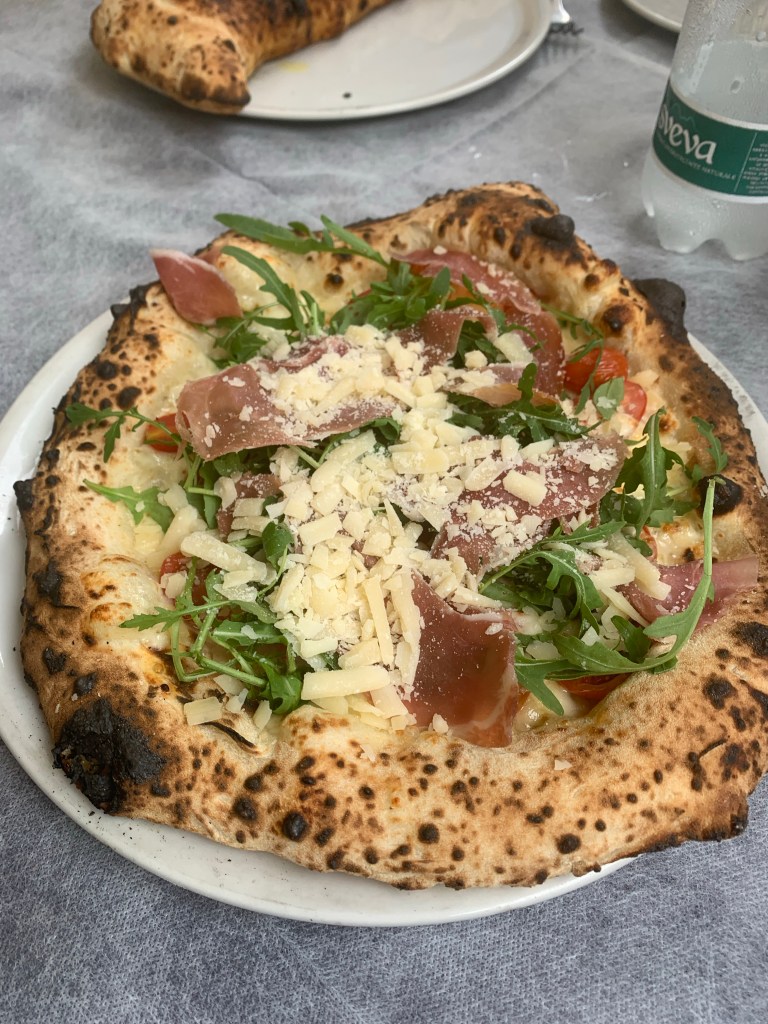
I will start with the humble pizza. Although in this part of the world they take their pizza very very seriously as Naples is the birthplace of pizza. There is even a pizza association to guarantee quality. So rest assured you will be eating fresh expertly made pizzas. Although they will always be thin crust rather than the deep pan variety I am more familiar with.
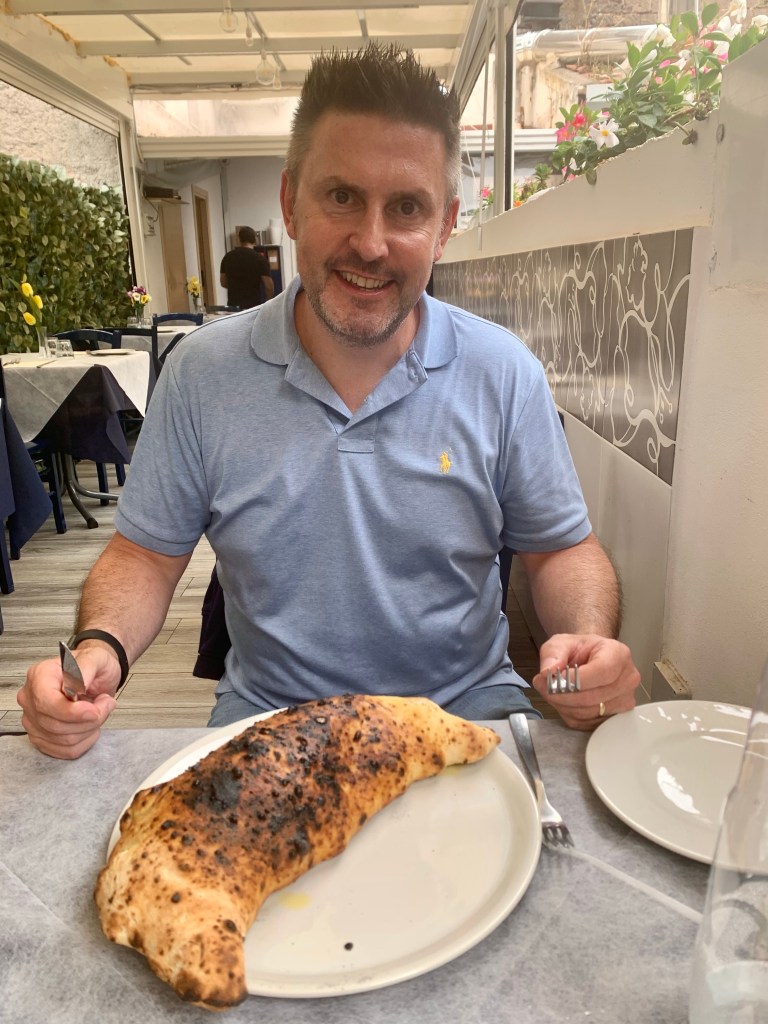
If you tire of pizza! What about sampling a calazone. For myself, this is perfection on a plate. This is a popular Italian dish oven baked inside-out pizza. Calazone are made from pizza dough folded into a half moon shape and traditionally filled with mozzarella, ricotta cheese, vegetables, ham or salami.
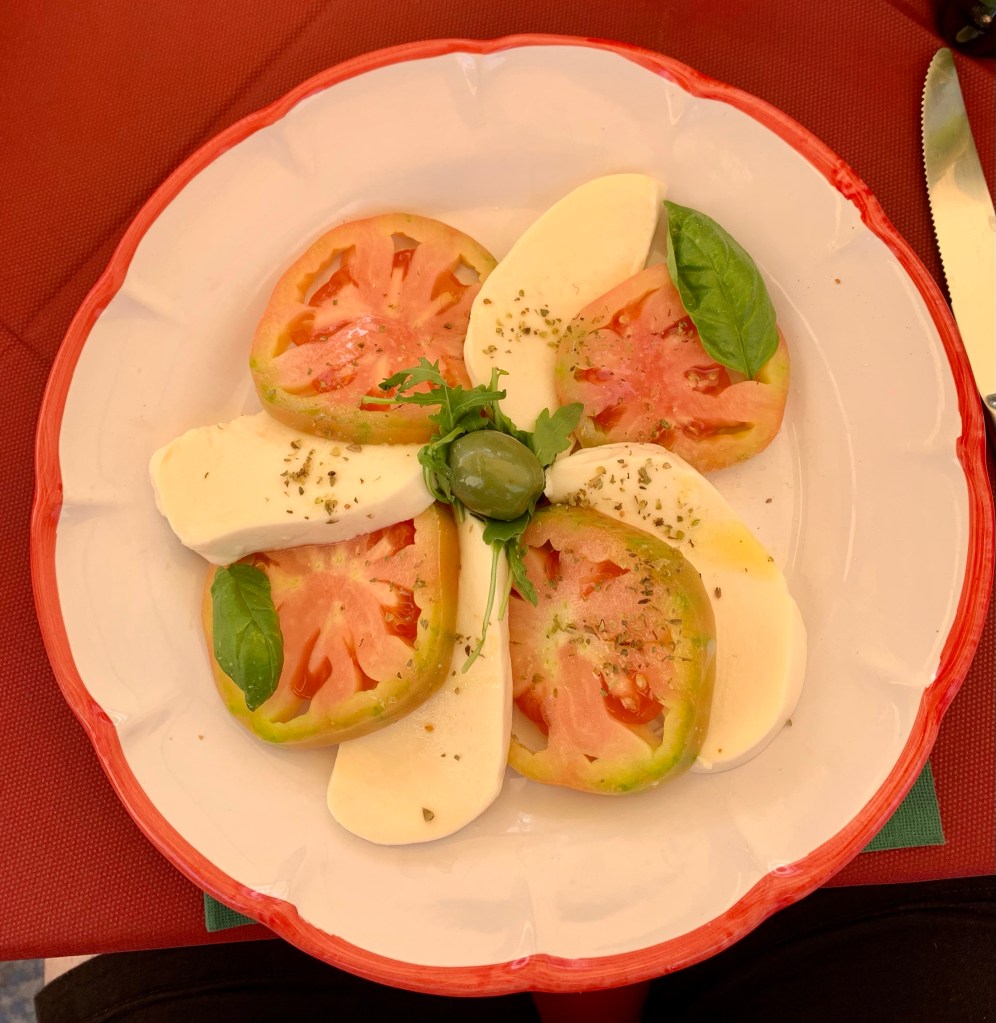
If that pizza seems a bit too much what about a Caprese salad. Simple but delicious mozzarella, tomatoes, basil and olive oil. Usually served as a starter and can be eaten any time of the day. It has been said that the red, white and green pay homage to the Italian 🇮🇹 flag.
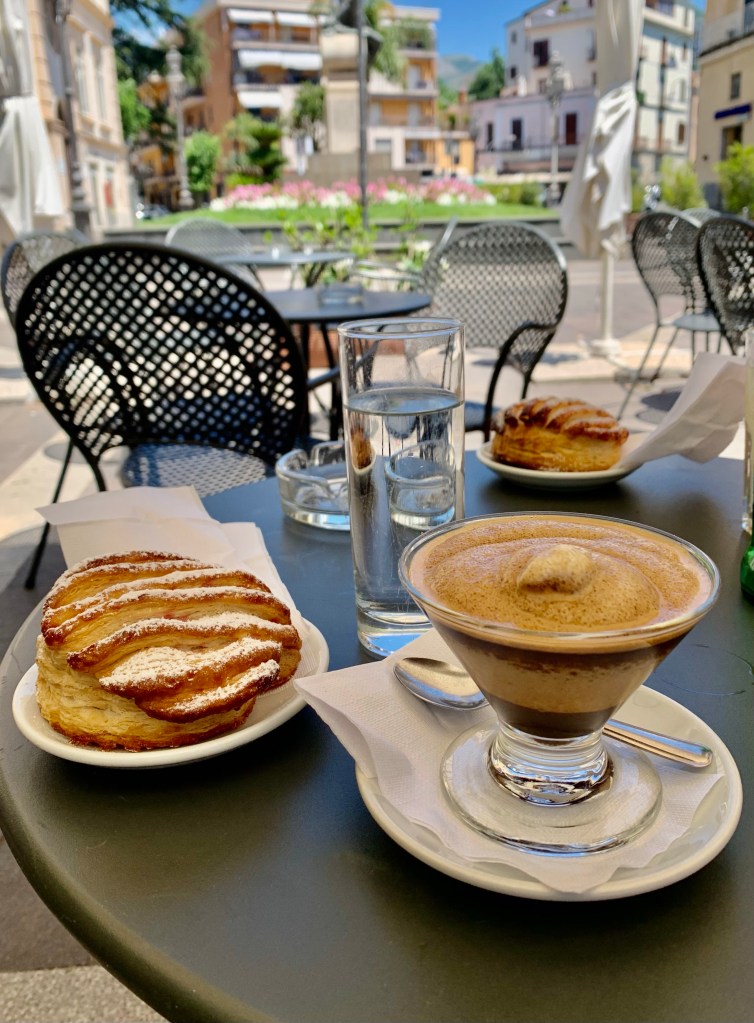
If you are expecting bacon and eggs then you will be disappointed. Breakfast in Italy is a very simple affair. The traditional breakfast in Sorrento is a cappuccino and a sfogliatella an Italian pastry usually filled with ricotta, almond or candied lemon peel. A word of warning Cappuccino is only served at breakfast, if you order after breakfast you will receive some funny looks from Italians.
Pasta Genovese
Another traditional food of Italy is of course pasta. There are numerous pasta shapes and sizes to enjoy with fresh local ingredients. A local specialty which I ate was pasta Genovese which is beef, onions, tomatoes and wine very slowly cooked down and served with oversized penne pasta. A popular dish in the south of Italy although it would be unfamiliar in the UK and to many Italians living in the north.
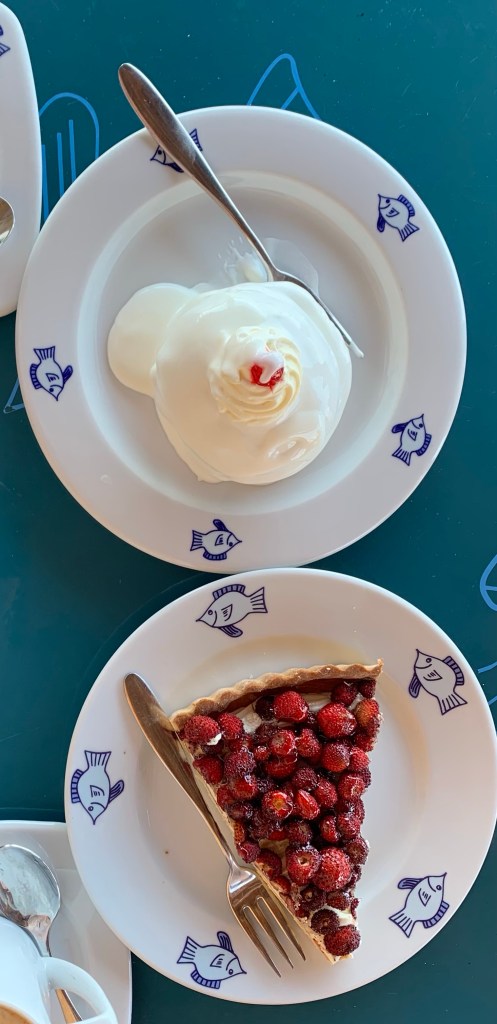
Delizia al limone top of picture with an equally delicious strawberry flan below it.
Don’t forget to leave some room for some scrumptious desserts. I could mention the ice cream but I’m not a fan, but judging by the queues were very popular, freshly picked cherries and peaches were also delicious. My personal favourite was Delizia al Simone, a dome-shaped sponge-based cake filled with lemon custard “Bellissimo” they can be found everywhere as it’s the traditional dessert in the region.
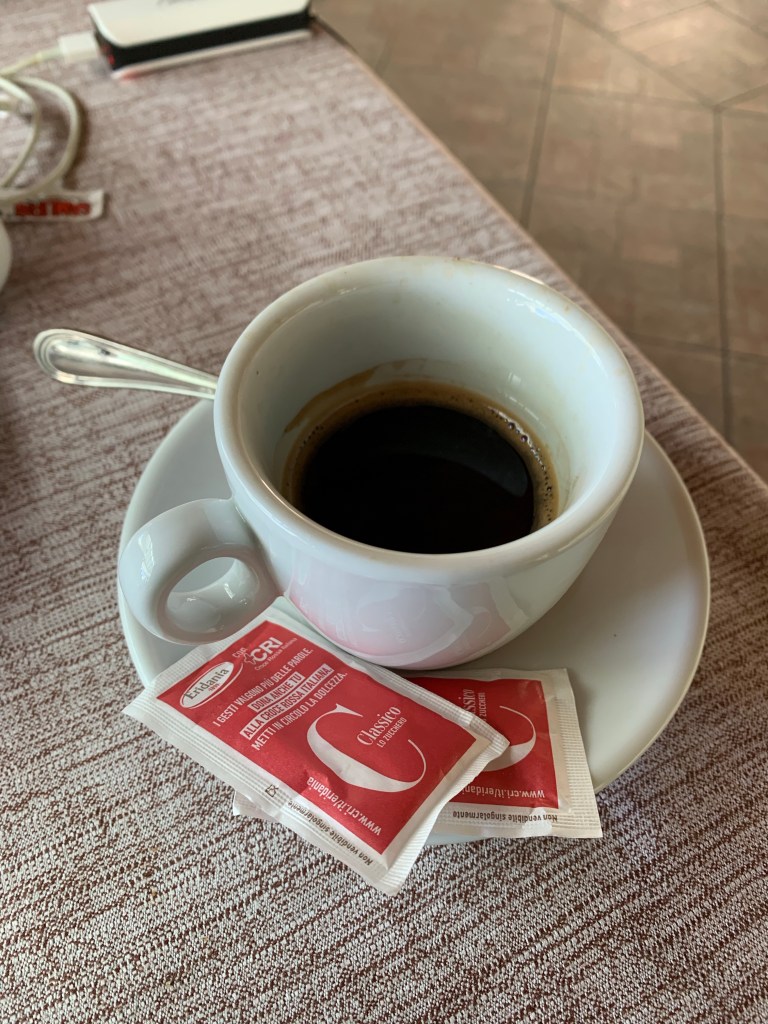
Another important part of Italian culture is coffee, where British people will partake in a cup of tea, and most Italians won’t turn down the opportunity to enjoy a coffee with friends. Nonetheless, the choice can be a bit bewildering as there are over 21 varieties to choose from😲 think I will stick to my expresso.
Aperitivo on the terrace
As I have previously mentioned aperitivo is an Italian ritual. Still, it’s not restricted to early evening, early afternoon drinks were generally offered with some snacks. We mostly skipped lunch and partook in the aperitivo instead. It doesn’t have to be an alcoholic drink either a bitter lemon soft drink works well.
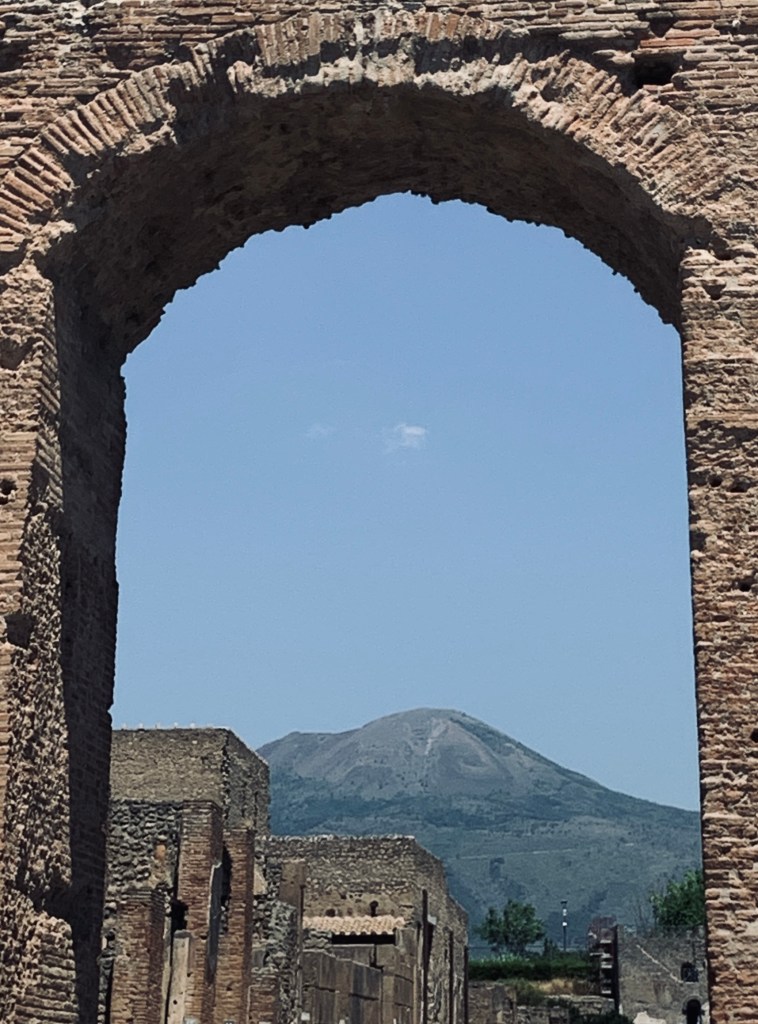
An unmissable visit to Pompeii, combined with an awe-inspiring trek up the top of Mount Vesuvius to see and (smell) the smoke that still rises from the crater.
I had wanted to visit Pompeii and Mount Vesuvius in one day. Sorrento where we were based not being that far away, made this very achievable. There are a few ways of doing this.
You can do it independently or by booking a tour with a local company. We booked with a local tour company on a guided tour around Pompeii, it just saves the hassle of getting there, waiting for connections between the two locations and having to rely on public transport, all this has to be planned when doing it yourself, factor in that public transportation is not very reliable.
Although I spoke to people who did it independently and they enjoyed the experience but said it was rather a long day and they had to pay if they wanted a guide in Pompeii. There are pros and cons to both options so best do a bit of research first.
By doing it independently you have more control over what you want to see and do but have the aggravation of waiting for buses and you will have a few connections. By pre-booking a tour you are picked up from your hotel have a guide for the day and everything is scheduled for you. The downside to this is you have no control of your day and may want to spend more time in some places and less in others.
I would personally advise doing Pompeii in the morning and Mount Vesuvius in the afternoon. As Pompeii is a bit quieter in the morning and you will get a few more lunch options at Mount Vesuvius. This however was just my personal preference.
Pompeii
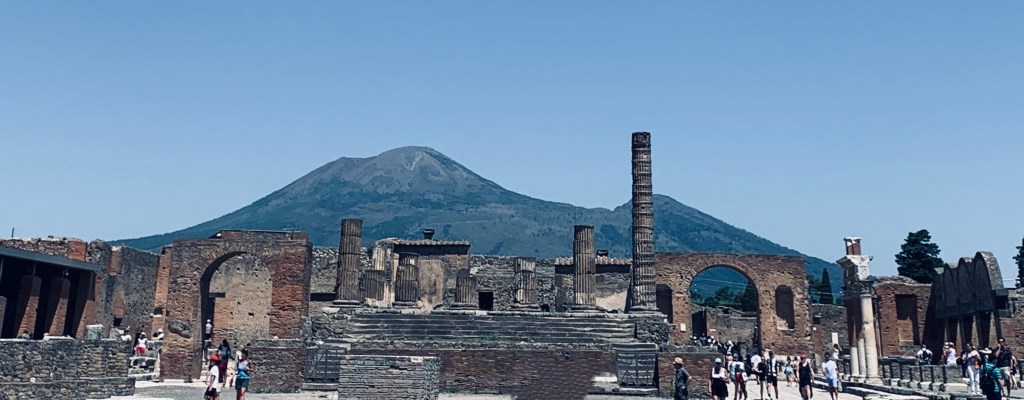
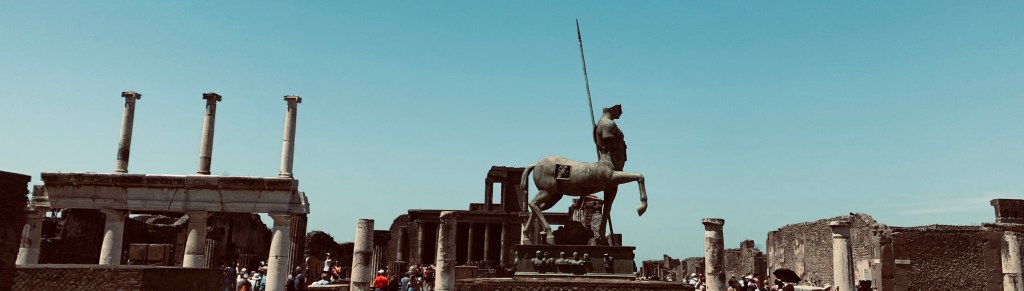
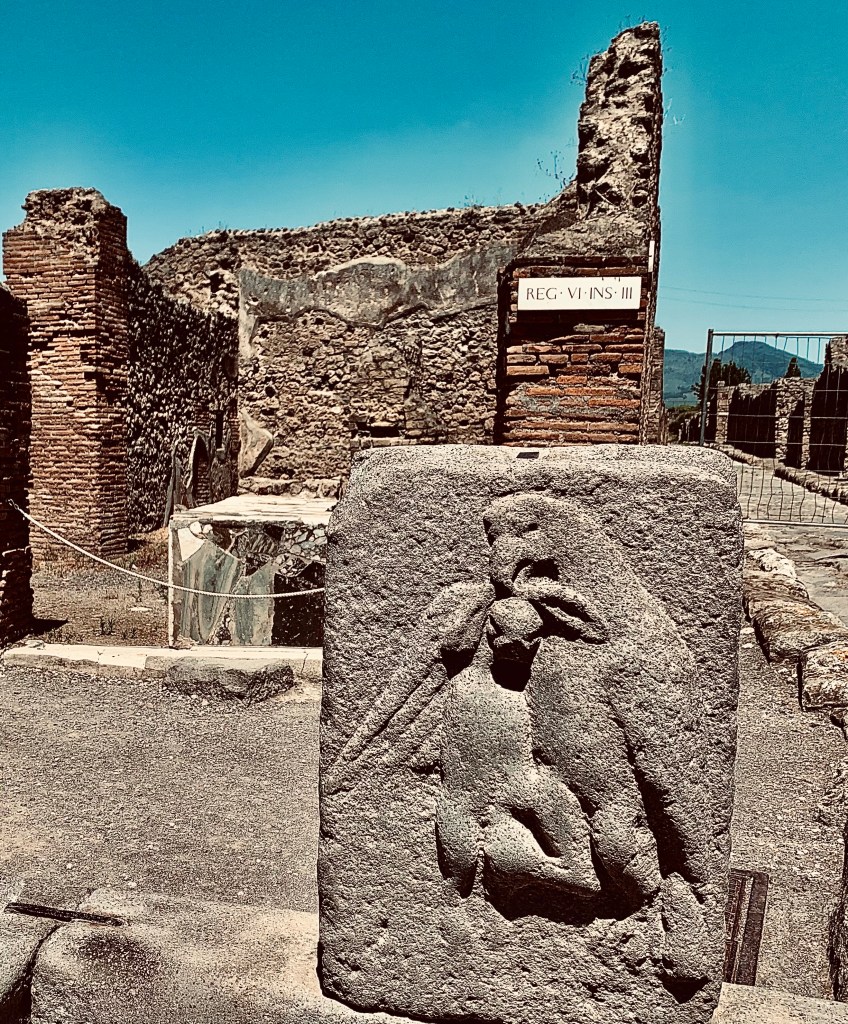
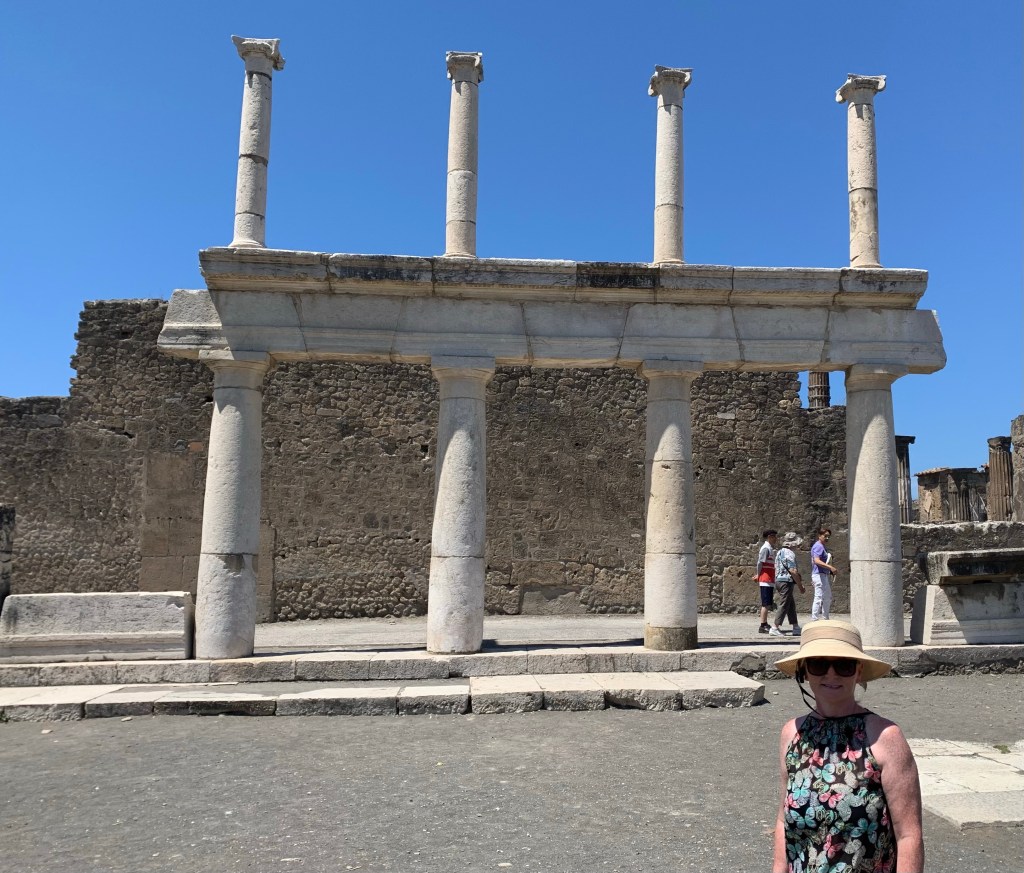
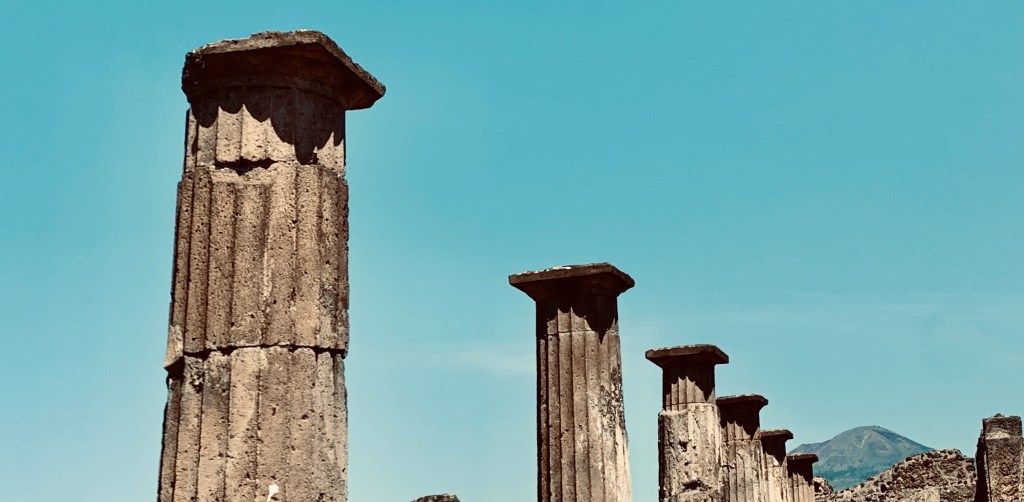
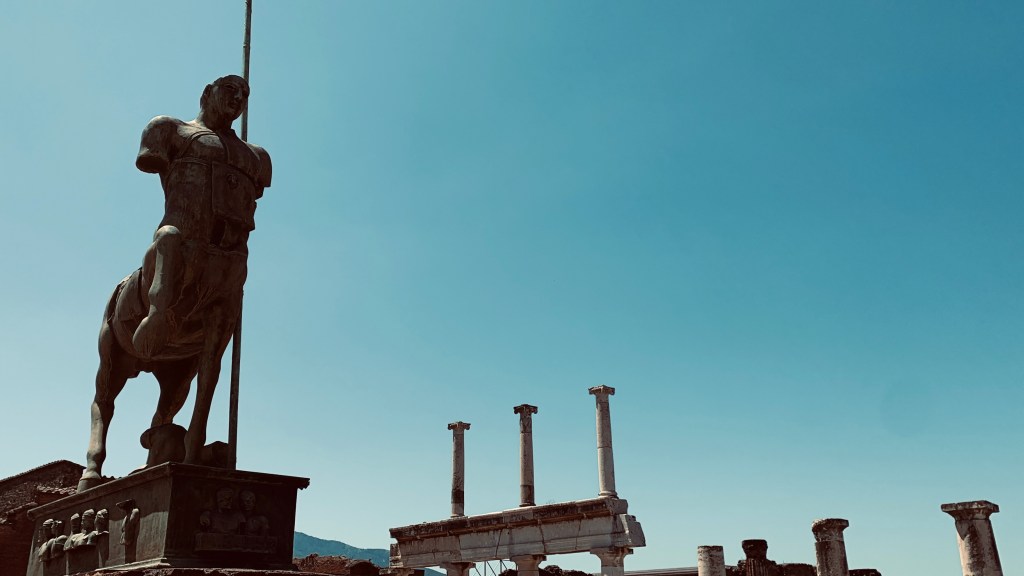
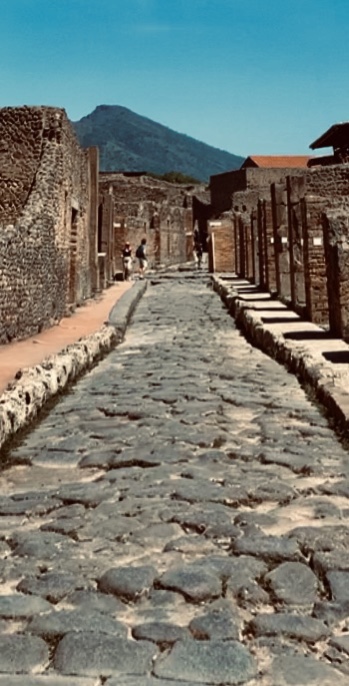
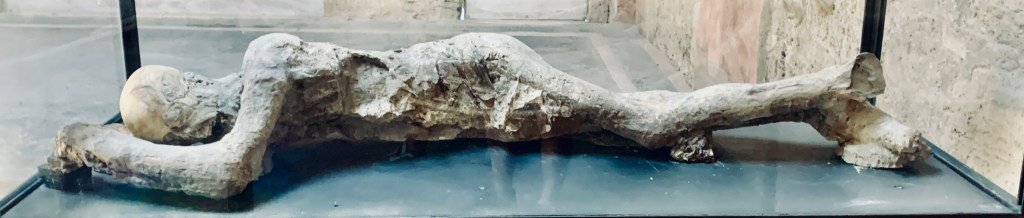
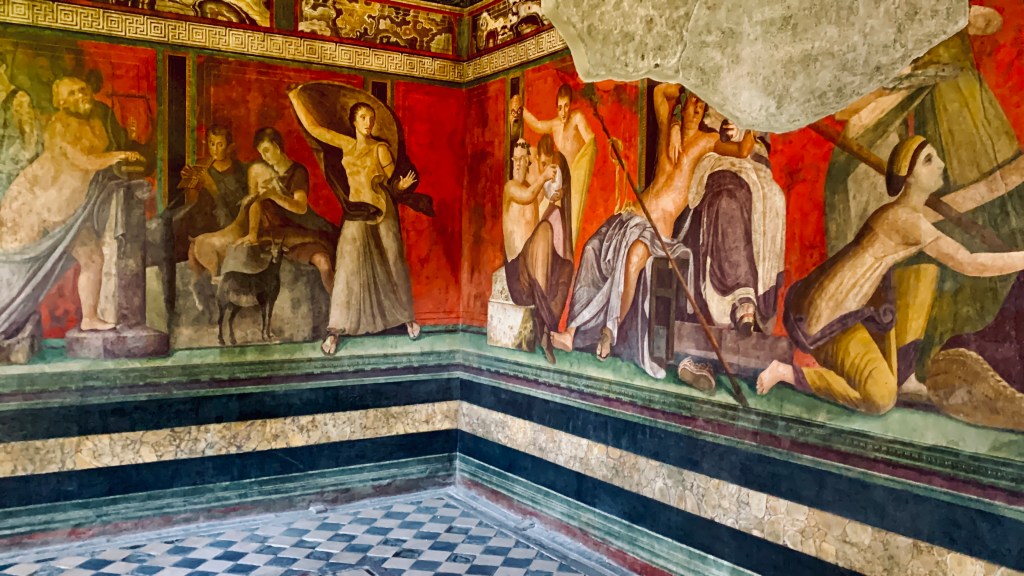
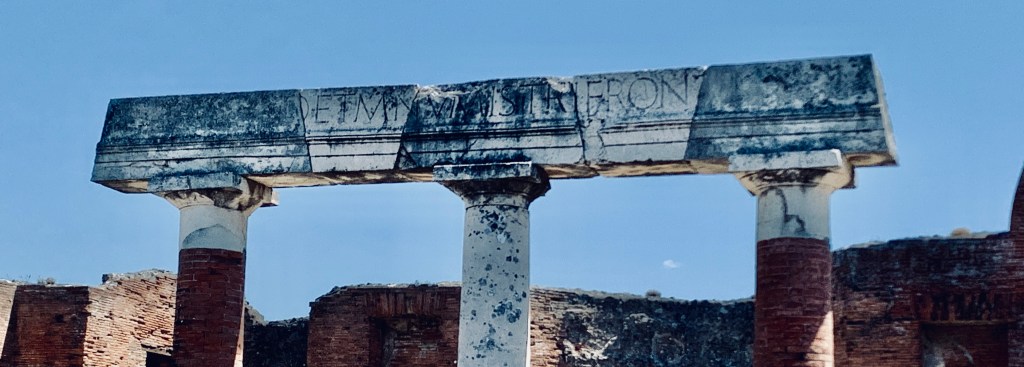
Largely preserved under ash, Pompeii offers a unique snapshot of Roman life frozen in time. A UNESCO World Heritage Site.
Today Pompeii is the major driving force behind the economy of the nearby town that bears its name. With many locals employed in the tourism and hospitality business which surrounds the area.
For many visitors, Pompeii is high on its travel agenda. It’s not hard to see why. Pompeii’s survival for nearly 2000 years makes it one of the Worlds historical, archaeological and human significance. It’s Italy’s second most visited “attraction”
Mount Vesuvius which had laid dormant for over 700 years towered over Pompeii. The fertile soil, its proximity to Naples, and its access to the sea would have made this a pleasant and prosperous place to live and work. All this altered in 79AD when Pompeii was devastated in a day or two, when Mount Vesuvius erupted.
The site is huge! It covers an area of 163 acres, spread out and involves a lot of walking in the hot sun with little shade. How long you take is another contentious issue. Some people could spend days here, for me two and half hours was enough time with a knowledgeable guide to point out the main sites. Any longer I would start to get ruin fatigue and my interest would start to wane.
The site remained practically buried for over 17 centuries. It was not always forgotten though as Pompeii was marked on a 12th-century map, and briefly having been discovered in the 15th century during some aqueduct tunnelling. However, they were properly discovered in 1748 and for many was the start of the modern science of archaeology.
The significance of Pompeii cannot be overstated. Although there are many Roman ruins across Italy and Europe with impressive sites in Verona, Rome and Sicily to name a few, Pompeii’s importance strangely enough is due to its normality, as well as its age, fate and size.
The fact that Pompeii is one of the few ancient sites that has been preserved in such great detail, everything from jars, paintings and people has been frozen in time, giving us the unprecedented opportunity to view how typical people lived over 2000 years ago, rather than the grand court of Emperor’s or stately royal castles which is usually the case.
You will find the ancient Roman roads with grooves in them made by the trams that ran along them over 2000 years ago. Although today Pompeii is strictly walking only. Just be aware of the grooves in the roads as they can be uneven, a comfortable pair of shoes is a must, especially factoring in the size of Pompeii.
It is this vastness of Pompeii that is its saviour, some sections and side streets are blissfully isolated and separated from the crowds. This is probably the big plus point in discovering Pompeii independently, with our guided tour we stuck to the main sights! which were inevitably very busy, I couldn’t wander off somewhere which wasn’t on our tour itinerary. With over 2.5 million visitors a year, there is no getting away from the fact that Pompeii is a very busy place.
Due to the vastness of Pompeii don’t expect to see everything. Our visit was 2.5 hours which give us enough time to see the main sights which are reasonably near to each other, this was okay for me, but you could very easily spend a day here.
Although Pompeii seems a site of human tragedy, 2,000 people lost their lives that day, these were the ones that didn’t heed the warnings whether this was through necessity, infirmity or just plain stubbornness. It’s important to note that 17,000 people survived by heeding the warnings and packing up and leaving.
Another fascinating insight into life at Pompeii is the wonderful frescoes. This highlights the beliefs, customs and indulgences of the people. Frescoes we’re used throughout Pompeii in public and private buildings. A large number of rooms were small without windows, so frescoes added colour and light to otherwise dark drab spaces.
Even if you’re not a history buff Pompeii is well worth a visit. My personal prospective, unless you are a Roman history aficionado or a keen photographer for most people a morning is more than enough time to see the main sights and to get a feel for this historical landmark.
Mount Vesuvius
An afternoon trek up to the summit of an active volcano 🌋The ideal accompaniment to a morning spent in nearby Pompeii.
A view of Mount Vesuvius from our hotel’s rooftop terrace
Wherever our location there was no escaping the looming presence Mount Vesuvius had over the Bay and city of Naples, the Amalfi Coast, Sorrento Peninsula and Capri.
Mount Vesuvius viewed from Sant’Agnello
When visiting the area it was one of our must-do activities. It’s the perfect activity that can be combined with a trip to Pompeii. Appreciating the great outdoors with some incredible views. Unlike my visit to Pompeii in the morning, this trek up to the top of Mount Vesuvius was relatively quiet in comparison.
We were going to trek to the summit of Mount Vesuvius, to call it a trek is a bit of an understatement if I’m being honest. I’d call it more of a walk than a hike. Beginning at the ticket gates, entry costs €10, you will pass some stalls selling drinks and snacks etc before we started the walk on a gravel path.
This section of the volcano is the hardest part of the walk, it’s only about 800 meters in distance but the elevation rises quickly. The views while you walk are stunning.
After about 25 minutes with a few stops for photo opportunities, we reached the first of three cafes at the summit. The walk evens out and is now reasonably flat, with a few marginal ups and downs with a small section of steps to climb.
Although in all honesty, we didn’t notice as we were distracted by the beautiful panoramic views of the Bay of Naples which was to our right, and the volcanic crater to our left.
One thing to take into account is that the walk is not a loop and you will have to take the same path down as you came up. The walk will be about 4, kilometres there and back, although the return journey will be quicker and easier as there is no incline to tackle.
When looking into the crater try not to be too disappointed, unfortunately, nothing exciting is happening, like bubbling lava, or towers of flames 🔥 shooting towards the sky. But this is a good thing as I remembered what the volcano had done to Pompeii only 9 kilometres away.
A few facts about Mount Vesuvius. The highest point is 1281 meters (4203 ft) It last erupted in 1944, and it is regarded as one of the most dangerous volcanoes in the world because of the population of 3 million people living near enough to be affected by it. There are no toilets within the Mount Vesuvius national park 🥺, a fact I found out for myself unfortunately 🤣
On a good day, the crater will release some steam or a subtle plume of smoke as a volcano tends to do. The crater resembles a giant cone. Currently, it has a diameter of 450 meters and a depth of 300 meters.
At the end of the walk, we found the third cafe/bar, this is a popular spot for a drink and has a good lookout point to view. Prices were very reasonable for the location and I thought an ice-cold limoncello was in order. It’s not every day I get to walk up to the summit of an active volcano. Just retrace our route back down to the entrance on what has been a very eventful day in Italy.
Exploring the Amalfi Coast, not by plane, train and automobile, but on foot, bus and boat
The Amalfi Coast is a glorious 50-kilometre stretch of coastline, along the edge of the Sorrentine Peninsula. A very popular destination due to its sheer cliffs rugged coastline and pastel-coloured fishing villages. It’s within easy reach of Sorrento and Naples.
How you visit is entirely up to you. By boat, on foot or by road,
We booked organised trips to best utilise our time. Booking these independently with local operators who were very knowledgeable and professionally run. Small groups on our trips so we had more personal service. Road trips and boat trips are available from Sorrento, or you can mix and match your itinerary, using both.
Path of the Gods
The Path of the Gods has been a popular walk for centuries. It provides pristine views of the Amalfi Coast from this cliffside path. The path certainly lives up to its name and is worthy of your time when visiting this delightful part of Italy.
You can do this walk independently, however from Sorrento, it requires a few bus transfers and the walk which should take a couple of hours turns into a full day. We opted for a guided walk, with a pick-up from the hotel and a stop for lunch before the transfer back to Sorrento, giving us some local insight into the Amalfi Coast. For us, this better utilised our time as we had a lot of places to explore.
A few things to consider, the weather it’s going to be hot in the summer, so the obvious advice is to have sun cream, bottled water and proper footwear. I wore trainers which were perfectly adequate but wish I had worn trail trainers or walking boots, the trail is not particularly difficult however the terrain can be unstable in parts.
The trek is a perfect way to spend some time experiencing the beauty of the Amalfi Coast. It was certainly more serene than taking to the road or water.
This trek will lead you above historic towns, following ancient mule routes, while as you go along serving up some of the most remarkable panoramas in Italy.
Goats and mules still roam the area as they would have centuries ago, giving the area a very rural domesticated feel.
Surprisingly we were able to view a myriad of different terrains, we saw the scenery evolve from tiered hills rich with shrubbery and many different crops, including grapes, lemons, cherries and tomatoes to name a few.
Initially, we thought we were on a nice but rather ordinary coastal walk. Then the agriculture and forestry give way, and the terrain opens up into something more dramatic, revealing numerous cliff faces and hillsides with dazzling views of the ocean, beaches and ancient towns below.
Now the course of the path starts to go up and down more abruptly, edges on cliff sides and the terrain varies in difficulty. We are coming to the most challenging part of the walk passing through Vallone Grarelle, we are now reaching our halfway point.
The obligatory picture with Positano in the background.
From here you can take the 1500 step staircase that leads to the village of Arienzo which is on the northern edges of Positano. We were looping back to the start of our walk. Positano was an adventure for another day. Just a brief stop to admire the beautiful panorama of Positano and the peninsula.
This section of the walk does offer some magnificent views of the Amalfi Coast. It had taken us about 90 minutes to reach this location, so it’s a good idea to bring a light lunch with you from one of the cafes, we had booked lunch in a local farmhouse which was less than 10 minutes from here.
We stopped at the farmhouse where we received some warm hospitality. A simple but delicious lunch of freshly baked bread, Caprese salad made from local mozzarella and tomatoes, with fresh cherries to finish. With some impromptu entertainment after lunch with even the dog joining in.
On the path, we experienced what life would have been like travelling from small village to small village, as you come across uninhabited buildings that are slowly being reclaimed by the natural environment.
We were soon back at our starting location, the trek was about 8 kilometres, although there are different starting points and routes. Many walk to Positano and get transport back from there.
We did a loop back to our starting point, whatever you choose it’s worth the time and effort to view this beautiful location from an entirely different perspective, far removed from the busy crowds you will find in the towns and coastline down below.
Amalfi Coast by boat
Another less energetic way of viewing the Amalfi Coast is by boat. There are no shortage of itineraries to choose from, full and half-day tours from Sorrento, shorter cruises from the towns along the coast or even hire a boat for the less inhibited.
I was going to be brave and rent a boat, however, common sense prevailed and I thought an organised charter boat may be less stressful. The two most popular destinations are Positano and Amalfi. I decided to take a boat tour from Amalfi as I had viewed Positano while on the Path of the Gods and visited on foot.
To explore Amalfi by land is only half of the experience. I was able to get some incredible views from the ocean. The town was a maritime republic known as the Duchy of Amalfi. It still acts as the main port for the Amalfi Coast to this day.
Unrestricted views of the coast’s world-renowned cliffs give a backdrop to lush vegetation and the pastel-coloured town of Amalfi straddling the azure ocean. The town lies at the mouth of a deep ravine, at the foot of Monte Cerreto which at 1315 metres (4314 feet) towers impressively above the town.
These short tour cruises don’t break the bank either, I paid €10 for a 30-minute cruise which took in all the various points of interest around the town of Amalfi. Outstanding value as I admired the views of what many people regard as one of Italy’s most beautiful coastal locations.
Amalfi coast by road
Entering Positano via the Amalfi coastal road.
A fantastic day exploring the SS163? It doesn’t sound quite so romantic when you give the road its official name. Better known as the Amalfi Coast road. Possibly one of Europe’s most scenic roads.
So beautiful it has UNESCO World Heritage Site status, “ Not like the South Wales stretch of the M4 😆😆😆” Whether you take a coach trip, drive the road in a car or enjoy it on two wheels 😱 the views are truly spectacular.
This is probably one of the few occasions for me where the road is the attraction. If traffic is a bit congested then I certainly won’t be bored with the view unless you are stuck in a tunnel, otherwise, the panoramas are going to be jaw-dropping.
Public buses although inexpensive are not much good as you could be standing or sitting on the wrong side then all you have are some cliffs to gaze at, that’s before you take into account the bus’s continual late arrivals and long queues at the bus stops. Hire a car by all means but again you will be focussing on driving and parking is an absolute nightmare.
I reserved a trip with a local travel firm, picking us up from Sorrento. In a minibus with 8 passengers, with a small group, all passengers have the opportunity to rotate around the bus and appreciate the fantastic views, while an experienced driver keeps his eyes 👀 on the road.
Some towns on the Amalfi Coast
A selection of some of the more popular towns on the Amalfi Coast. This list is by no means a comprehensive list of towns in the area. Just a few I had the opportunity to explore. The entire Amalfi Coast is a UNESCO World Heritage Site. Coast highlights included Positano, Ravello and Amalfi.
Positano
I will start with the most part famous and iconic location on the Amalfi Coast Positano. The first town on the Amalfi Coast and the nearest to Sorrento and Naples.
Positano was once a major part of the Amalfi Republic in medieval times. Though, by the beginning of the 20th century, it was a poor fishing village with more than half the population having emigrated.
Fortune improved in the 1950s when it started to attract tourists, particularly after the author John Steinbeck lived there and wrote a novel about his time there. Suddenly this once sleepy fishing village was luring all the A-list celebrities of the day.
Today it is very much en vogue. The scenic splendour of the town hasn’t changed in centuries. It is a place to discover on foot as you meander your way up and down the stairs and alleyways of the town. Despite it being a popular location the town didn’t feel swamped and had a laid-back vibe.
Although not your first thought when visiting it’s an excellent location for shopping with lots of artisan products for sale and of course plenty of lemon-themed products to buy. It’s a wonderful location for a bit of alfresco dining.
A view of Positano from Marina Grande beach. This is the most recognizable beach at Positano, other popular beaches nearby Fornillo beach and Arienzo beach. I came for its extraordinary setting but the beaches aren’t half bad either.
Amalfi
Amalfi is the main town on which the coast is named after. A former maritime republic, an important trading power between 839 to 1200s.
There is no getting away from the fact that Amalfi is a very busy congested town. The most crowded location I visited on the Amalfi Coast. The town is not without charm but to be honest I think it’s best viewed from the water to best appreciate the town.
The town’s main attraction is the very impressive 11th-century St Andrews Cathedral. Amalfi was an important location in medieval architecture
At the top of a rather busy flight of steps, Saint Andrew’s Cathedral overlooks the Piazza Duomo the heart of Amalfi, where you find an array of shops, cafes and restaurants.
The town is small but is easily navigable. Its narrow alleyways are full of shops selling souvenirs, including every variation of the famous lemon 🍋 products imaginable.
Amalfi is the docking port for cruise ships, so the area does feel very commercialised and very, very busy. If I am honest Amalfi was my least favourite town which I visited. I’m glad I took the boat excursion to fully appreciate its coastal splendour.
Ravello
Ravello differs from other towns on the Amalfi Coast, it stands high above the sea rather than beside the sea, 365 metres (1200ft) above to be precise.
The town has a very laid-back feeling, it’s an artistic hub with many concerts and performances staged within the town. The ancient cobbled streets lead to Piazza Duomo the main square where you will find numerous cafes and restaurants to enjoy an aperitif and soak up the town’s old-world charm.
Running off the main square you will find elegant cobbled streets and pastel-coloured buildings. Where we were able to wander around in peace, Ravello is far removed from the crowds that flock to the sea towns of Amalfi and Positano.
Villa Rufolo
A historical villa constructed in the 13th century by the powerful Rufolo family. Just a short distance from the town’s main square.
Villa Rufolo, one of the most important architectural masterpieces in southern Italy, has greatly contributed to Ravello’s worldwide fame.
Both Moorish and Norman influences can be seen in the towers and cloisters. The villa has a rich and storied past. In its prime it was one of the largest and most expensive villas on the Amalfi Coast.
A view of the Church of Santa Maria delle Grazie, which was first constructed in 1163 and gives a fantastic backdrop as you view the ocean from high above at Villa Rufolo.
As if the architectural charms weren’t enough the villa is equally famous for its beautiful cascading gardens. Created by Scotsman Sir Francis Neville Reed in 1853.
I am generally not a horticultural aficionado, however, these gardens are truly magnificent, commanding divine panoramic views packed with exotic colours.
The gardens host world-class concerts on its terrace which unfortunately was closed during our visit for maintenance. The villa had close links with Richard Wagner who regularly used to stay in Ravello.
Ravello can be overlooked as not all local tour operators visit the town, concentrating on the coastal towns. We wanted to visit this beautiful location and it was the highlight of my visit to the Amalfi Coast, my only regret was we didn’t have enough time to explore this remarkable location.
A visit to the famous island of Capri. Multiple people visit the island while visiting nearby Sorrento, to experience this famous sophisticated island, although the reality of this is somewhat different at Marina Grande, where ferries dock from Sorrento and Naples. The dock can be very manic-like, with the heaving mass of humanity.
We decided we would stay a couple of nights on the island, to get a true taste of what Capri has to offer away from the maddening crowds. It is not a cheap place to stay, however with a bit of research, there are some affordable places to stay in Anacapri which are not quite as expensive as the main town of Capri.
With frequent ferries from Sorrento Capri is very accessible and the bus service and funicular railway linking Marina Grande with Capri Town, or like myself you can walk, which I wouldn’t advise with luggage and 30-degree heat which takes about 20 minutes. We then caught another bus to Anacapri at the central bus station, taxis are available but can work out expensive.
Anacapri
Unknown to me, Capri is divided into two municipalities Capri and Anacapri. We were staying in Anacapri which has a more relaxed vibe than Capri. As a budget traveller, it gave me the option of more affordable accommodation and dining.
Map of Anacapri
Anacapri has a higher elevation than Capri, separated by mountains with only one road connecting the two towns. Anacapri is more picturesque and rural compared to Capri.
Accommodation on Capri
Our accommodation was in the heart of Anacapri Old Town. Staying in Anacapri isn’t going to be as glamorous or glitzy as staying in Capri Town. Still, it was certainly more tranquil and less touristy.
You will certainly save a lot of money by staying here, compared to the expensive prices of Capri Town. With more mid-range and even some budget accommodation available as well as getting a more authentic feel for the island.
Our accommodation was situated in its private garden and had been tastefully decorated. Just a short walk through the atmospheric old town to the main square Piazza Vittoria. After the day-trippers have departed, Anacapri resembled a sleepy village, very peaceful and residential in total contrast to Capri Town.
Villa San Michele
This is a museum with a difference, home to Swedish Physician Axel Munthe who first came to Capri in 1885. One of the island’s most visited attractions.
The villa was built on the ruins of an ancient chapel dedicated to San Michele. The villa is now a museum containing the Swedish physician’s collection of ancient artefacts.
Although in all honesty, the museum is not the main attraction at this location. The garden at San Michele has been called the most beautiful in Italy. Which begins in the shade of the pergola.
The Sphinx
It culminates bathed in sunlight on the Sphinx terrace overlooking the island with fantastic views of the town of Capri and it’s harbour, the Sorrentine Peninsula and Mount Vesuvius.
Looking east from Villa San Michele
We were lucky enough to visit towards the end of the day as we were staying nearby. The famous attraction was practically deserted, most day visitors having left to catch the ferries back to the Italian mainland, giving us time to admire and contemplate this beautiful location in peace and tranquillity.
The gardens are adorned with many relics and works of art dating from ancient Egypt and other periods of classical antiquity. The serenity of San Michele is a million miles away from the hustle and bustle of Capri Town down below us.
Axel Menthe, the Swedish physician, appears to survey his garden even now. The island was a great love of the physician who lived on Capri for 56 years.
Mount Solaro
If you want a perfect view of Capri’s most beautiful panorama look no further than the summit of Mount Solaro which soars 589 meters above sea level.
Don’t fancy the walk up to the summit, then fear not they have come up with a unique form of transportation to get you up to the summit a chair lift, more associated with the Italian Dolomites rather than a Mediterranean island.
It is the easiest option to get to the summit of Monte Solaro, the journey takes 12 minutes. Take the chairlift from Piazza Vittoria in the centre of Anacapri, believe me, you can’t miss it the entrance is only a few meters away from the main bus stop. Walking will take considerably longer about 90 minutes to reach the summit.
Once we reached the summit there are a few things to do, taking in the fantastic views, and exploring the island’s history. Next to the chairlift you will find the remains of Fortino de Bruto a military fort built by the British in the 1800s. It is also an excellent location to discover a wide range of flower and plant species.
One of the best sights to see from Monte Solaro are the Faraglioni Rocks. These sea stacks jut from the water and tower over the nearby bays, each rock has a name.
There is a terrace at the summit with some stunning views to be had while we enjoyed our alfresco drink. A statue of Emperor Augustus overseeing the island below. It was certainly a rather majestic location and well worth a visit.
After our visit just the simple process of getting back down via the chairlift. You will get some fabulous views on this rather unusual transport. It costs €12 but in all honesty, it’s worth that just for the views you get from the ride alone. Another tip is it can be very busy in the day if you can, late afternoon is a good time to visit where crowds will be considerably quieter, this is when we visited and we had a very relaxed visit.
Anacapri Old Town
Staying in Anacapri allowed us to explore this ancient town, which is very compact and we were able to view everything by walking around its ancient streets.
Not far from where we were staying we found a rather charming square Piazza Boffe. Where we found the Chiesa di Santa Sofia the church is nothing spectacular but does seem to have a special character where you will find locals sitting watching the world go by.
By the church, we found some rather colourful benches adorned with flowers situated there. These were very pretty and too good a picture opportunity to pass up. There are a few reasonably priced cafes at this location as well.
Near to the Church of Sant Sofia we found ourselves in the district of Boffe, one of the oldest districts on the island dating back to the 16th century. Where you will find the famous barrel vaulted homes. There is a labyrinth of little lanes within this historic district.
Even in the daytime, this part of Anacapri is very quiet and you will be able to experience the real character of the island. It is a world away from what we experienced in Capri Town and Marina Grande where many visitors never venture from.
There are plenty of places to eat in Anacapri. On our first night, we were rather indulgent and had pre-booked this delightful restaurant where we were able to dine alfresco amongst the lemon groves. Not the cheapest meal I have ever had but certainly a very memorable location to enjoy my evening’s dining.
Day 2
Breakfast in the main square
We start the day at one of the cafes in Piazza Vittoria, which is the main square in Anacapri. We were one of the first customers of the day and ordered cappuccino and pastries, a traditional Italian breakfast to fuel us for our trek down to Capri. No bus for us today we were going to walk down the ancient Phoenician Steps.
The Phoenician Steps
A long step stairway that connects Anacapri with Capri.
The steps are believed to date back to when Ancient Greek colonists occupied the island, rather than the Phoenicians who they have been named after. For centuries before the completion of the road, this was the only means of reaching Anacapri from Capri.
The Phoenician steps are well conserved (completely restored in 1998) The steps start at the Chapel of San Michele this section was unfortunately closed during our stay, we walked on the road for a short distance and joined the steps lower down. The steps then finish at Marina Grande.
How long you take to complete them depends on your fitness and which way you are going. Down is “easier” than up, but you will have some stress on your knees if you are not used to walking. It took us about 30 minutes with a few stops to take in the magnificent vistas.
We could have taken a bus or taxi down to Marina Grande, however, we would have missed out on a fantastic experience of walking these ancient steps and being able to take in those fantastic views at our leisure. It gives you a real feel for the island, a cardio workout and it’s a free activity what’s not to like?
Capri Town
A pretty little bay just a short ride away from the centre of town. Where you can spend a day on the beach. A slightly more relaxed location than Maina Grande and Capri Town.
One of the beach clubs located at Marina Piccolo
As is the norm in Italy a day at the beach comes at a price as lots of beaches are private. Marina Piccolo is no different with three private beach clubs for you to choose from with some fabulous views of the Faraglioni.
Enjoy a lemon slushie at the beach
However, there are two sections of “free” beach in Marina Piccolo. The pebble beach is very popular with Italians and is very crowned. With a few beachside cafes located there, it is a perfect location to people watch.
We were down at Marina Piccolo till lunchtime and with fantastic views of the Faraglioni what a fantastic location to lunch. Private beach clubs all have restaurants overlooking the Faraglioni which are open to the public to dine out. This was certainly a lunchtime spot with a view.
Augustus Gardens
The gardens are situated close to the town centre. It comprises a series of panoramic flower-decked terraces,
It gives some fantastic vistas of the lower part of the island, including the Marina Piccolo, Via Krupp and the Faraglioni
Due to its central location and fantastic views, the gardens are a very busy location. If possible the best time to visit is early morning or late afternoon when the gardens tend to be a bit quieter.
Via Krupp
This is a famous historic hairpin-turned path, which connects the gardens with Marina Piccolo. The path was constructed at the beginning of the 20th century by German industrialist Frederick Krupp. The path covers an elevation of 100 meters. The path has been closed for several years as it is now deemed unsafe due to falling rocks.
Capri Town
The town that lends its name to probably Italy’s most famous island. We had decided two spend our second night in and around the main square.
Capri is just not the name of the most popular island in the Bay of Naples, but one of the names of one of the two towns on the island. The other town is the previous mentioned Anacapri.
Renowned as a place for the rich and famous, no trip to the island is complete without a visit to the town of Capri very much the epicentre of this illustrious island.
The Grand Hotel Quisisana is a Capri landmark.
The centre of town is full of expensive hotels and designer shops, with all the top brands having a presence here. Capri is also renowned for its perfumes with many perfumeries located in the town.
The town itself is a maze of narrow streets winding between traditional whitewashed buildings. A way from the centre of town you will come across a much calmer pace of life.
One of the few historic sights in Capri is the monastery, the Certosa di San Giacomo which dates back to the 14th century.
Piazzetta Umberto
The most famous square in Capri is located in the centre of the old town. Since Roman times the centre of the island and a meeting place for locals and others alike.
The main architectural focal point of the square is the clock tower. It is one of the most familiar buildings associated with the island of Capri. The clock tower is named Torre’ dell Orologio originally the bell tower of St Stephen’s Cathedral.
Today the square is renowned for its staggering views surrounded by elements of historic, classical and modern architecture. This historic square was known as the world’s living room
This enchanting square is brimming with life and is the beating heart of the island. With sights and sounds to be seen all around the square.
The square is still the focal point of the island where everyone comes to relax and socialize and watch the world pass by. From a humble fish market to fashionable meeting places. All roads now seem to lead to the square.
So what better place to sit down and enjoy an aperitivo, that very splendid and very Italian tradition of enjoying a pre-dinner drink with some delightful nibbles. The cafes surrounding the square are not cheap by any standards but this is very much a must-do in Capri, once you have got your table there is no rush to leave, so just sit down and relax and take all the sights and sounds that this square offers up to its visitors, who knows you may even spot a celebrity passing by.
Day 3
Capri by water
No trip to Capri is complete without a boat trip around the island, a fantastic way to view is from the water. Numerous boat trips take you around the island most depart from Marina Grande. It’s very busy here so always allow plenty of time to get here. We had decided to do this on our final day before getting the late afternoon ferry back to Sorrento.
Punta Carena Lighthouse
The lighthouse of Punta Carena dominates the southwestern coast of the island. This impressive lighthouse was built-in 1866 and is the second tallest in Italy.
Scugnizzo Gennarino statue
My eyes were not deceiving me I thought I saw someone waving at me. It’s the statue of Scugnizzo Gennarino which greets visitors to the island with a friendly wave. Scugnizzo is a Neapolitan word for street urchin.
Natural Arch
The island of Capri is certainly not short of unique rock formations. This is less famous than the Faraglioni and Blue Grotto but no less impressive. The Natural Arch is a limestone arch that forms a bridge between two pillars of rock. It spans 18 metres in height and 12 meters in width and is certainly an impressive sight from the water.
Faraglioni
This natural geological phenomenon is a trio of natural rock formations and is one of Capri’s most recognizable natural landmarks.
The rocks are named Stella closest to the coast, di Mezzo and di Fuori.
Our boat sailed through the stone passageway of the di Mezzo and as legend dictates good luck will be bestowed on lovers who kiss while passing under its arch.
Blue Grotto
The highlight of the boat tour of the island is a stop at the famous Blue Grotto.
This is what I was led to believe before our arrival. Although the location is very beautiful it was one of the most poorly organised tourist traps I have had the misfortune to visit. Waiting on a hot open-air boat for an hour, for reluctant oarsmen to transport you into the Blue Grotto, when paid oarsmen did arrive they were practically demanding tips, it wasn’t the idyllic experience I had envisaged.
We finally managed to get an oarsman to take us into the Blue Grotto, only just managing not to get my head decapitated on the way in, as the instructions to lower my head were only communicated by the oarsman at the very last second of entry.
Finally, we were inside the famous Blue Grotto. The colours are truly beautiful and despite it being very busy I did have a feeling of serenity or was that just the feeling of relief of still having my head intact from my traumatic entrance into the Blue Grotto.
One of the most popular locations on the island of Capri. Although very beautiful like a lot of must-see locations the reality of my visit doesn’t quite live up to my expectations. Not so much a place of outstanding beauty but rather a place to simply be financially exploited.
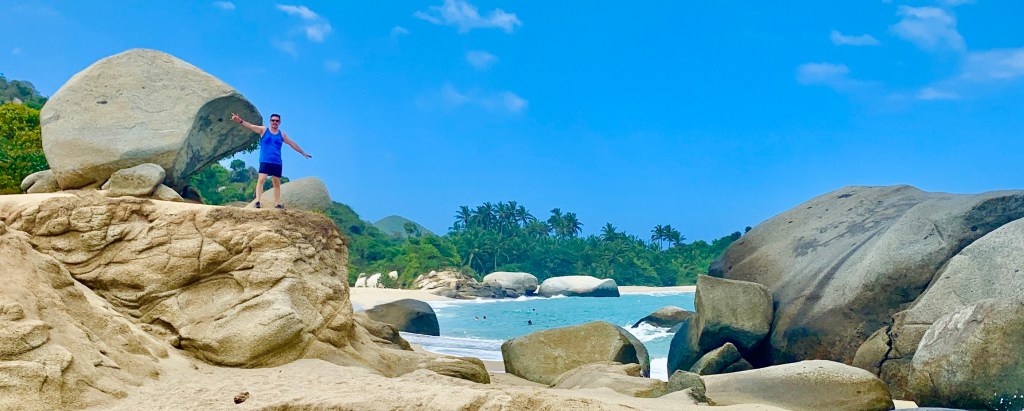
Transport on the island
The funicular railway is the main transport link between the port Marina Grande where all the ferries dock taking you on the short journey to the centre of Capri Town.
It is the quickest and easiest link to the town, tickets cost €1.80 single journey from the ticket office situated close to the ferry terminal. The railway runs every 15 minutes but can be very congested in the mid-morning and late afternoon when ferries arrive and depart frequently.
Another popular choice and the main mode of public transportation are the buses. Tickets must be pre-purchased before your journey. The main routes are Marina Grande, Anacapri and Marina Piccola from Capri central bus station, although I use the term bus station loosely as there are only four bus bays.
The buses used on the island are fit for purpose as roads are very narrow with many tight bends. Probably more akin to a minibus. They run about every 15 minutes on major routes if you can get on one at peak times as they only hold about 15 people, so allow plenty of time if you need to be somewhere important.
Taxis are very unique all open top and some able to seat seven people. A fun way of seeing the island, it can be expensive for two people but if you have a group of four or more they became a more reasonable proposition to hire.
For us, it was more of a necessity as we needed to get down to Marina Grande and buses going past were constantly full. €30 from Anacapri was certainly not cheap for the two of us, however, it was a fun journey with fantastic views of the island below as the taxi driver drove the vehicle quickly down the twisty road. I hadn’t planned a taxi ride but it was an enjoyable experience nonetheless and got us to the port on time.
All good things must come to an end, a fabulous three days in Capri. One last lunch before we catch the ferry back to Sorrento this time on a rooftop terrace overlooking the Faraglioni. Having enjoyed my time on this fabulous Island and with a bit of planning a short stay here needn’t blow the budget 💰😁
Lapland is a vast open wilderness. Where reindeers outnumber people. A location you can indulge in all activities it has to offer. With surreal wintry landscapes that features a snow covered countryside.
Reindeer Sleigh riding
An introduction to one of Lapland’s most iconic animals.
We visited a reindeer farm close to Levi. Which has been established for over 30 years. It’s a family business run by a traditional Sami reindeer herder.
The location was originally an inn founded over 100 years ago. Situated by a river it was a strategic spot between the north and the south of the country. Due to the abundance of reindeer in the area, it was this animal and not the horse which was the main mode of transportation in Lapland.
A visit to a reindeer farm is one of Lapland’s most iconic activities. To this day reindeer herding is still important to the local economy. The Sami were traditionally involved in reindeer herding and lived a very nomadic lifestyle.
Reindeers are semi-wild animals, that roam freely in the forest and are rounded up twice a year. Many reindeers pass over International borders as they roam around the Arctic forests of Norway, Sweden and Finland.
The reindeers at the farm are bred and chosen to pull sledges rather than bred for meat. After looking at these majestic creatures reindeer was definitely off the menu for me.
Traditionally reindeer herding in this part of Lapland is how many from the Sami community would earn a living. Times change although still an important part of the local economy many reindeer herders have diversified and sleigh rides are an important income to them.
All wrapped up and ready to go. It’s important to wrap up warm as during this activity you will be remaining stationary and temperatures on the day of -12 degrees that is important.
We choose the shorter 1-kilometre ride, 3 kilometres rides are available. The sun setting over the forests was simply breathing. The sky is full of vibrant reds and oranges lighting up the last of the day.
The one-kilometre ride was long enough to experience the reminders pulling us on the sledge. Travelling through the wintery forest and back to the farm, getting some breathing photos into the bargain.
The sleigh ride which I thought was going to be a bit of a tourist trap turned out to be quite magical. Experiencing first-hand the beautiful natural surroundings.
Husky rides
Another popular activity and high on my must-do list while in Lapland.
Before the advent of snowmobiles, huskies were the main mode of transportation. Providing a fast reliable way to transport people and goods.
Today husky sledging is immensely popular with visitors and plays a significant part in the Lapland economy. There are lots of unique activities in Lapland, this one was truly memorable.
The exhilaration of being pulled through this Arctic wonderland by huskies so eager they are chomping at the bit if you excuse the horse analogy.
We had an early morning start. We received our safety briefing and riding instructions and we were the first group out that day.
The raw power of four huskies was something to behold. First out on hard compacted snow, the speed of the dogs was phenomenal. I had to concentrate fully to keep the sledge on track.
Our dog sledging adventure was about 60 minutes speeding through the frozen landscapes and taking in the beautiful natural setting, well my wife was taking them in, but I was too busy trying to guide the huskies. Dodging snow-covered branches and keeping the sledge on track.
A few things to take into consideration for the welfare of the huskies. When choosing a provider look for the ones who offer longer tours, the huskies prefer this and it takes much less out of them physically than a shorter run.
Bigger is sometimes better. These businesses have more huskies more staff and greater resources to look after the dogs, making sure they are rotated regularly and not being overworked. Most tour operators should only be using fully accredited providers.
When we finished the tour we were given a tour of the kennels and given an insight of the life of a working husky.
Before leaving we visited a traditional Finnish teepee, this one was rather large and grand with a large roaring fire. With some welcoming hot berry juice on offer to enjoy in front of a roaring fire.
Cross country skiing
Something of a national sport in Finland. Which is deeply ingrained in the Finnish psyche.
You will find 100s of kilometres of well-maintained trails in Lapland. There is an extensive in and around Levi, taking you through Arctic forests and frozen lakes.
We are always eager to engage in new experiences and this was a perfect opportunity. We had seen numerous people skiing while on our walks. How difficult can it be we thought?
We booked a cross country skiing session with a local company. We picked a beginner’s lesson, it was certainly a lot cheaper than ski school where they teach you alpine skiing the down hill variant.
We were provided with all the equipment and an instructor to guide us through the basics. I fell to the floor within seconds of putting my skis on, the instructor was going to be in for a long afternoon, showing a great level of patience and understanding throughout the session.
We were being taught on a classic ski trail ( two parallel tracks next to each other. These are mainly flat not too long and are excellent for beginners.
Snowshoeing on the Mountain ⛰️
A fantastic way to stay active and enjoy the countryside. Unlike skiing or snowboarding it is beginner friendly and low cost.
No previous experience is necessary after quickly getting our equipment fitted we were off on a trail straight away, a very inclusive activity which most people can enjoy.
We had booked a group walk departing from zero point Levi. It was the same guide as we had earlier for cross country skiing, hopefully, I will give a better account of myself this evening. Even at the start of our walk the nighttime views of Levi were fantastic.
Due to the mixed abilities of the group, this was an intermediate walk. The trails were marked and we also ventured on to tougher terrain.
Views of the northern lights in the distance. It was a fantastic experience to view them while in the Arctic forest.
We stopped at a Finnish Laavau, this is a small shed where you stop on the mountain, dotted around in various locations. An excellent spot to partake in a hot berry juice before our ascent back down the mountain.
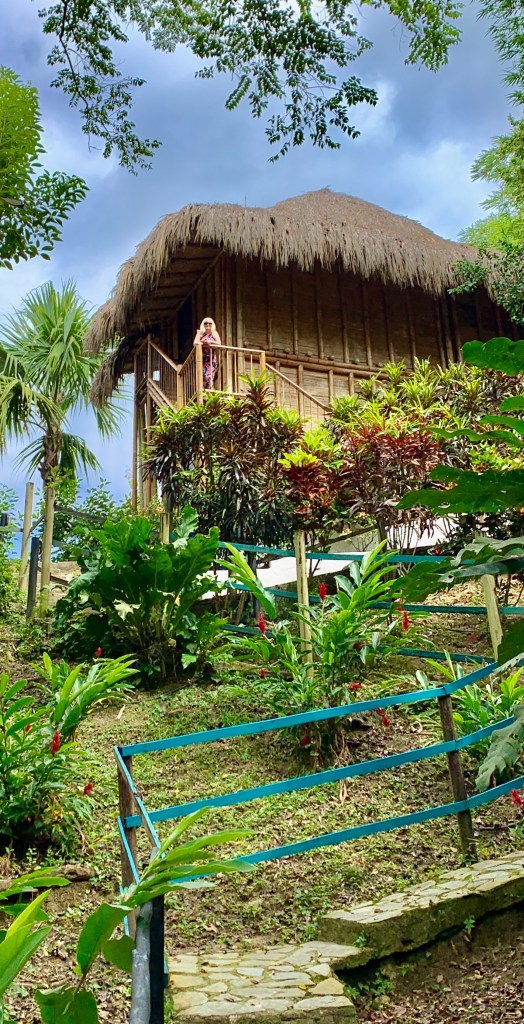
Northern Lights walks
Snow✔️ reindeer ✔️ huskies✔️ northern lights maybe..??? Finnish Lapland is an excellent location to view them where they are active over 100 nights a year.
There are many tours and activities where you can view the northern lights, many that involve an expensive your. However, it needn’t cost anything as Lapland is a perfect location to view them.
In Lapland, we stayed in a glass igloo where we were able to view them which was mesmerizing. A few days later we saw an equally impressive display of the northern lights in Levi.
Although never guaranteed, Lapland which is located deep within the Arctic Circle is an excellent location to view the northern lights.
Snowmobiling tours
Another thing that surprised me was the number of snowmobiles in Lapland. Not an unnecessary indulgence but one of the best ways to get around this cast wilderness.
You can hop on and discover frozen rivers and expansive hilltop vistas. You will find a bewildering selection of tours so do your research beforehand.
We chose a guided tour with established routes where the guide will advise on the weather conditions and terrain. While riding through some pretty countryside.
A typical sight in and around Levi as public transport is non-existent and many roads are impassable. Snowmobiles have their own track network with speed limits and road signs.
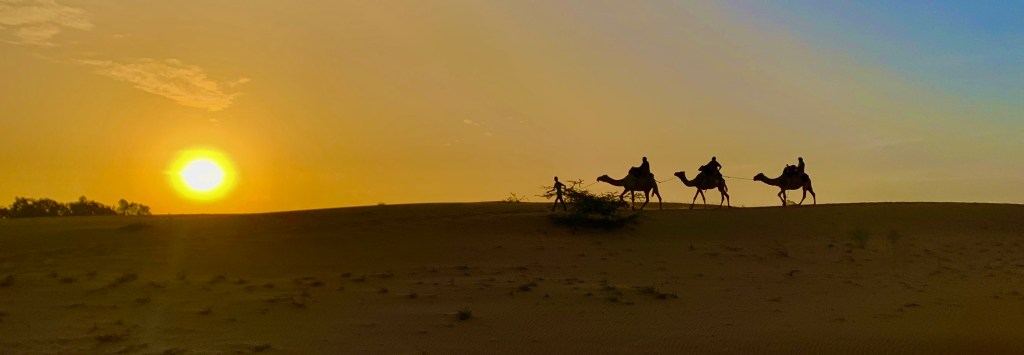
Such is the popularity of snowmobiling, you will find snowmobiling parking rather than car parking. You will find these in popular locations and stopping points.